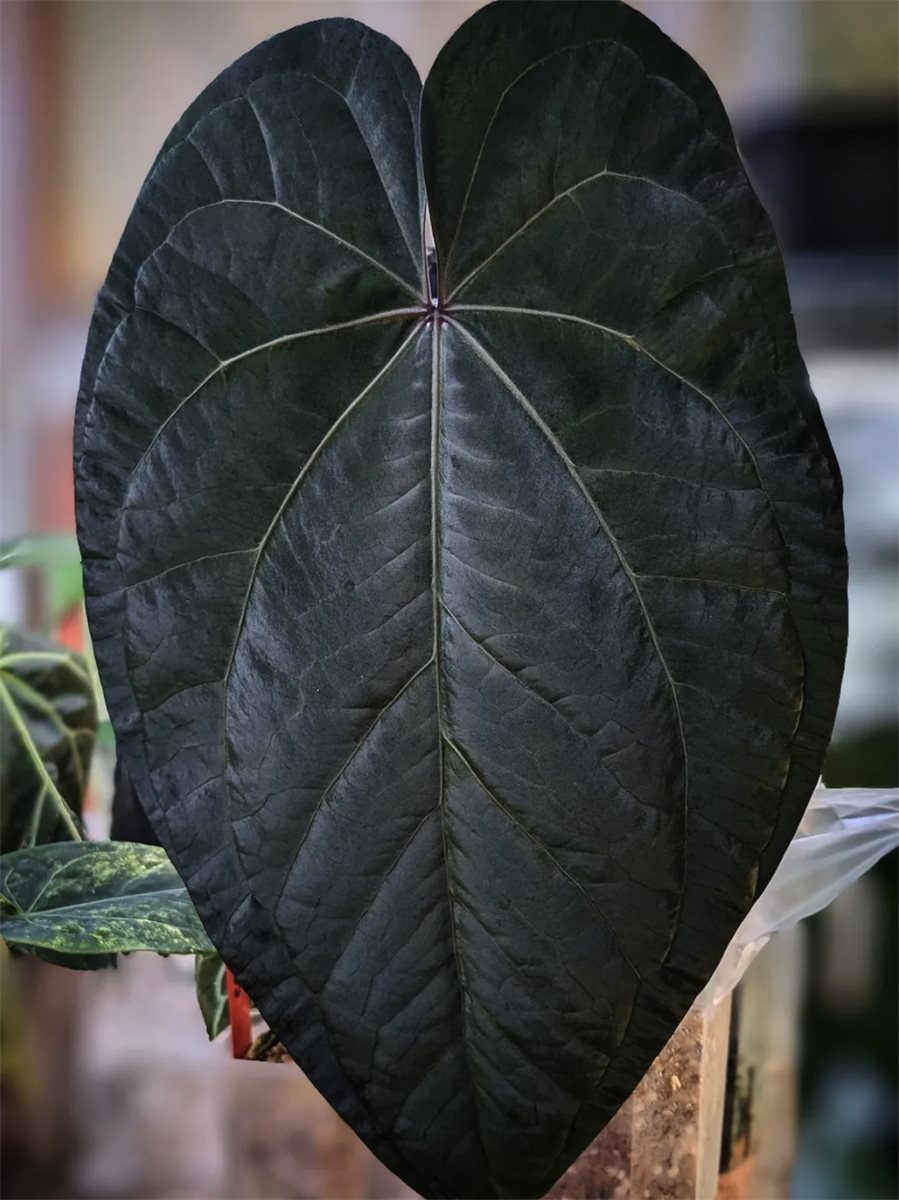
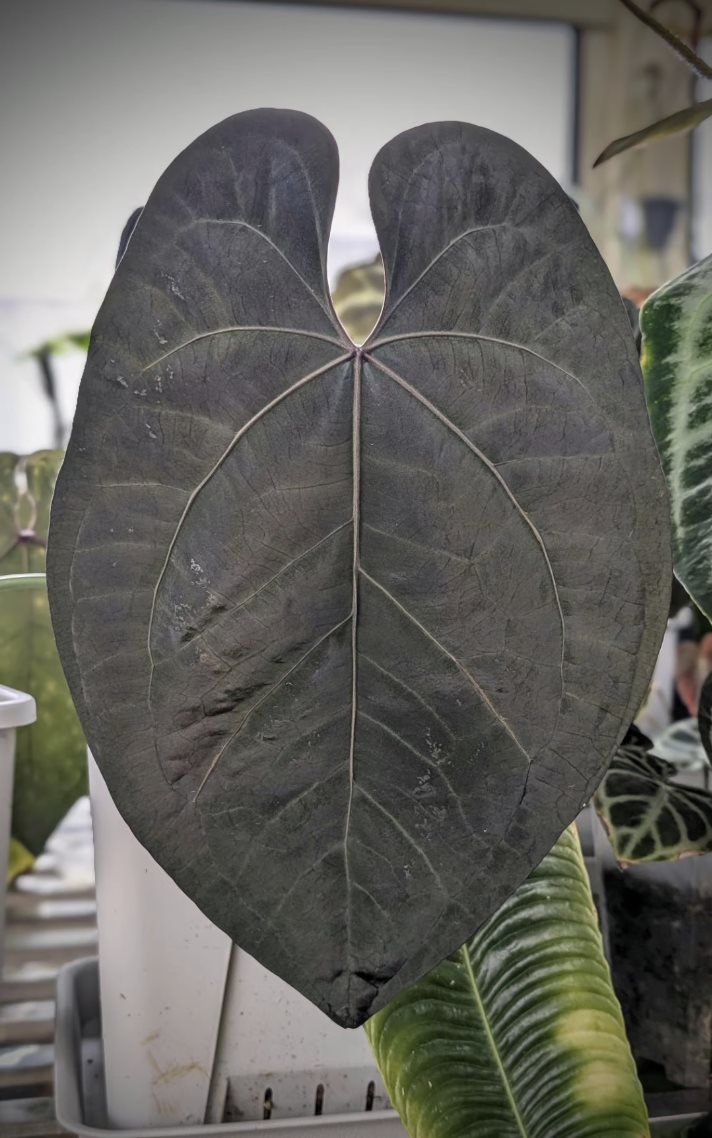
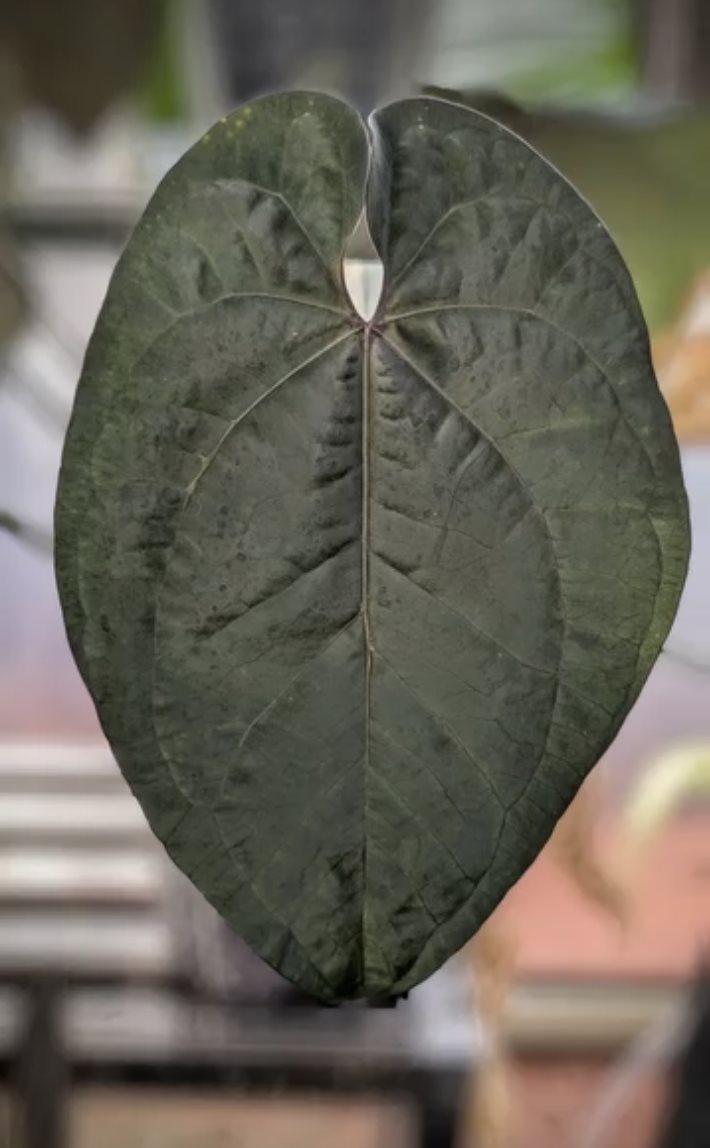
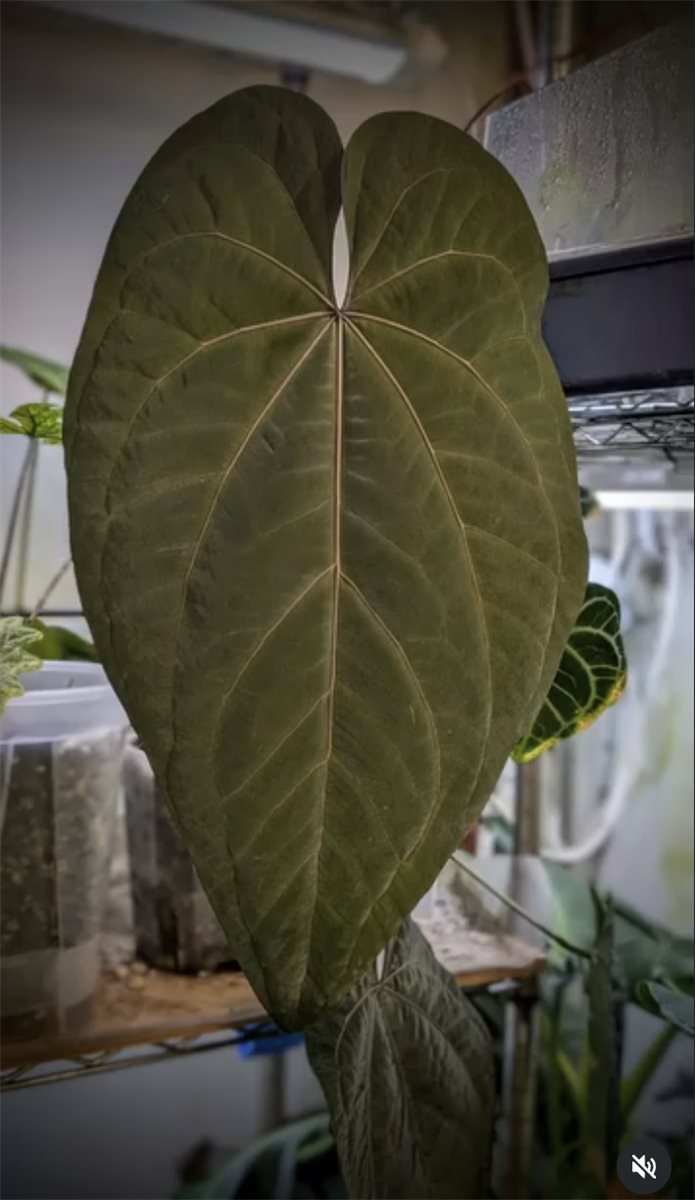
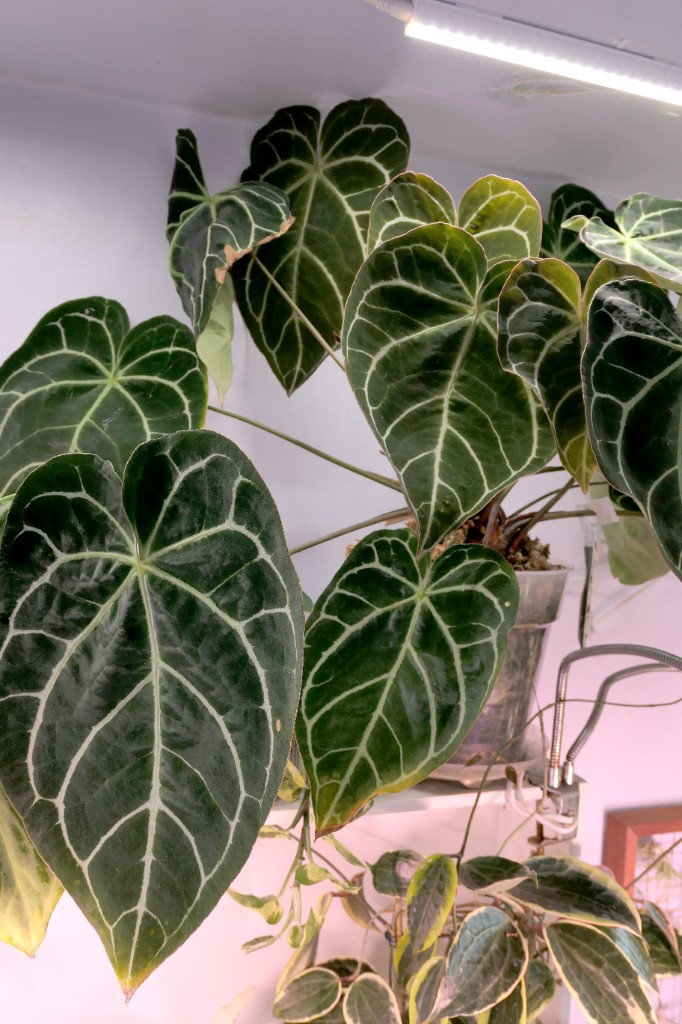
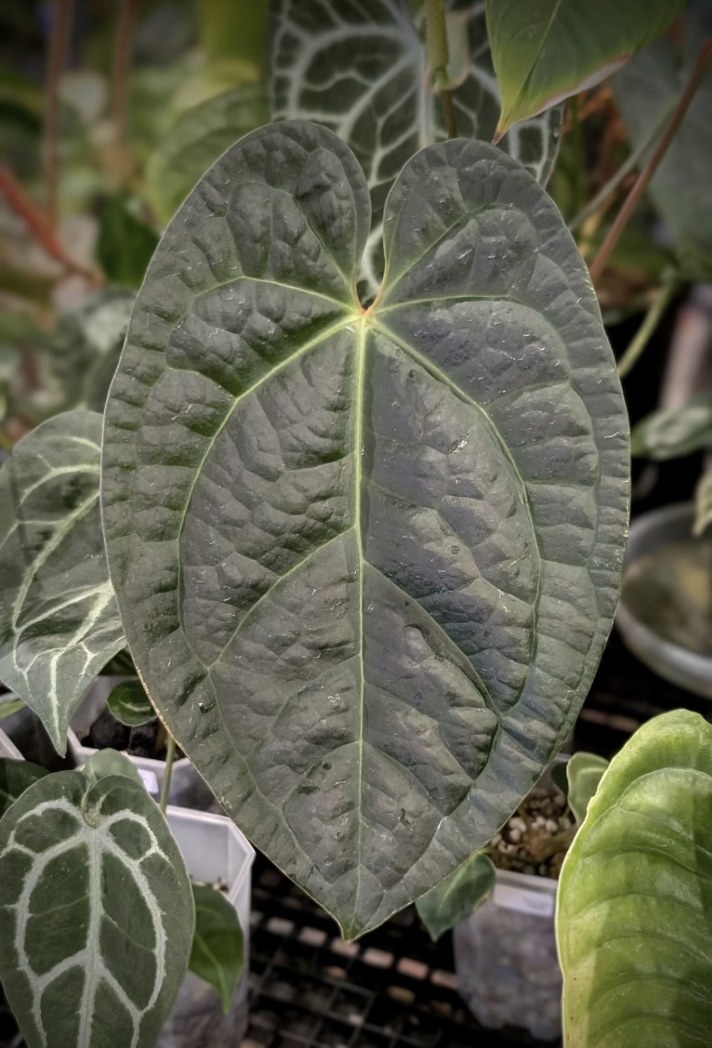
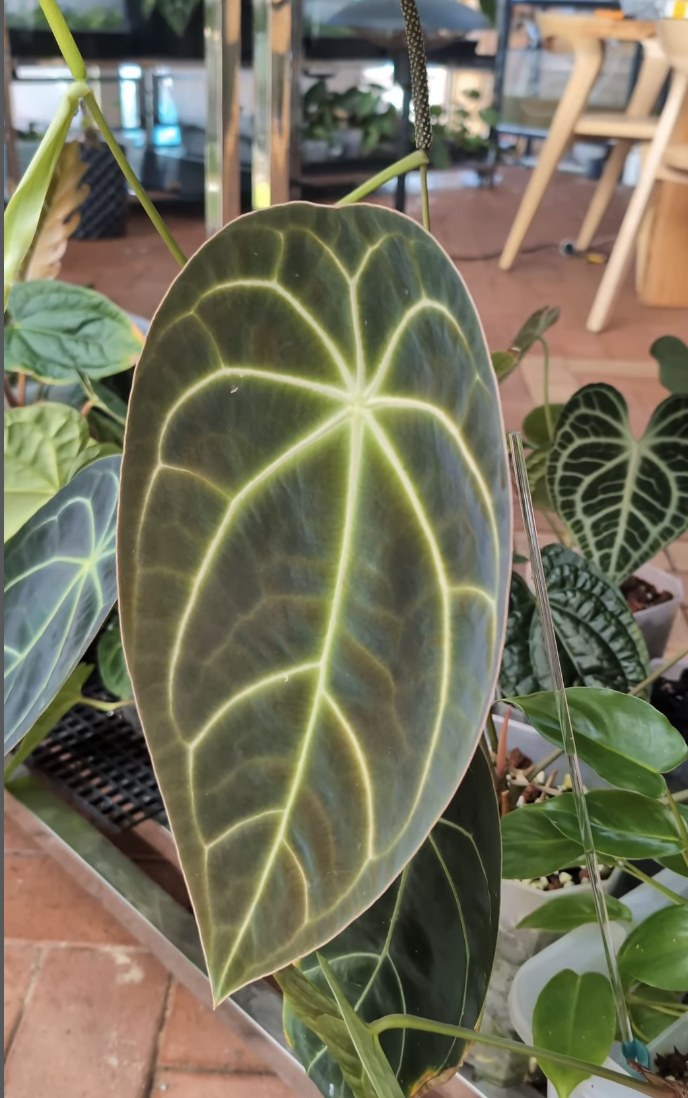
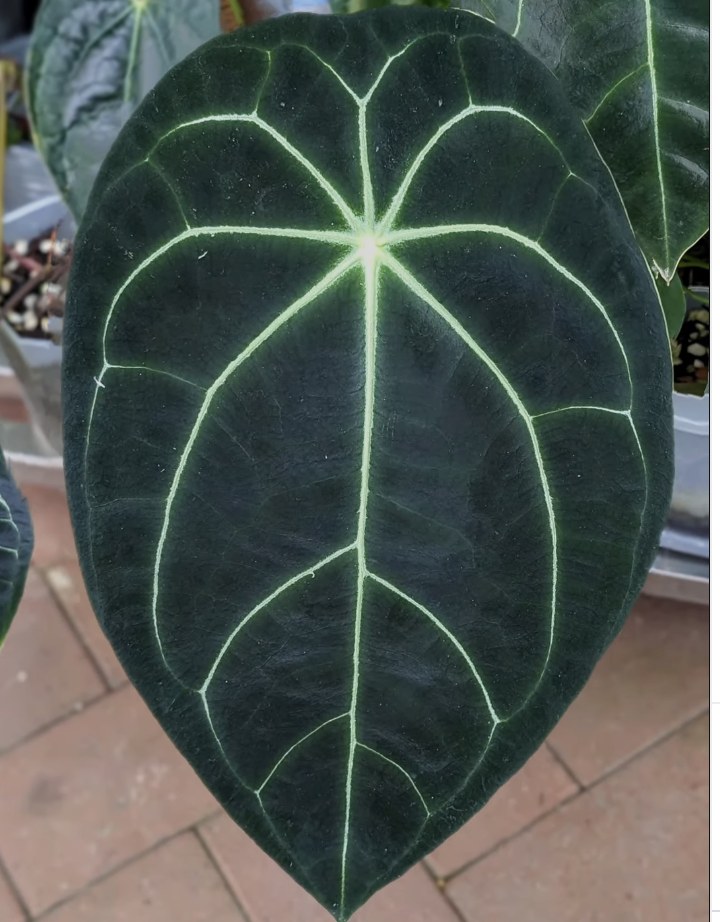
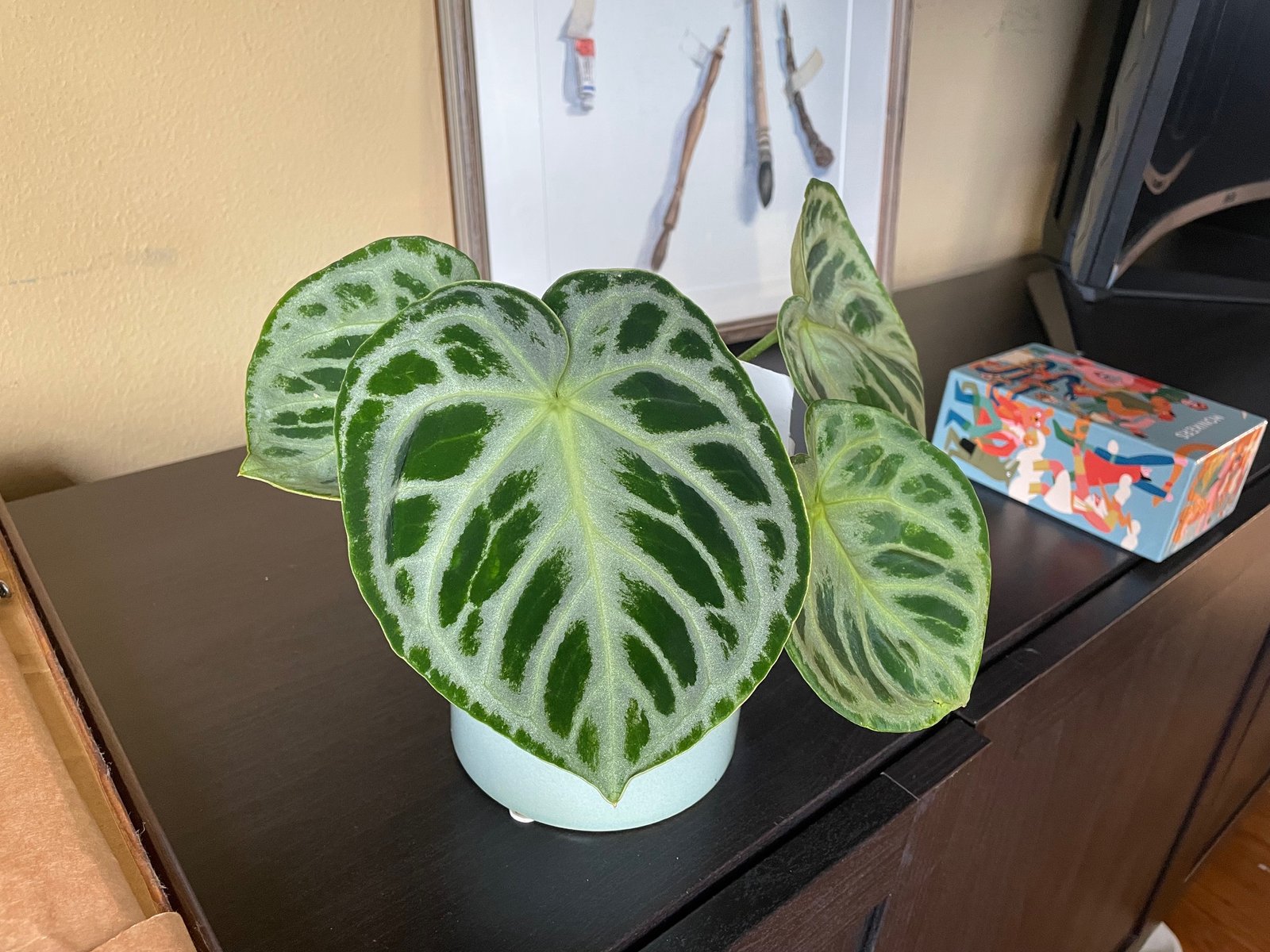
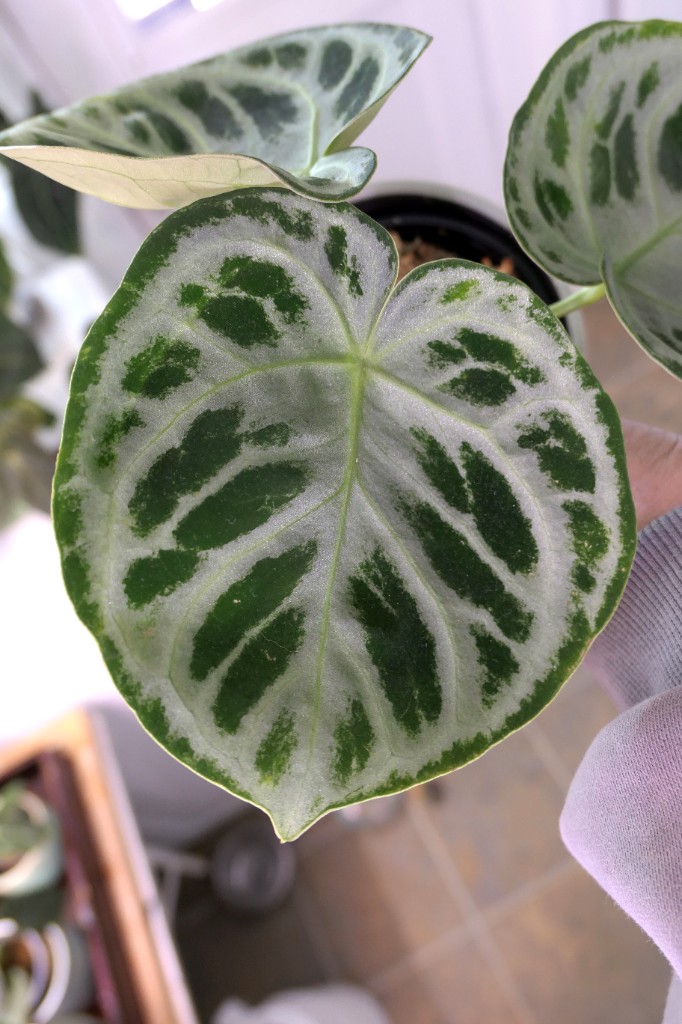
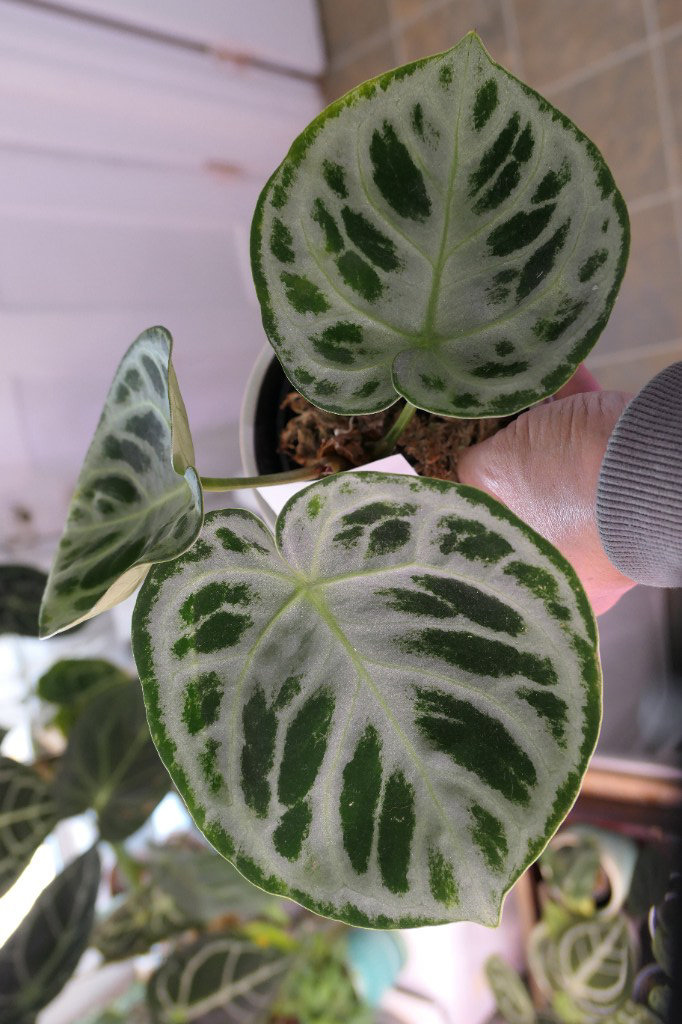
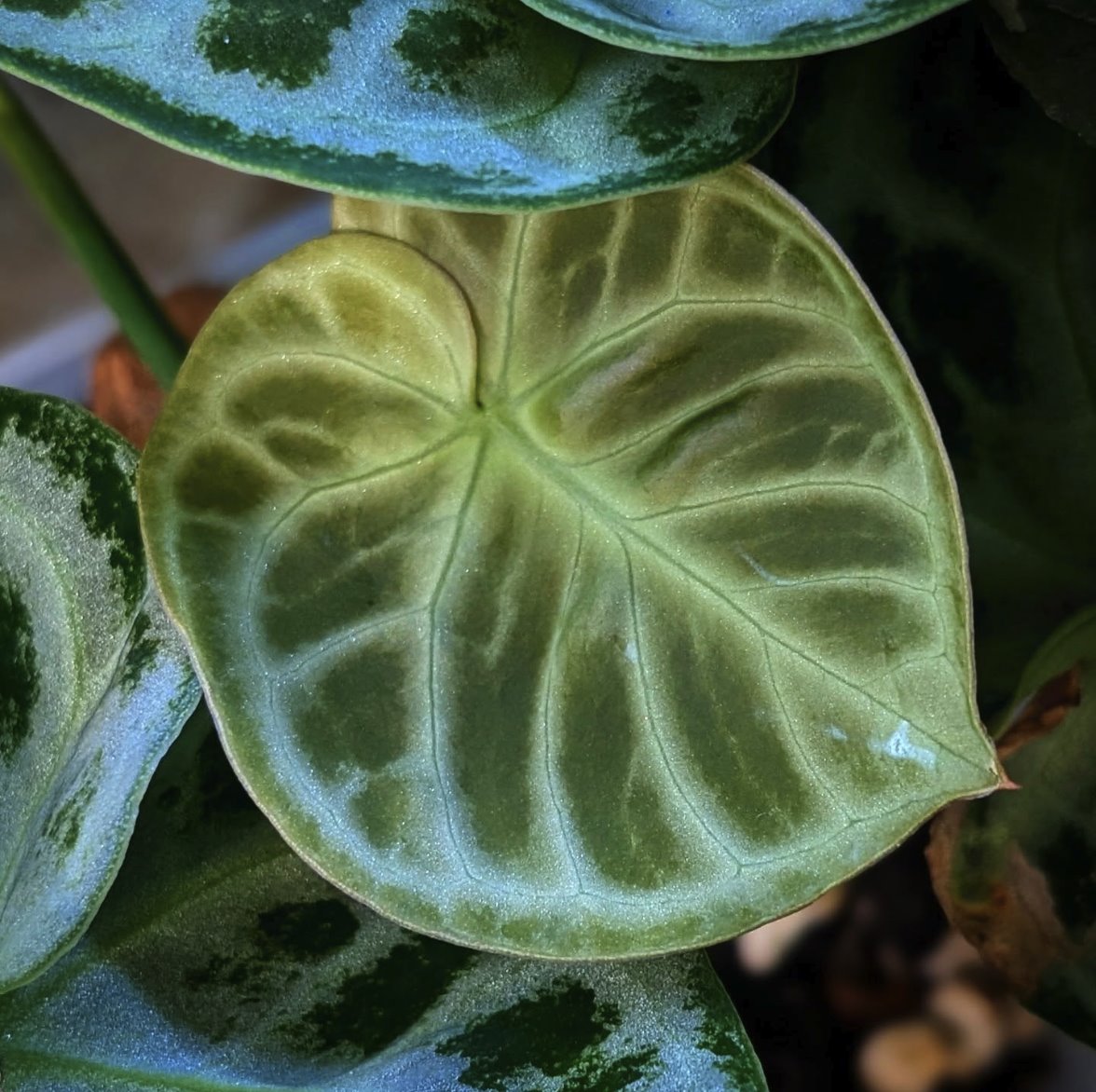
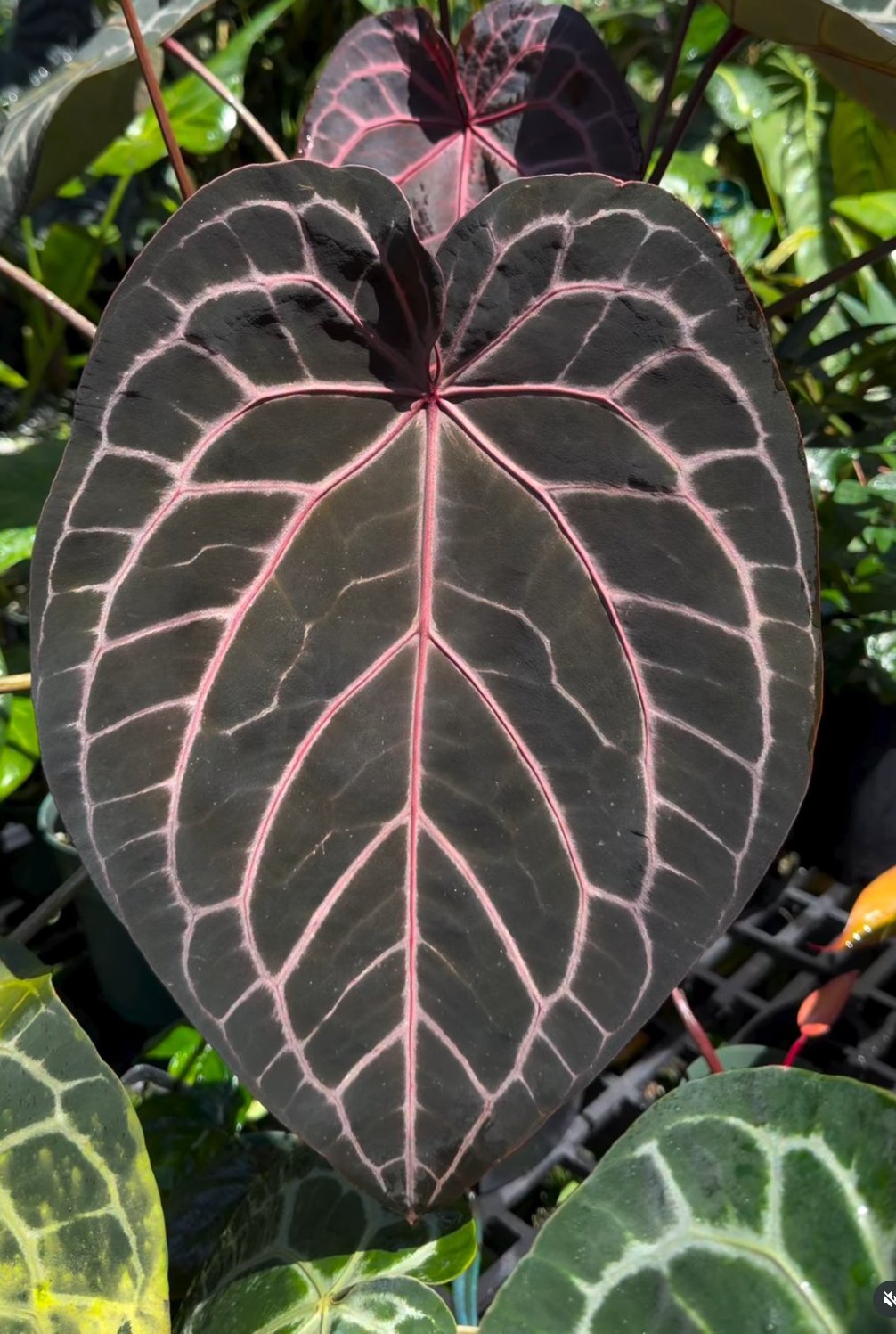
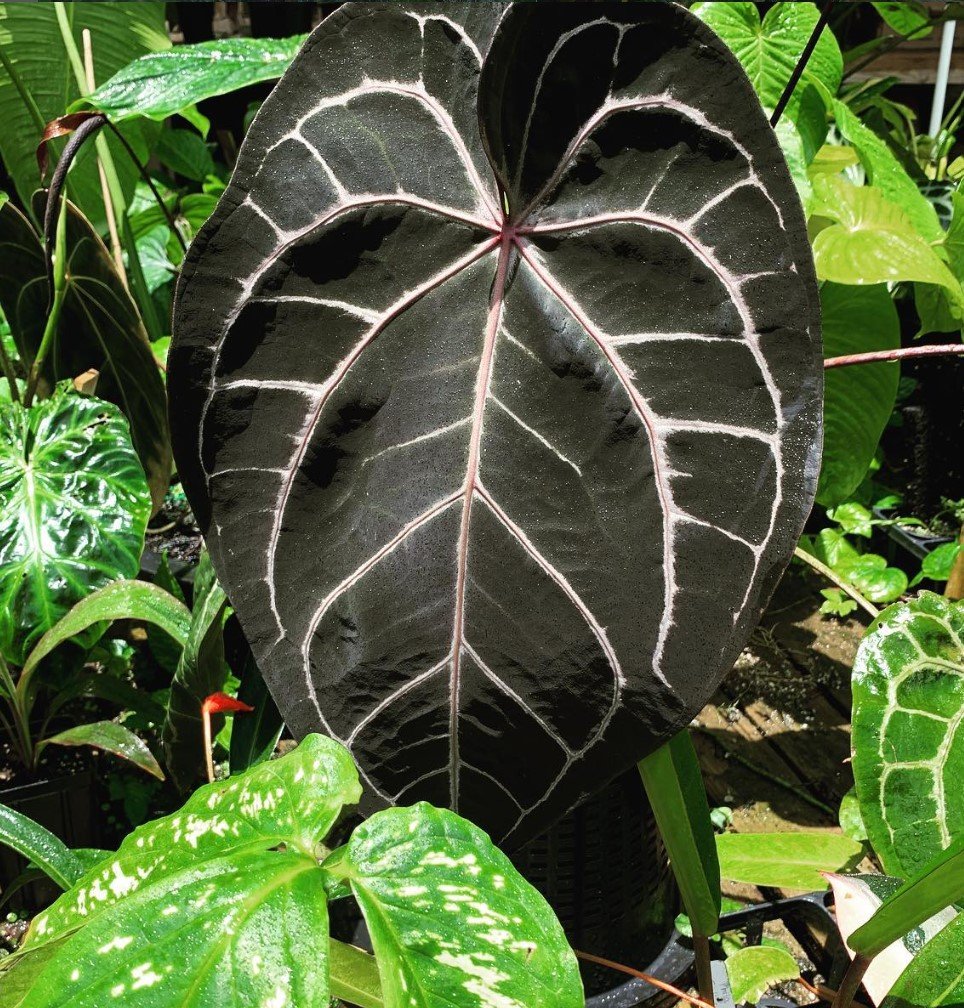
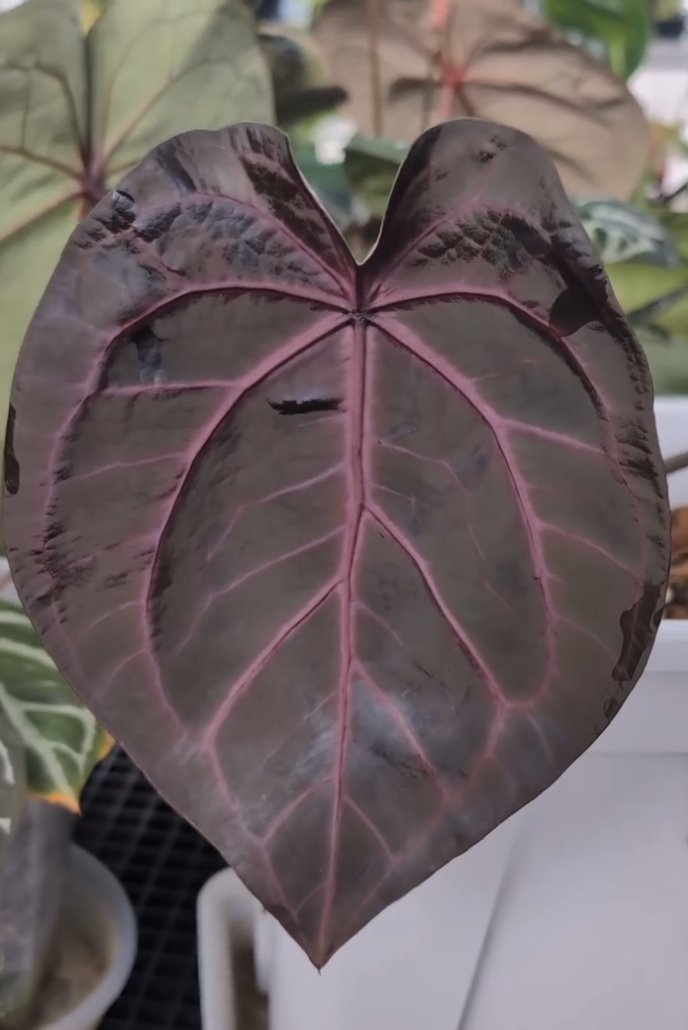
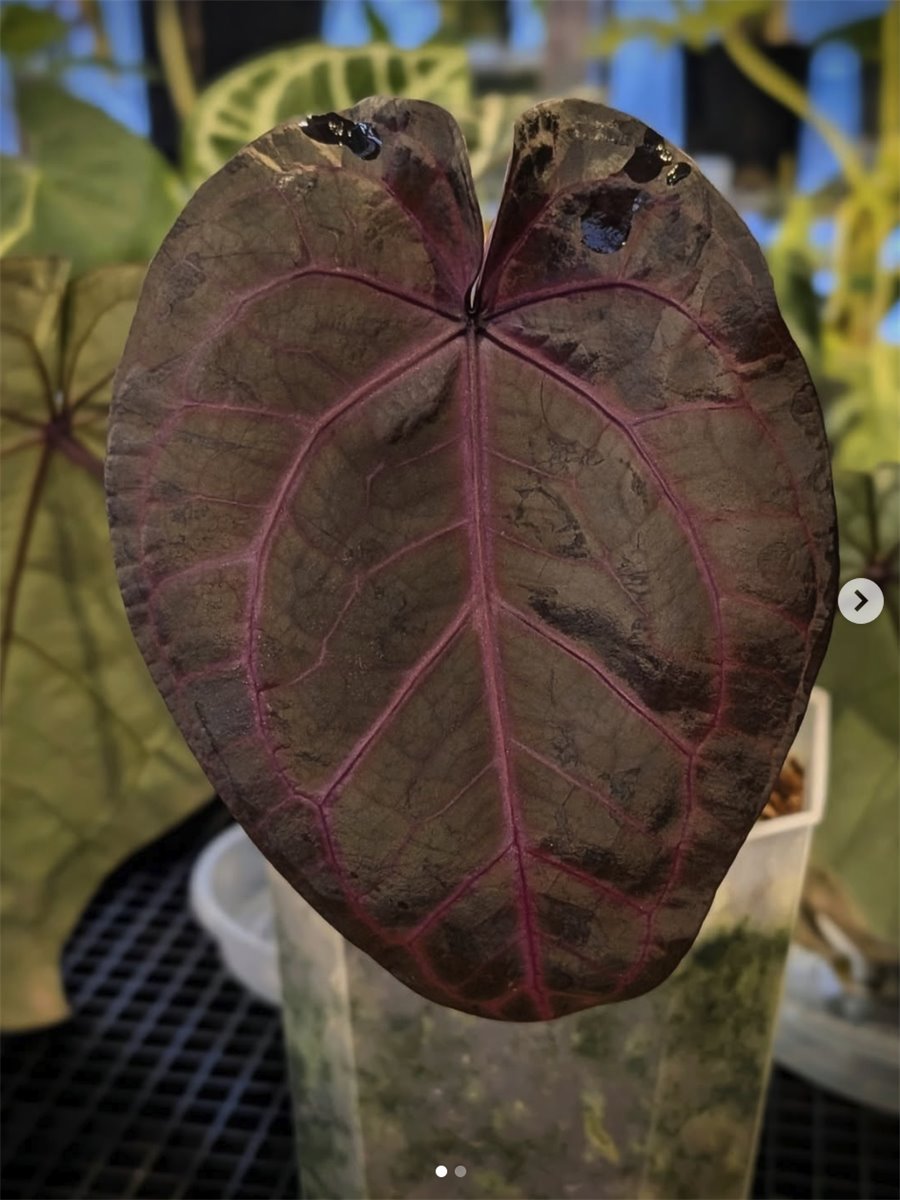
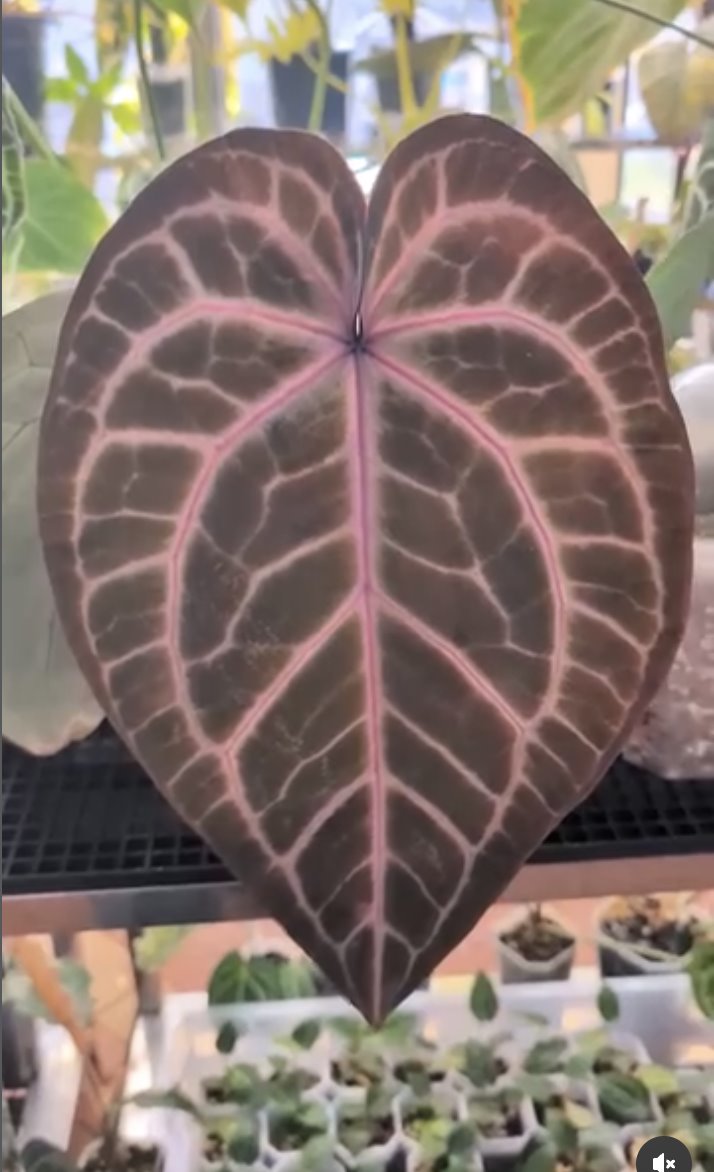
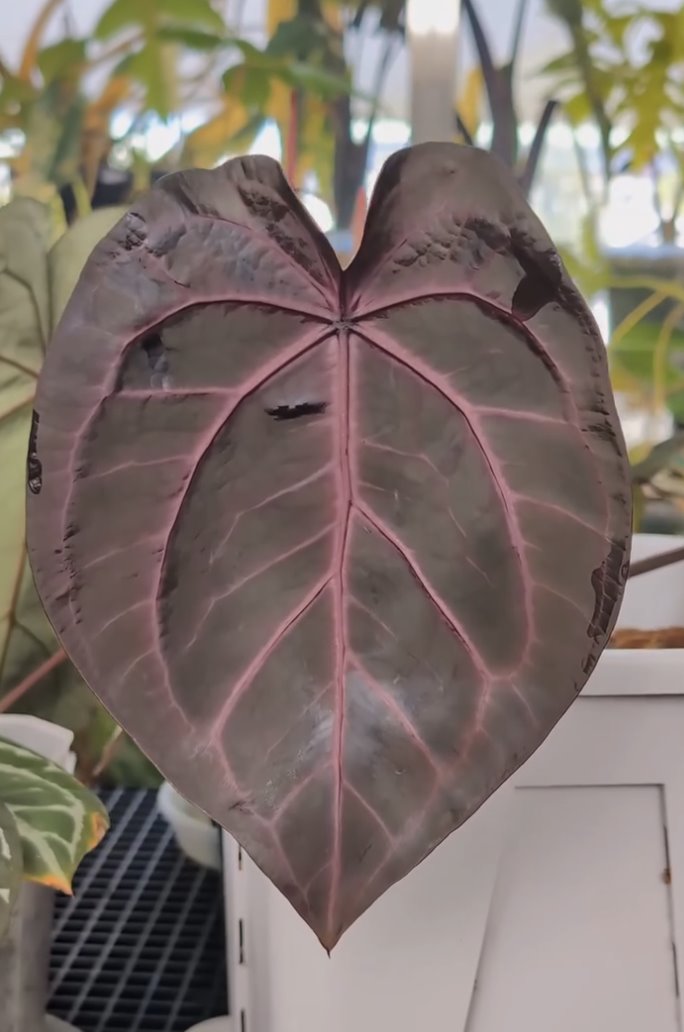
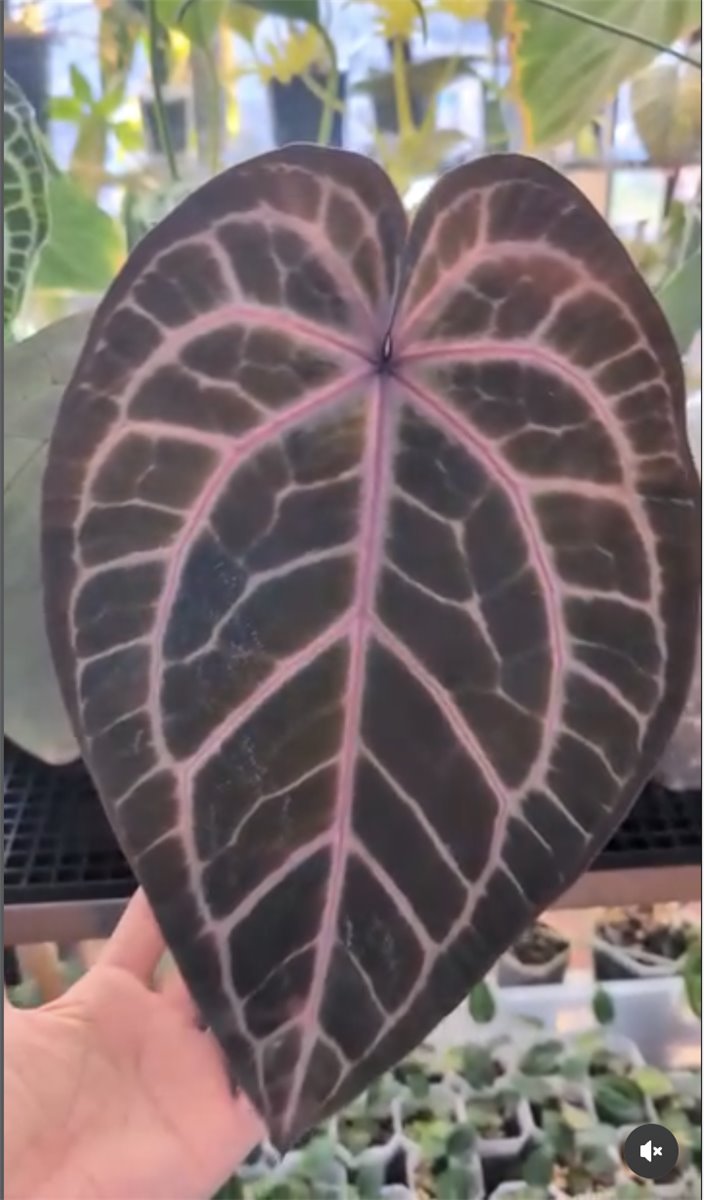
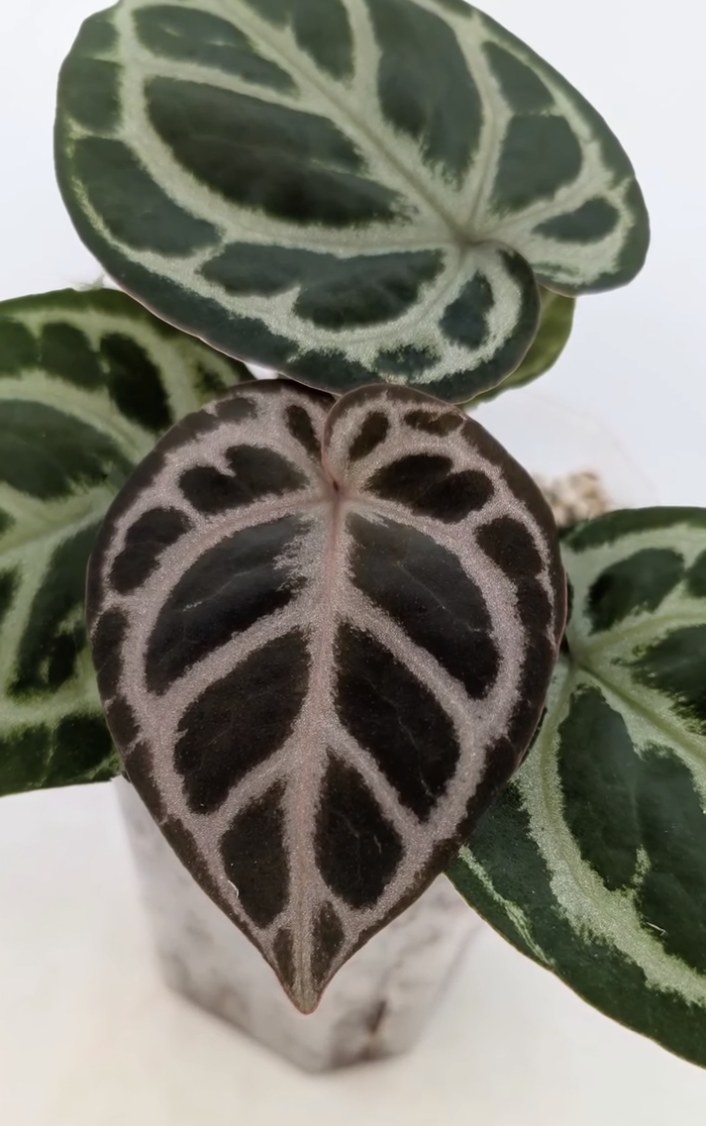
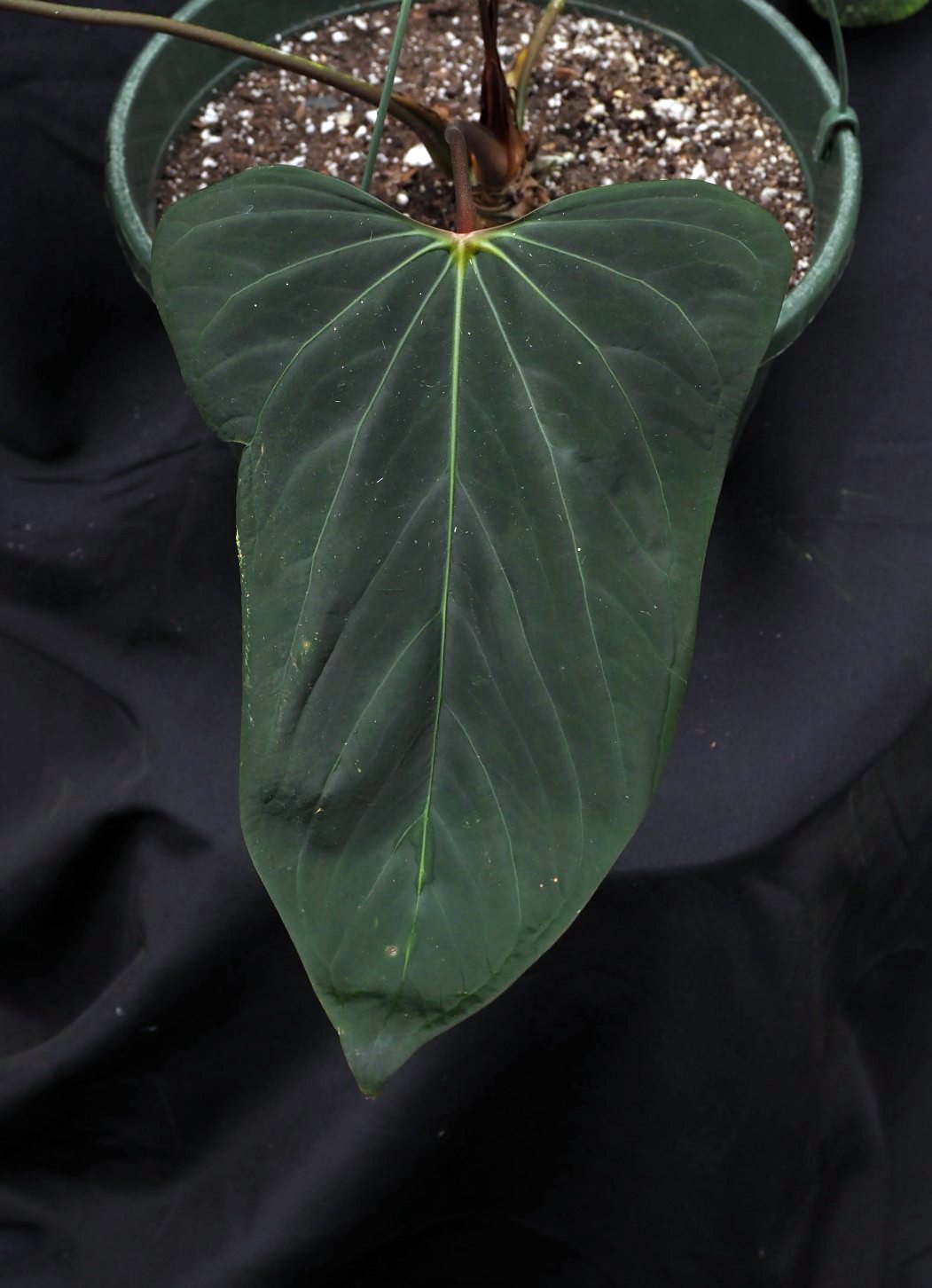
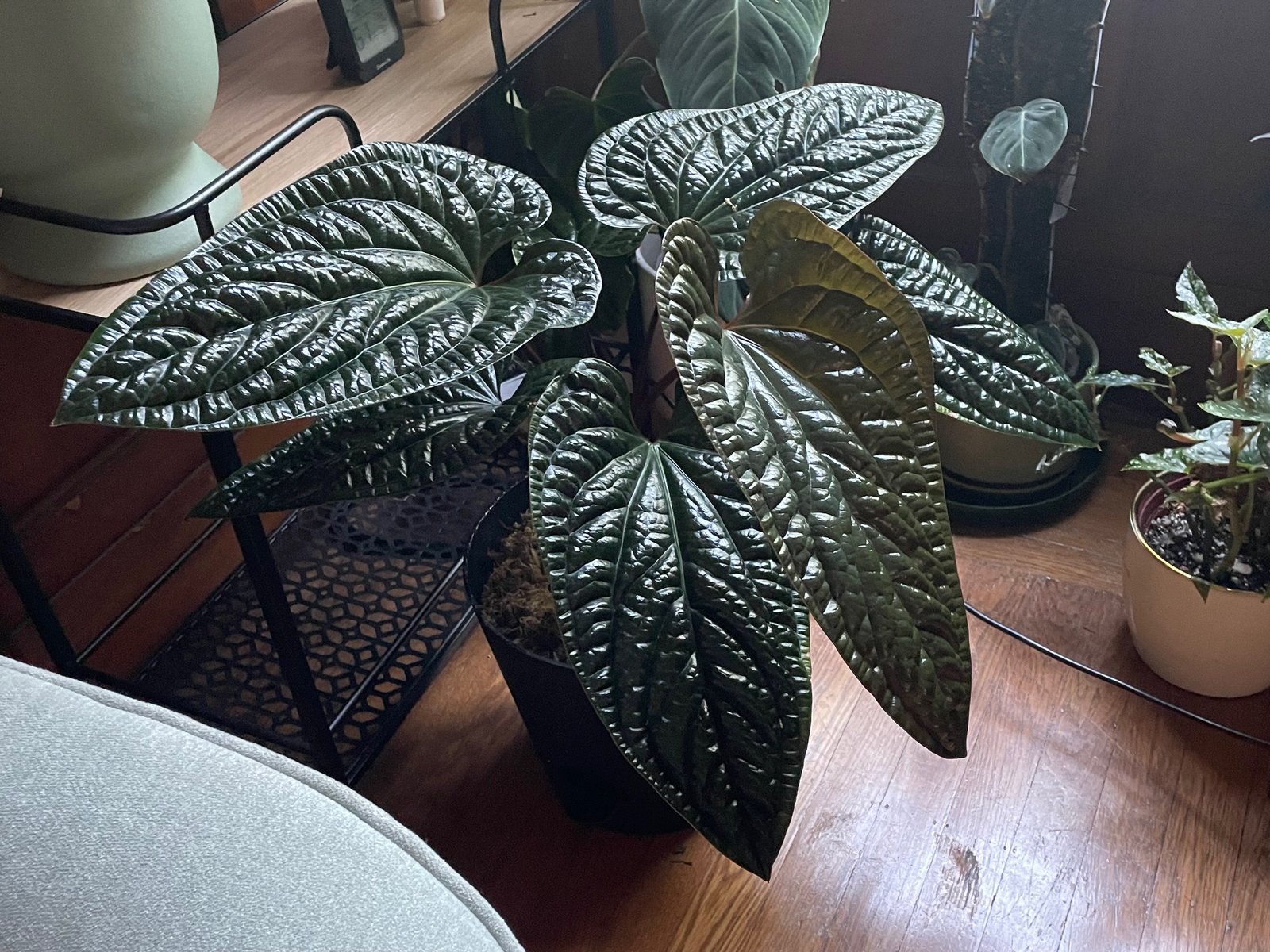
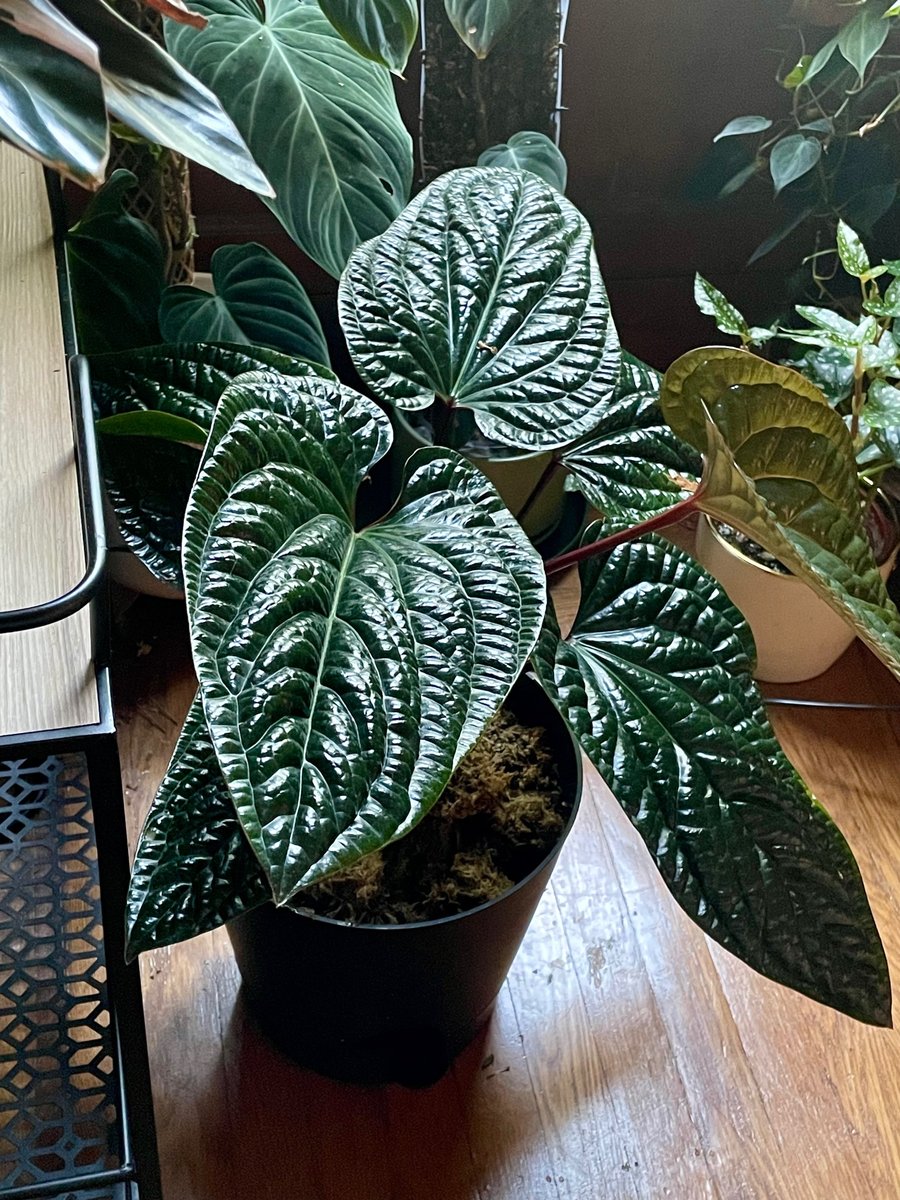
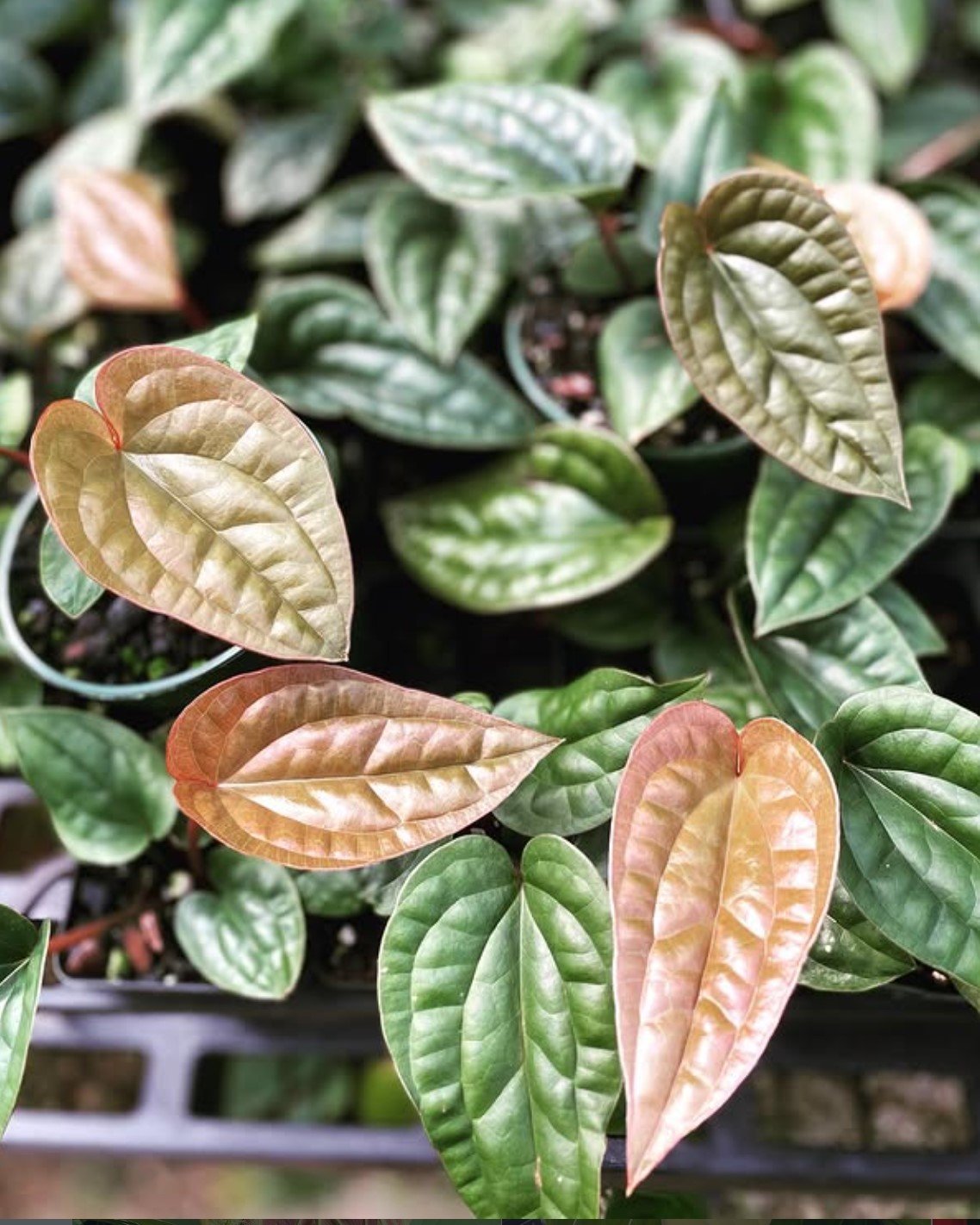
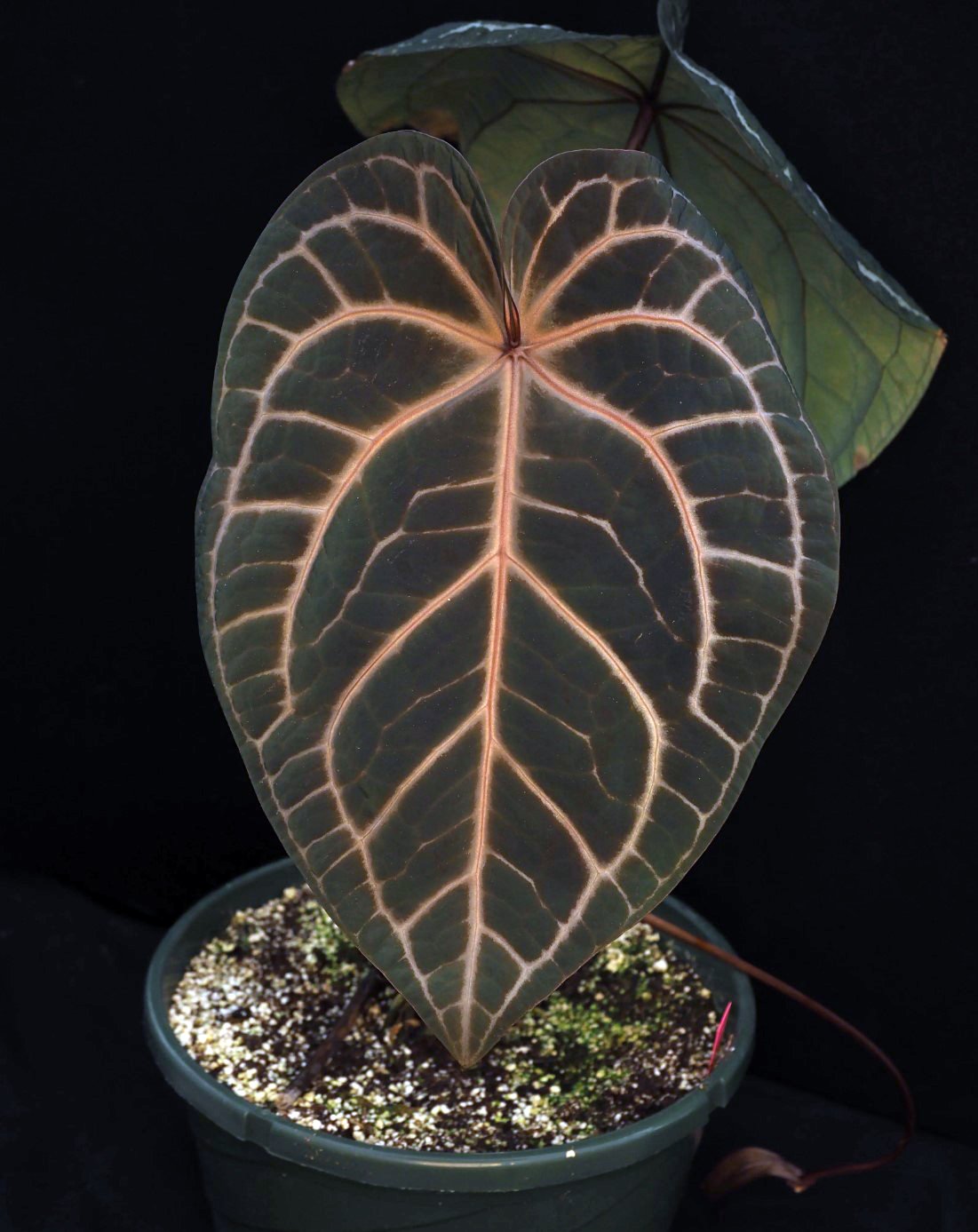
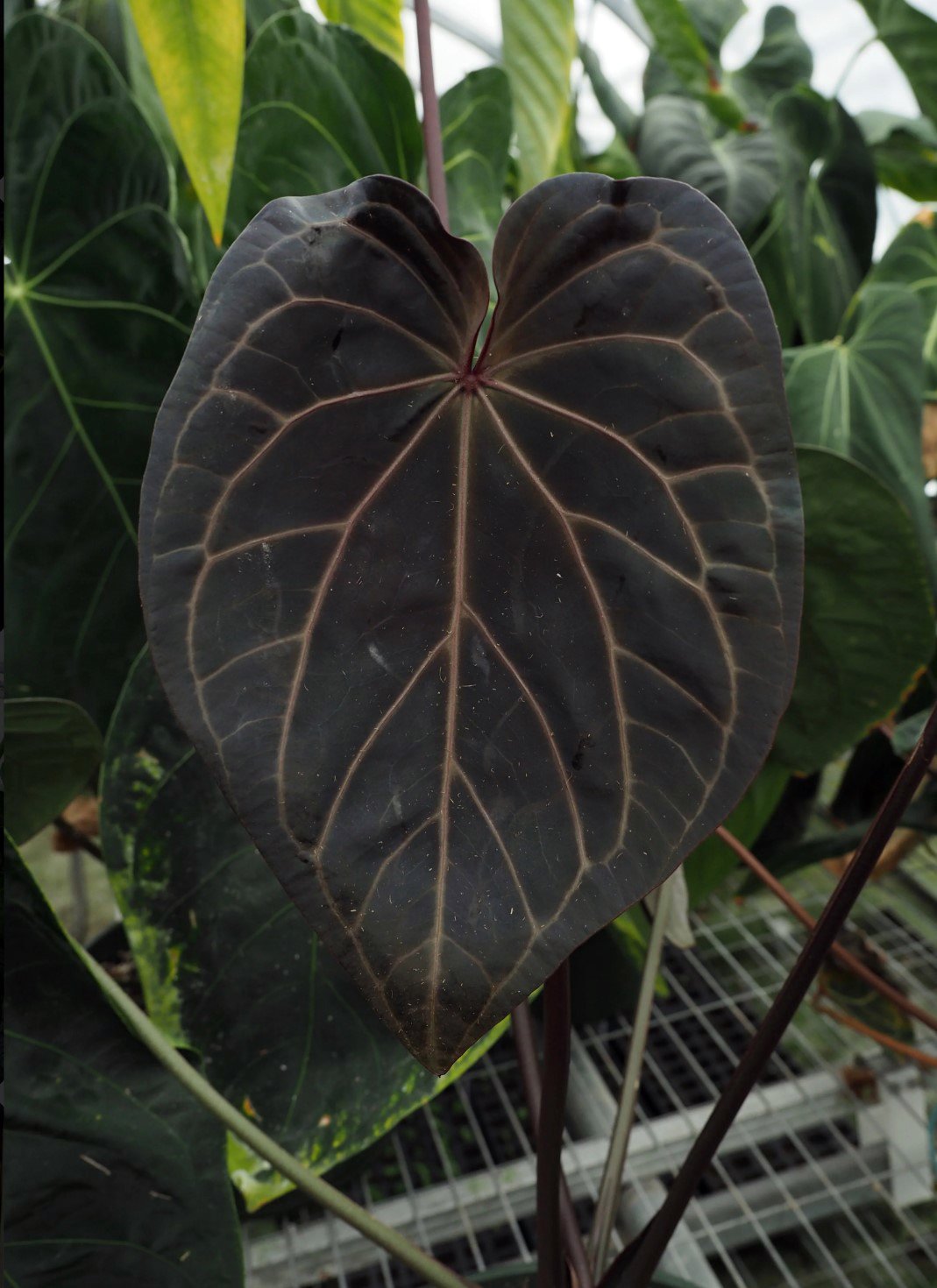
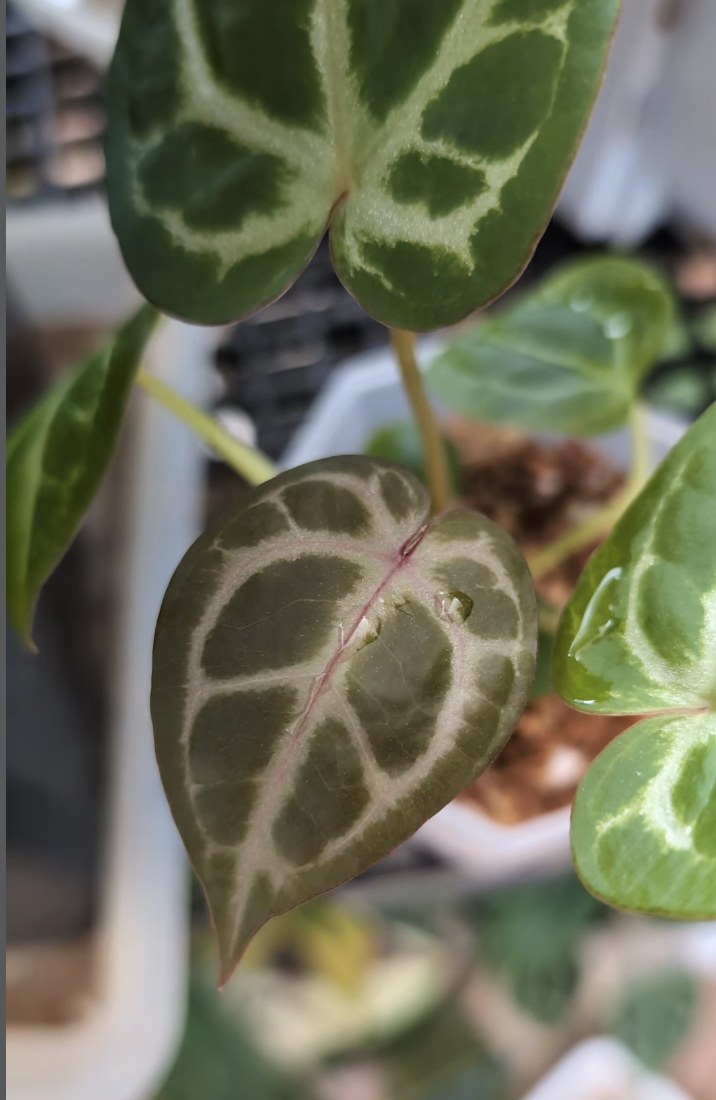
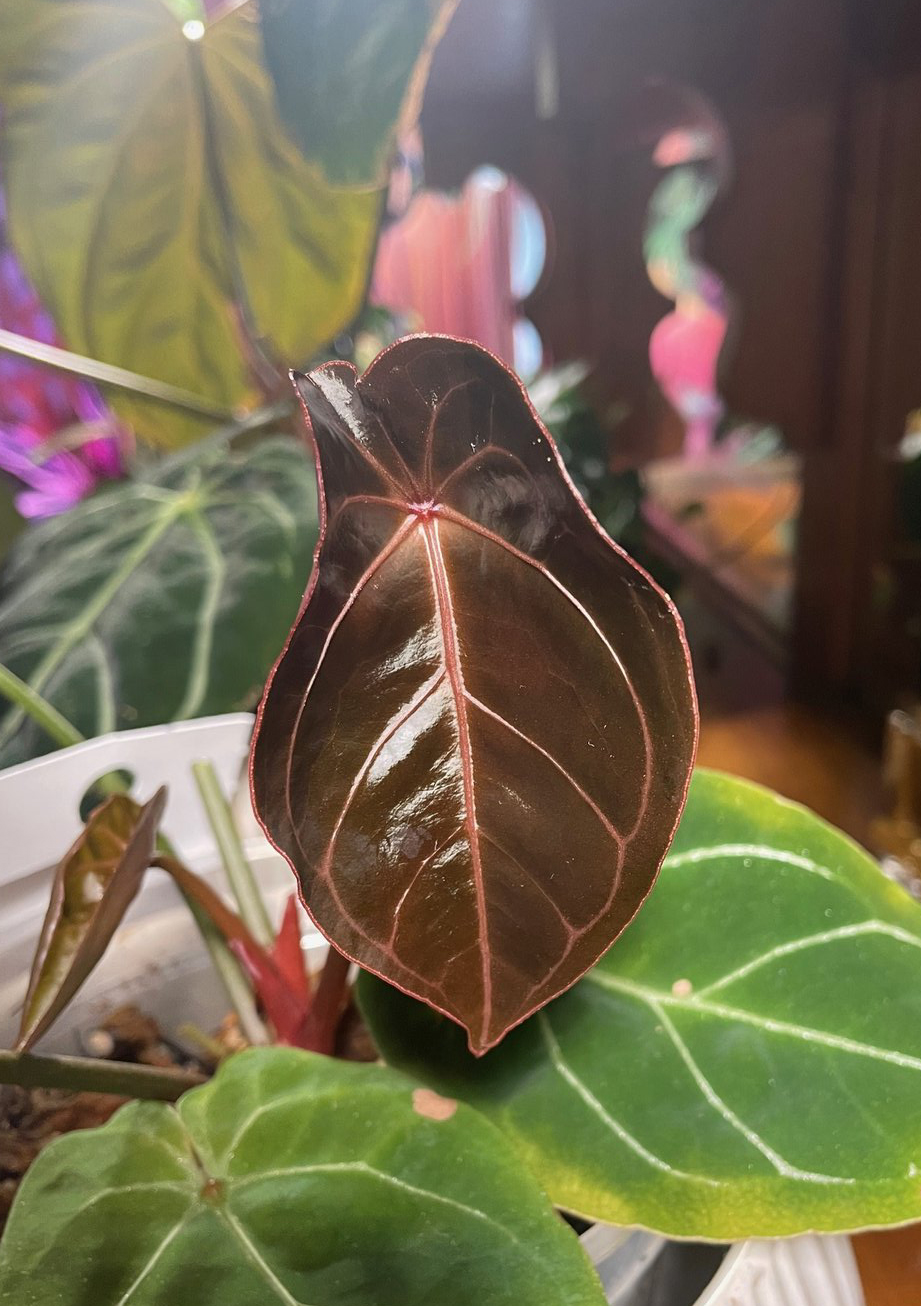
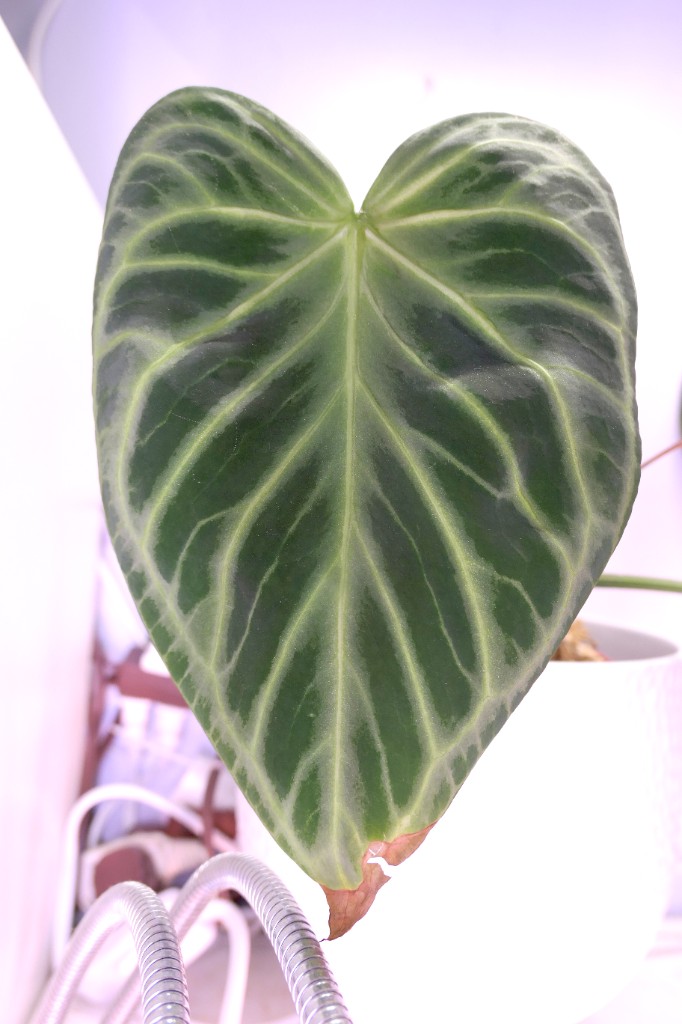
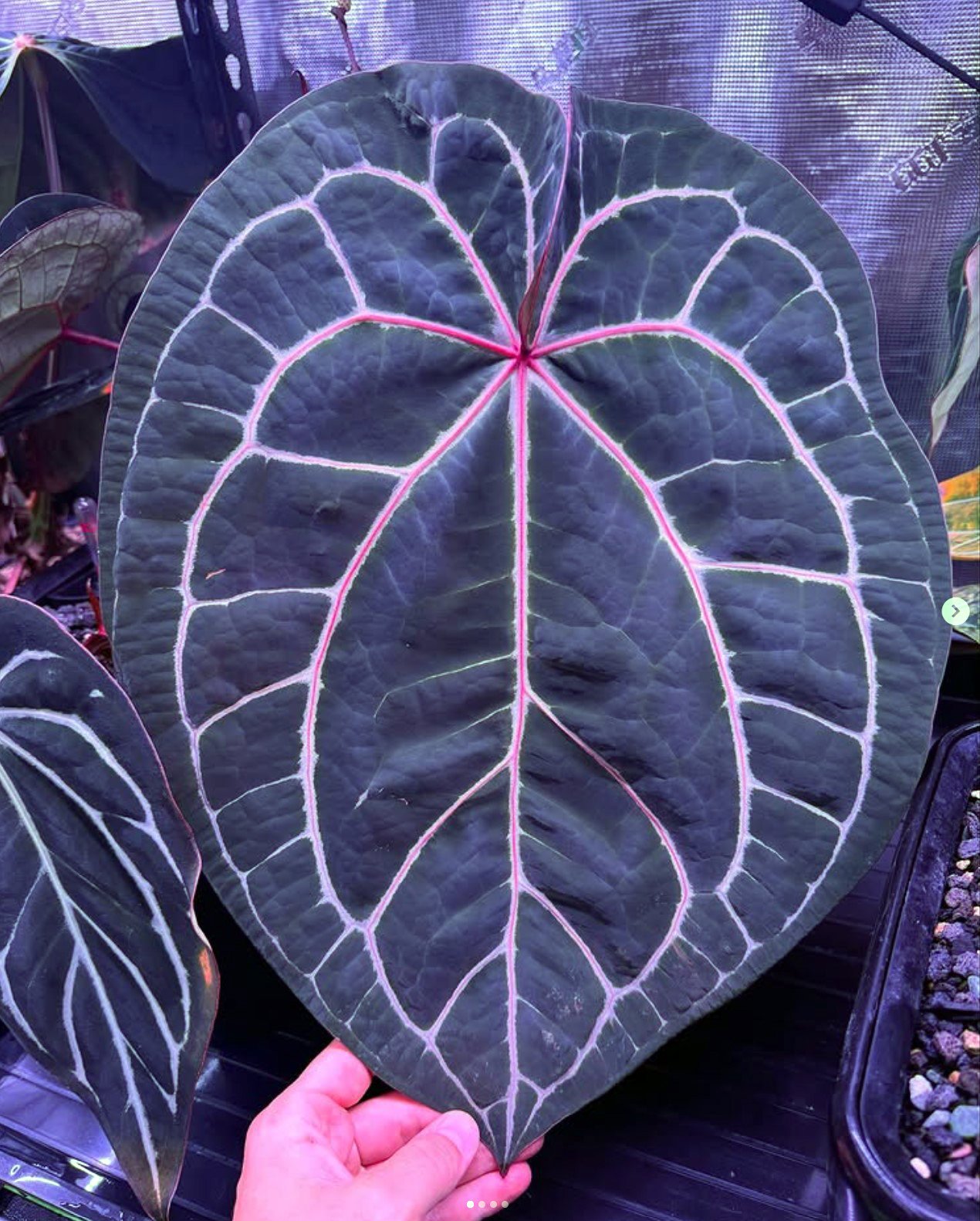
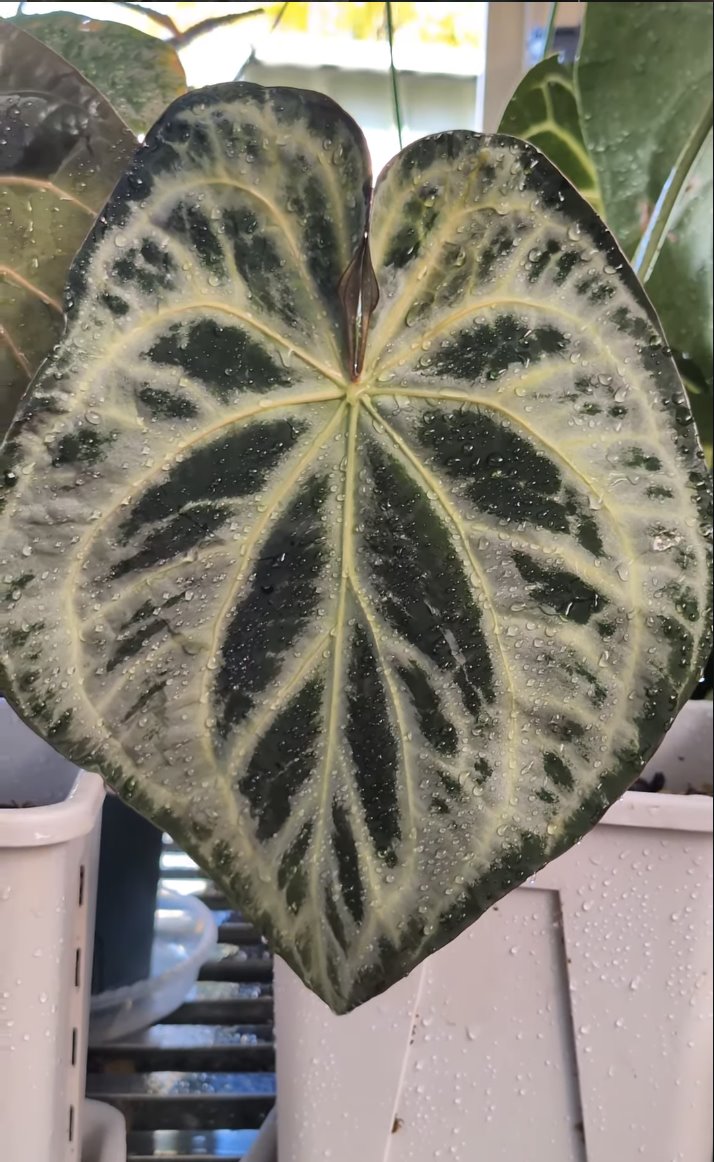
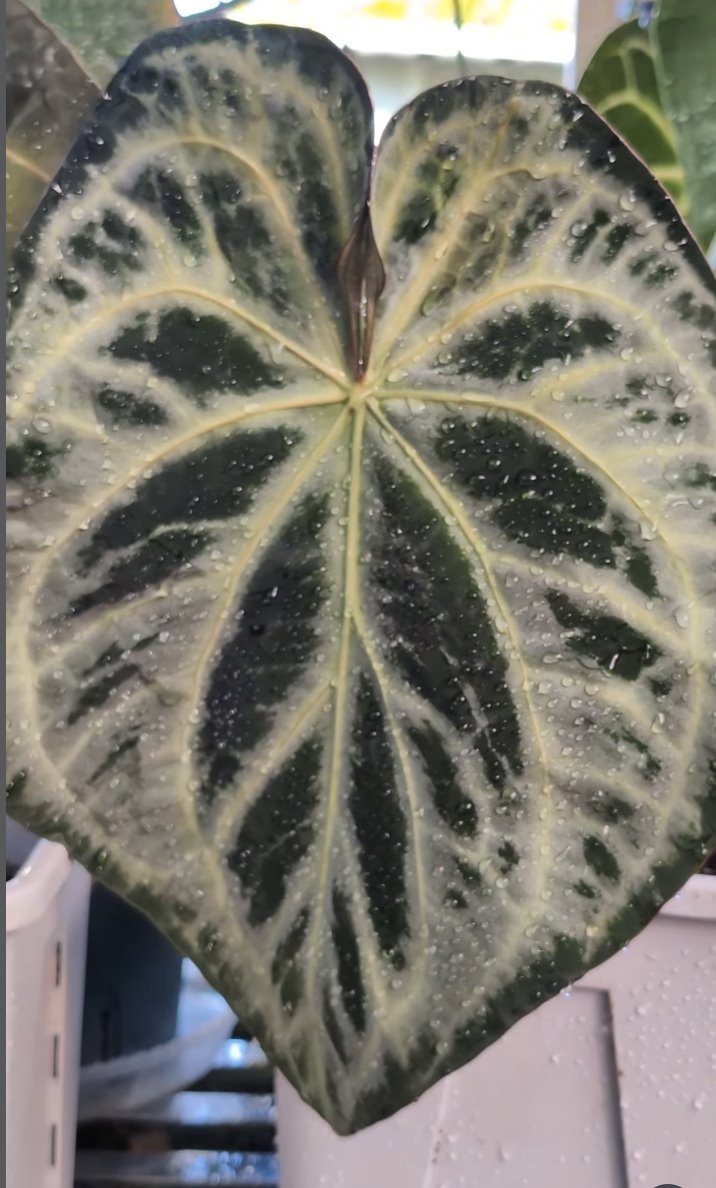
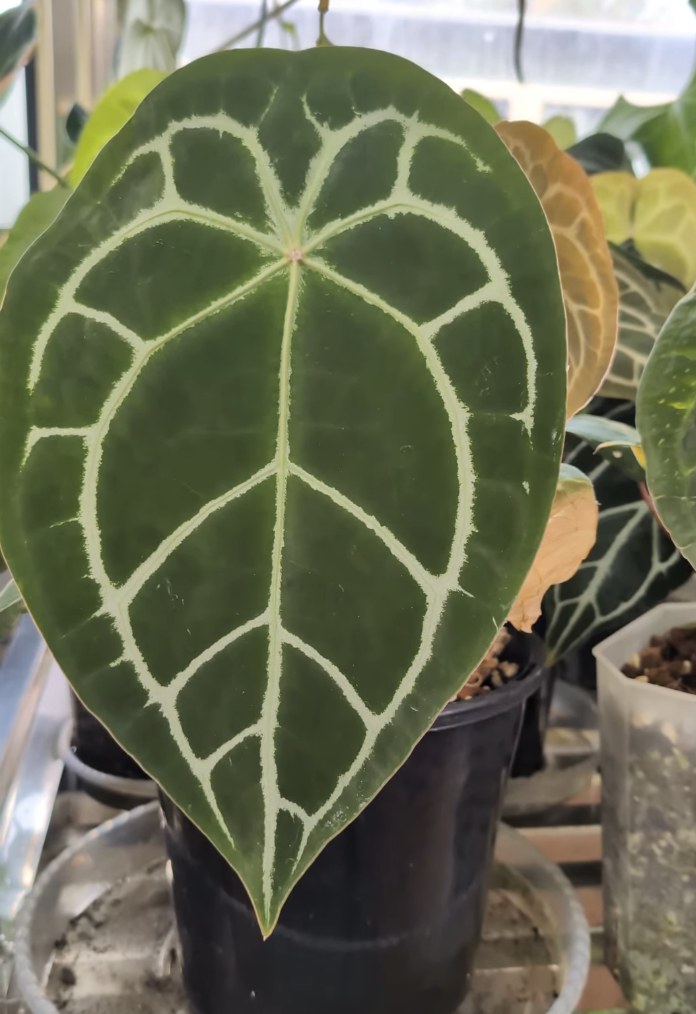
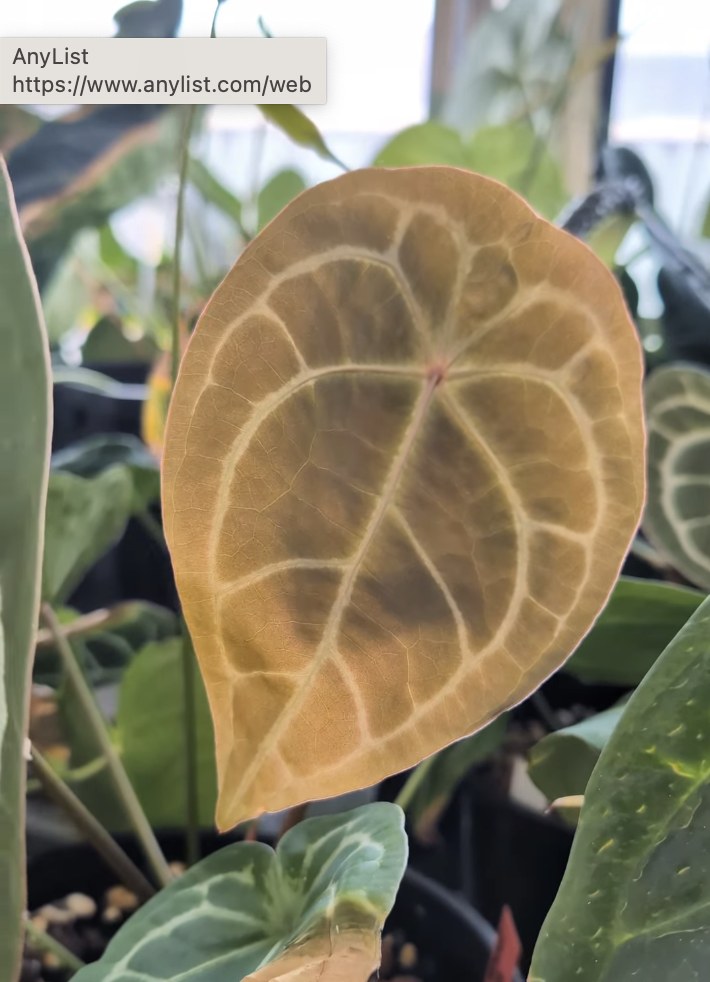
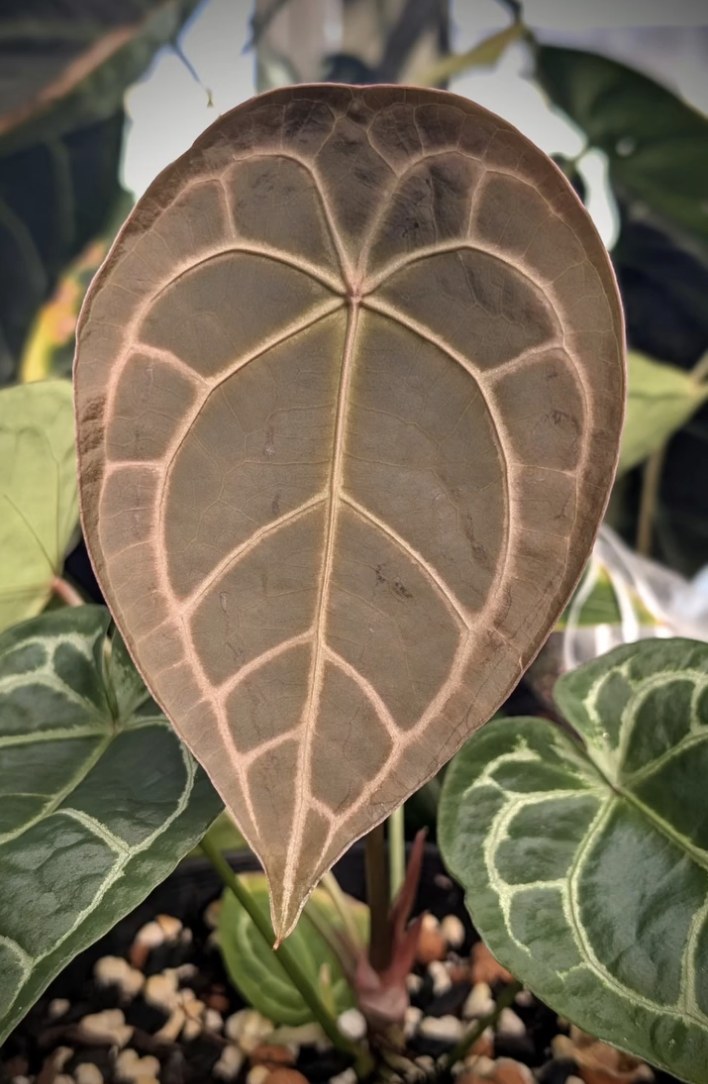
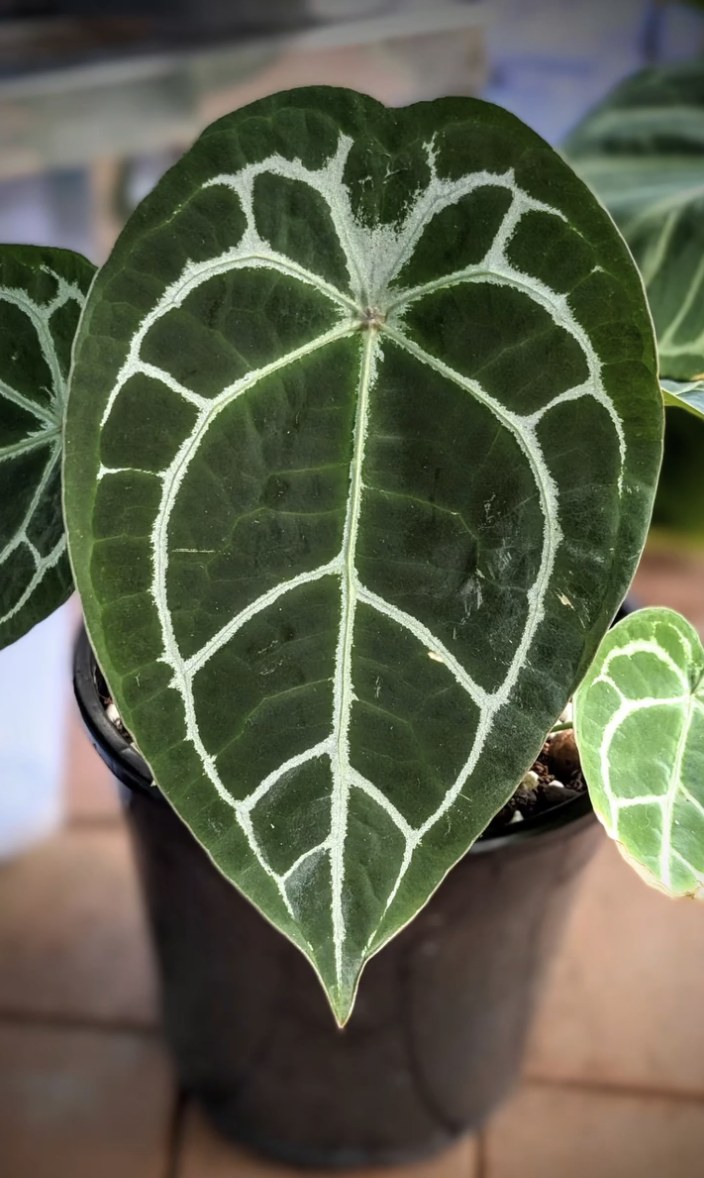
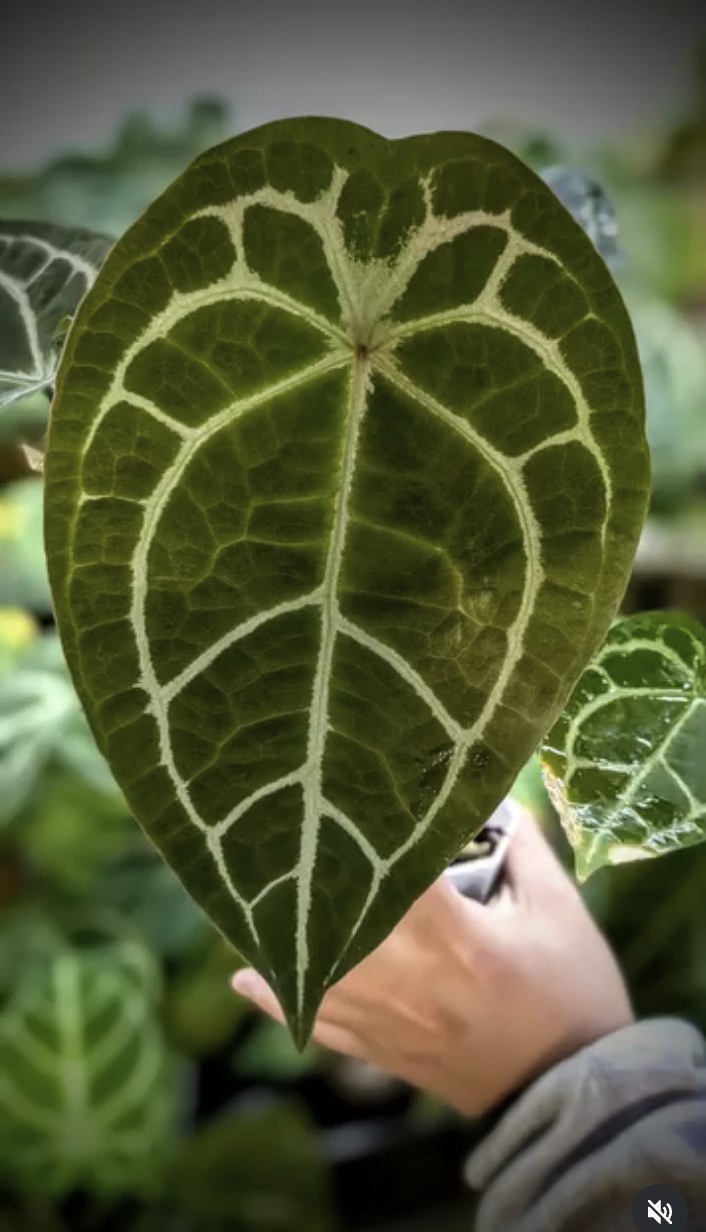
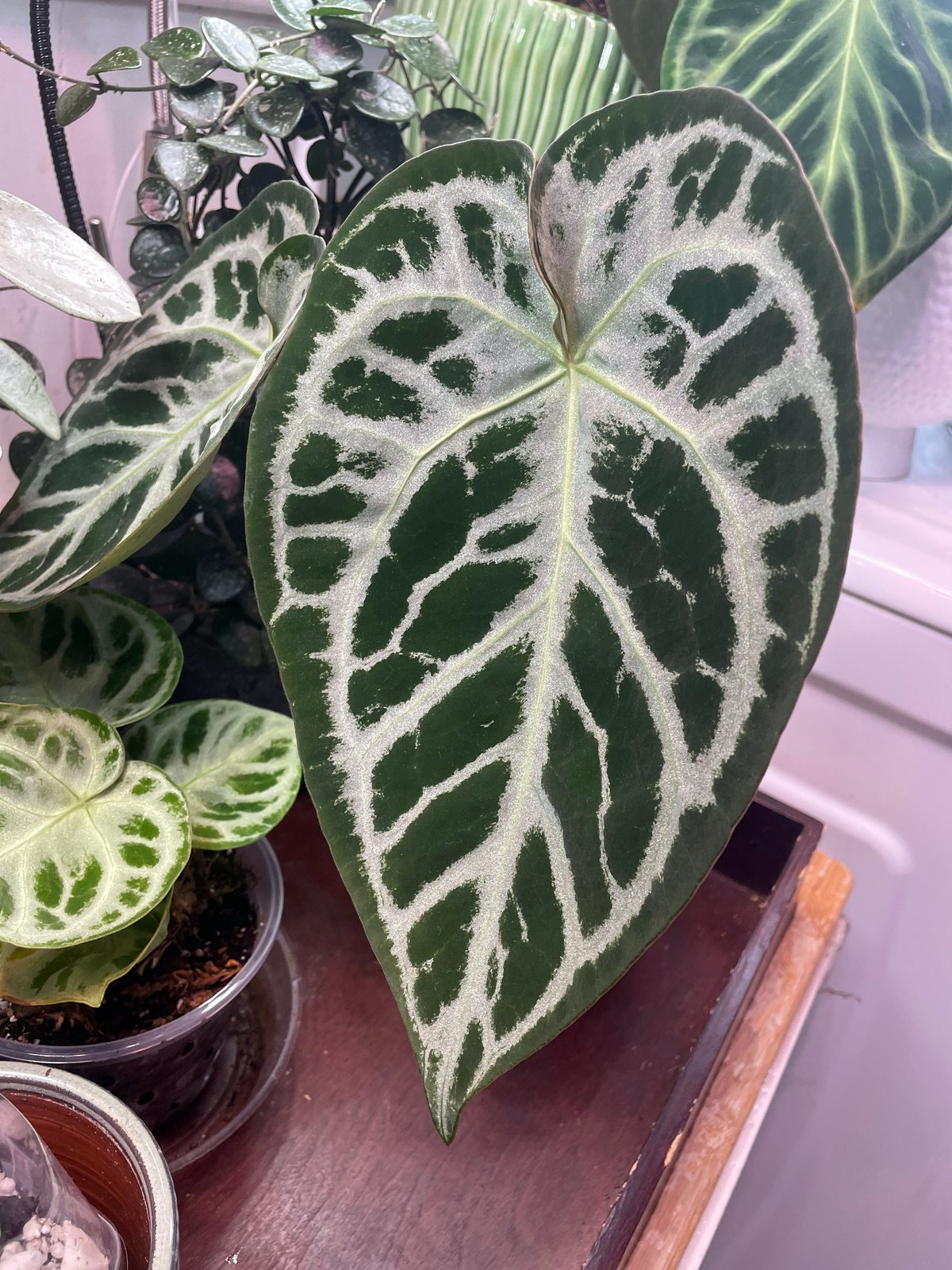
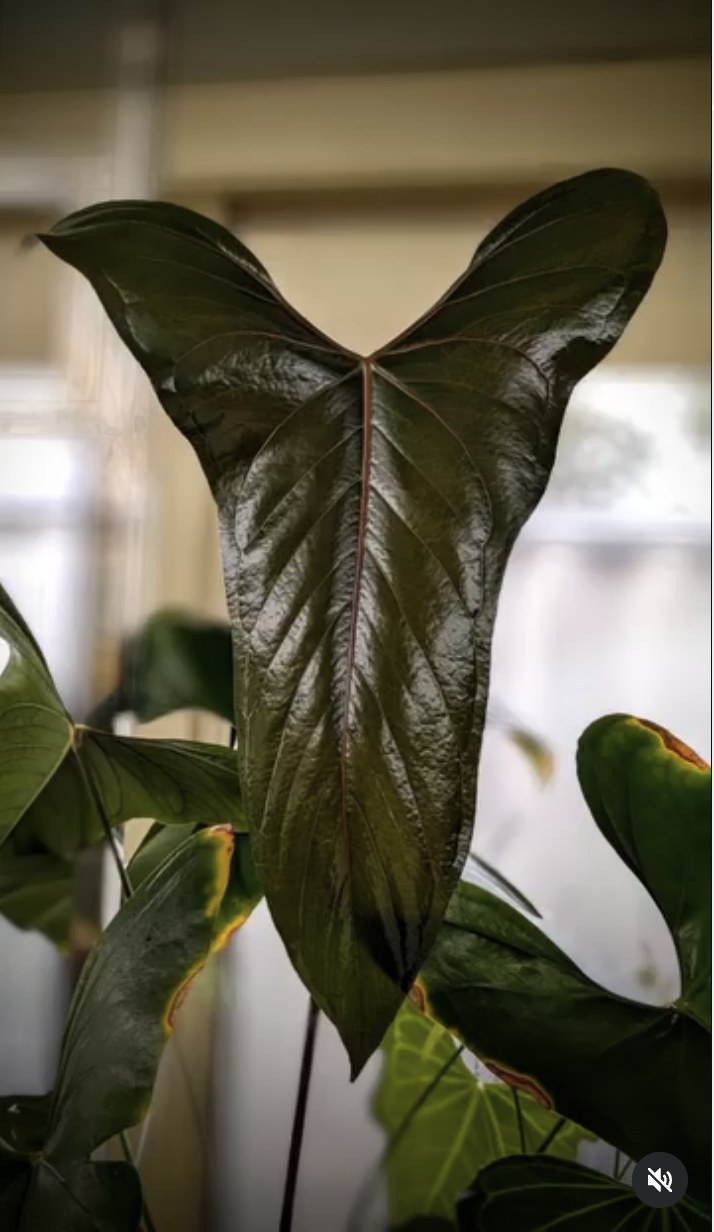
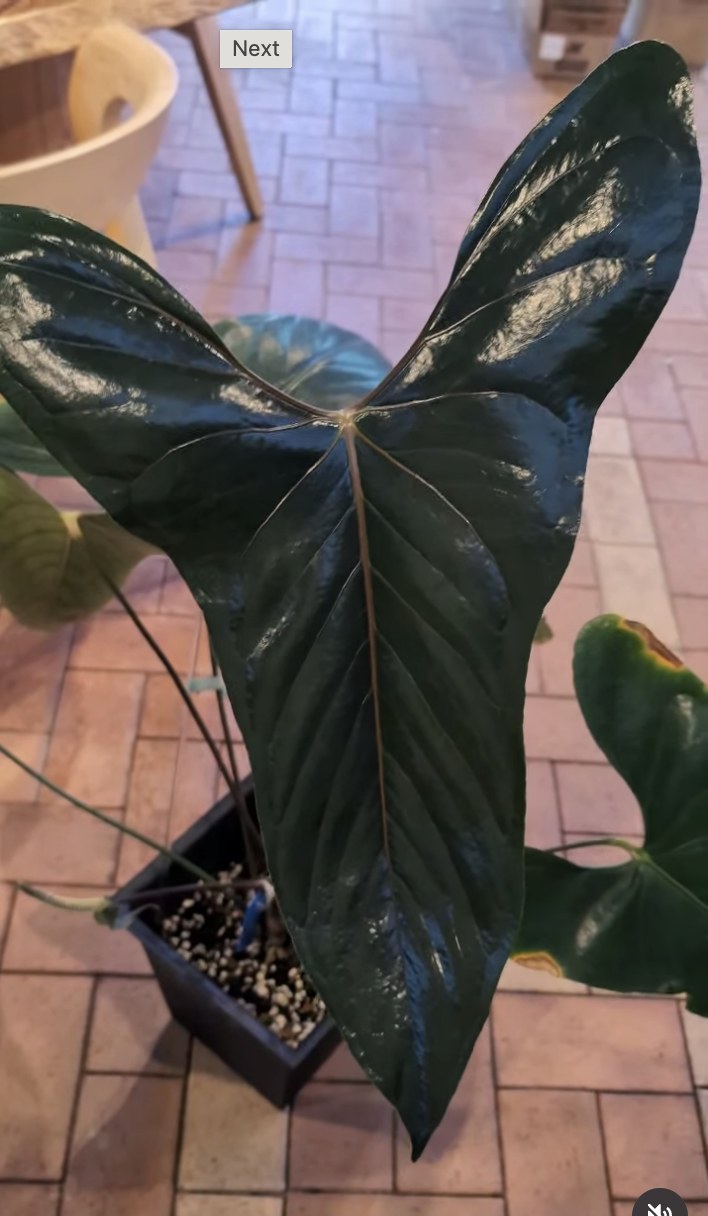
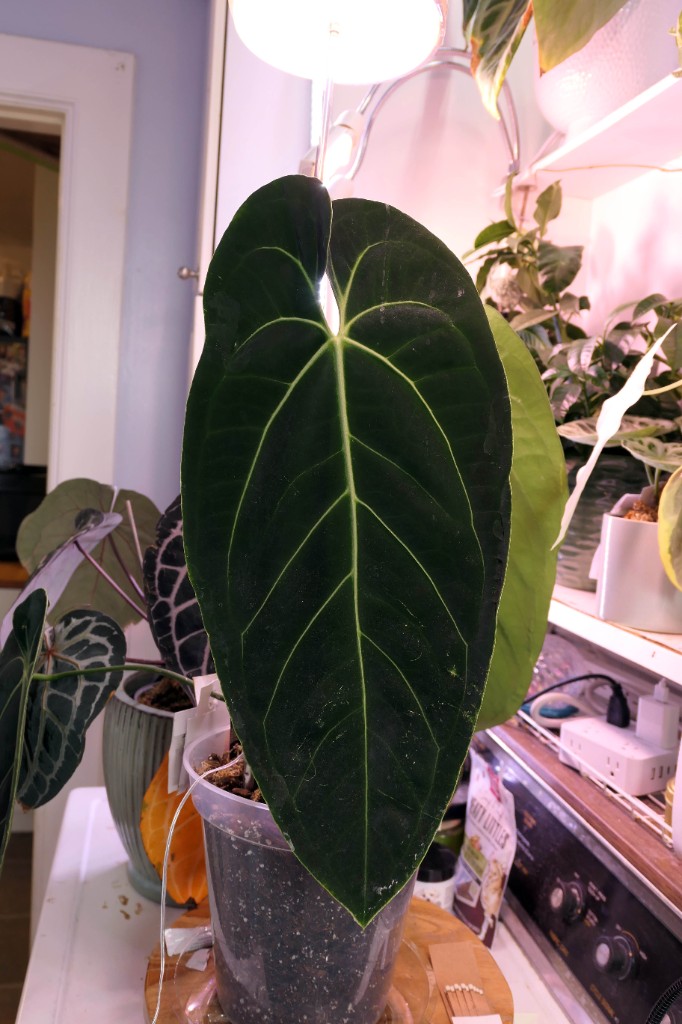
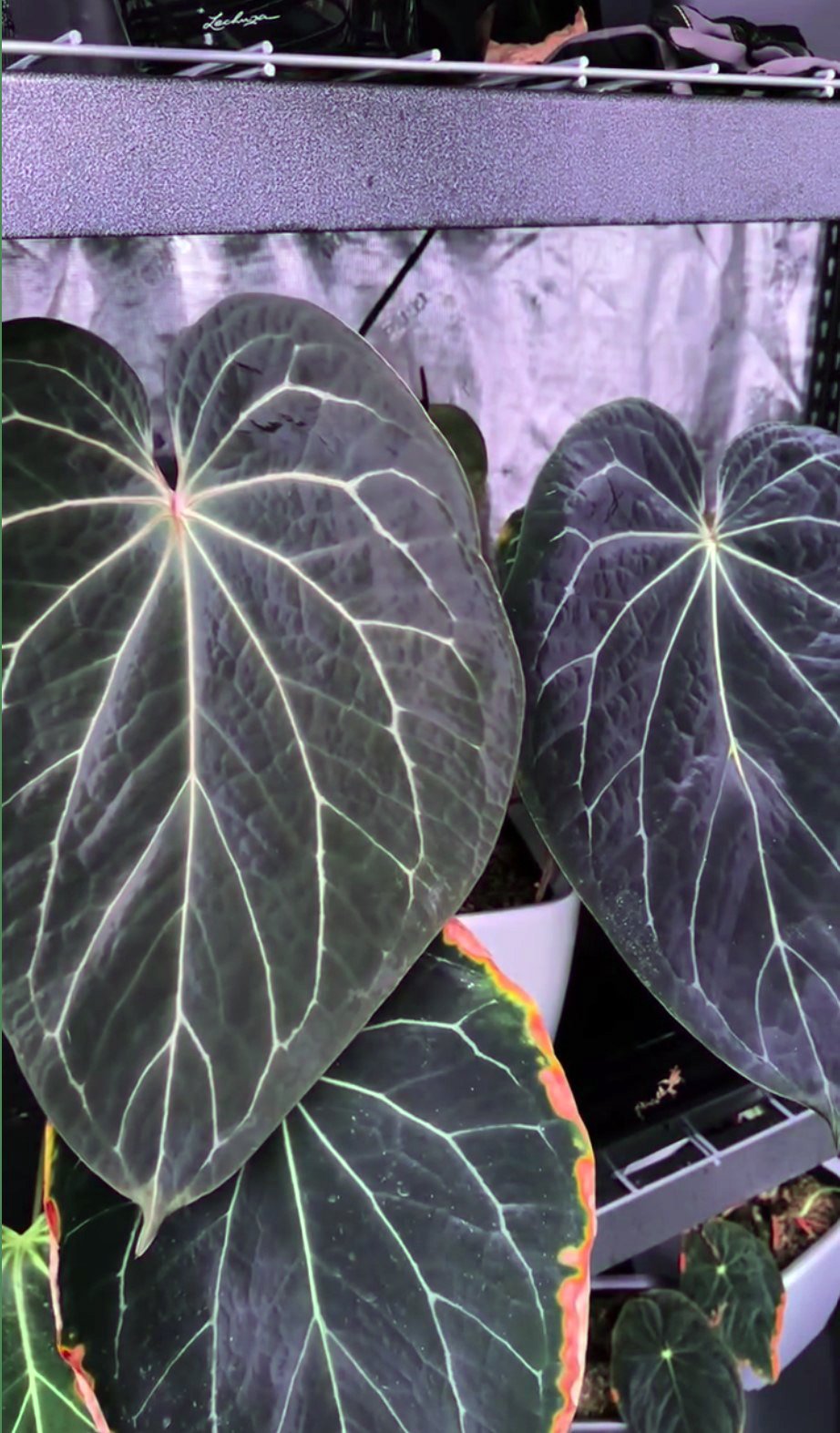
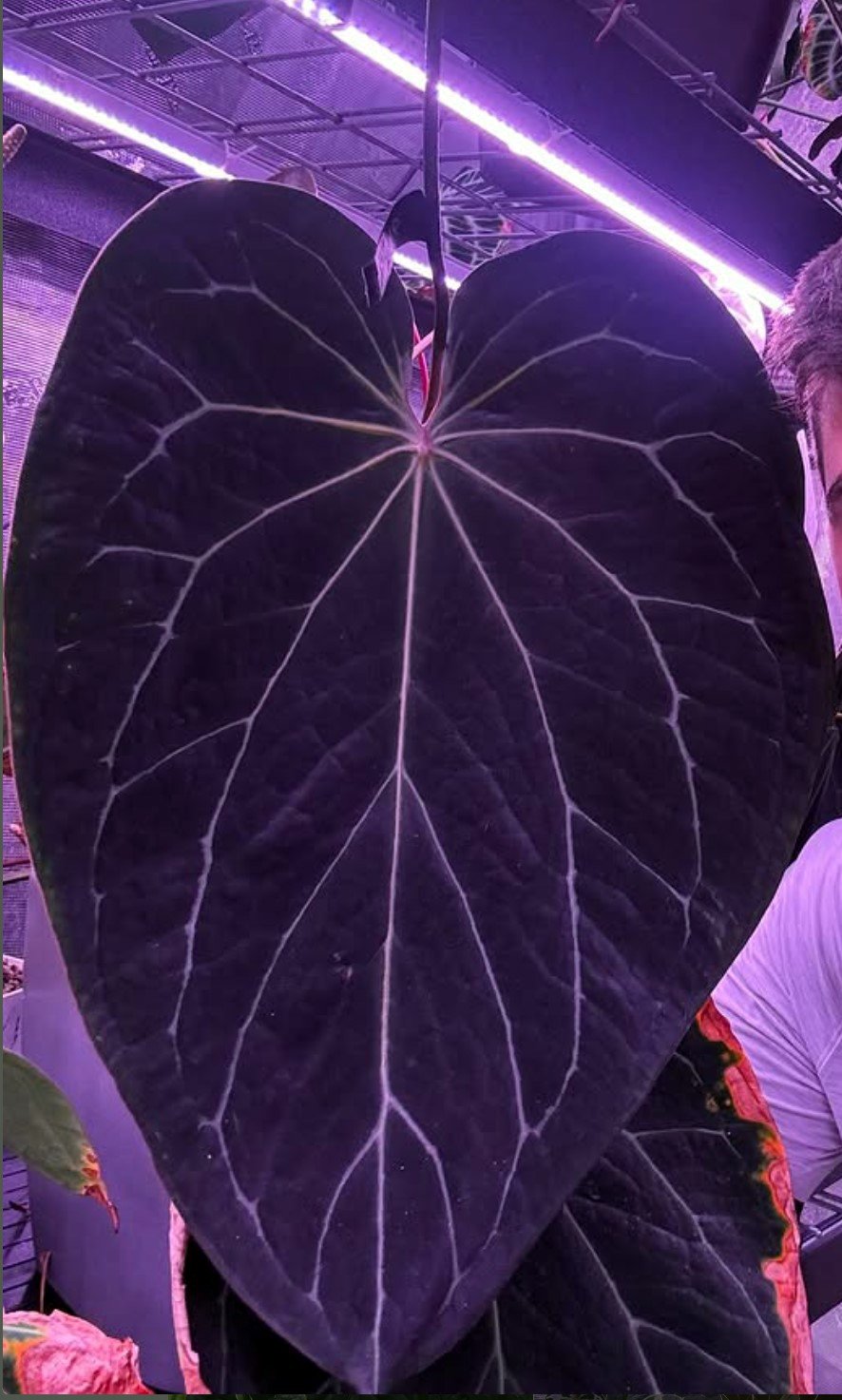
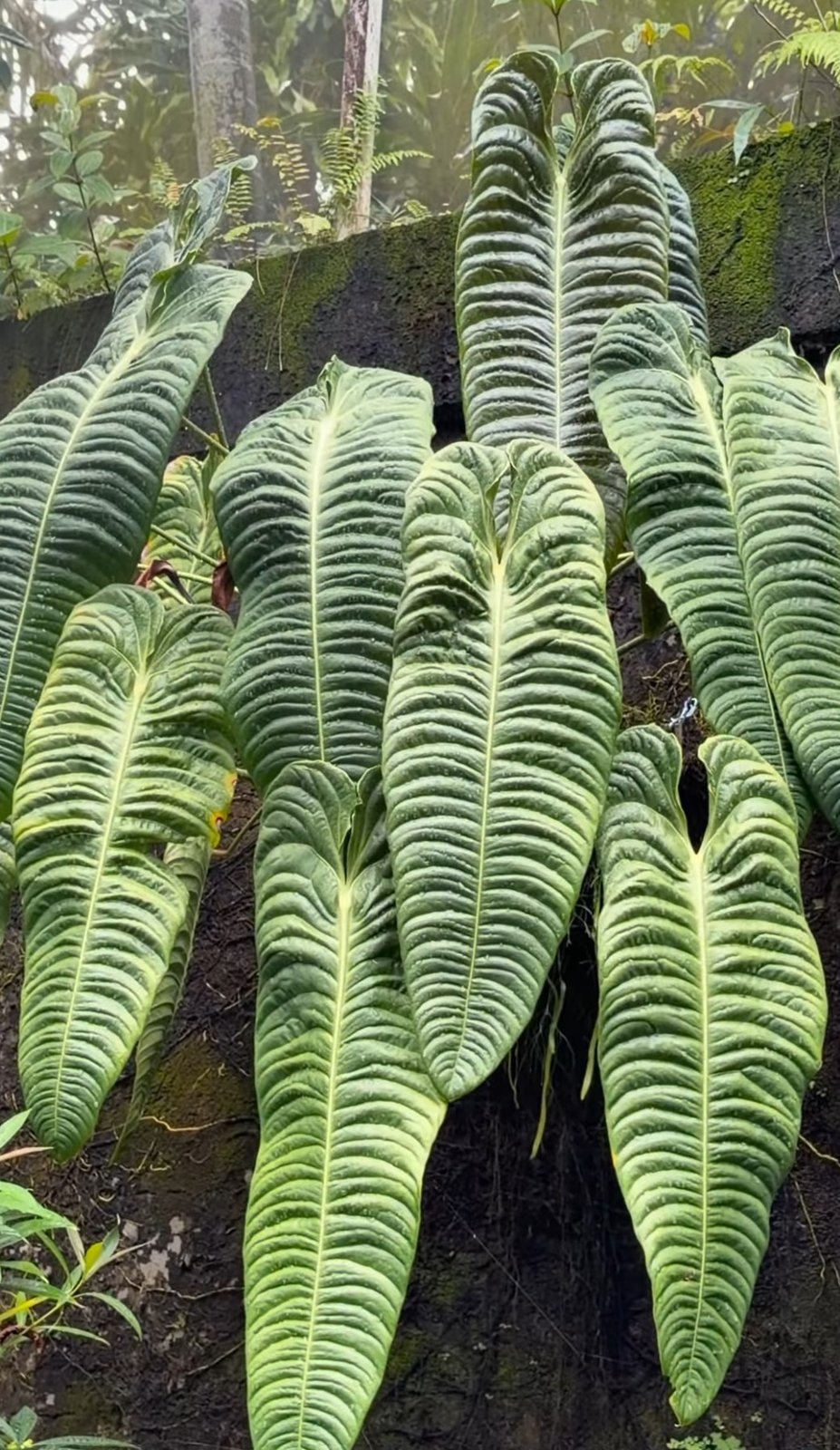
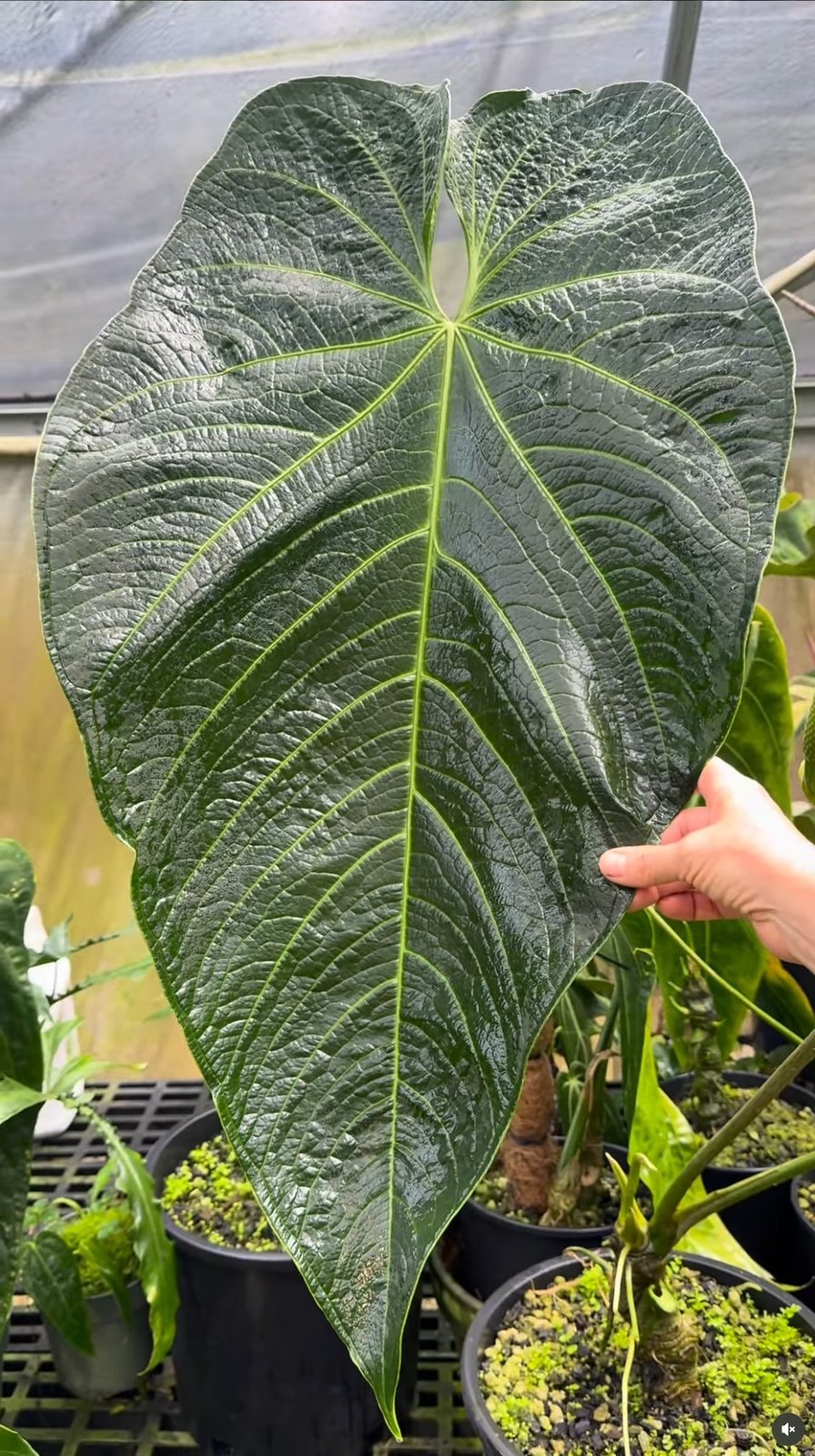
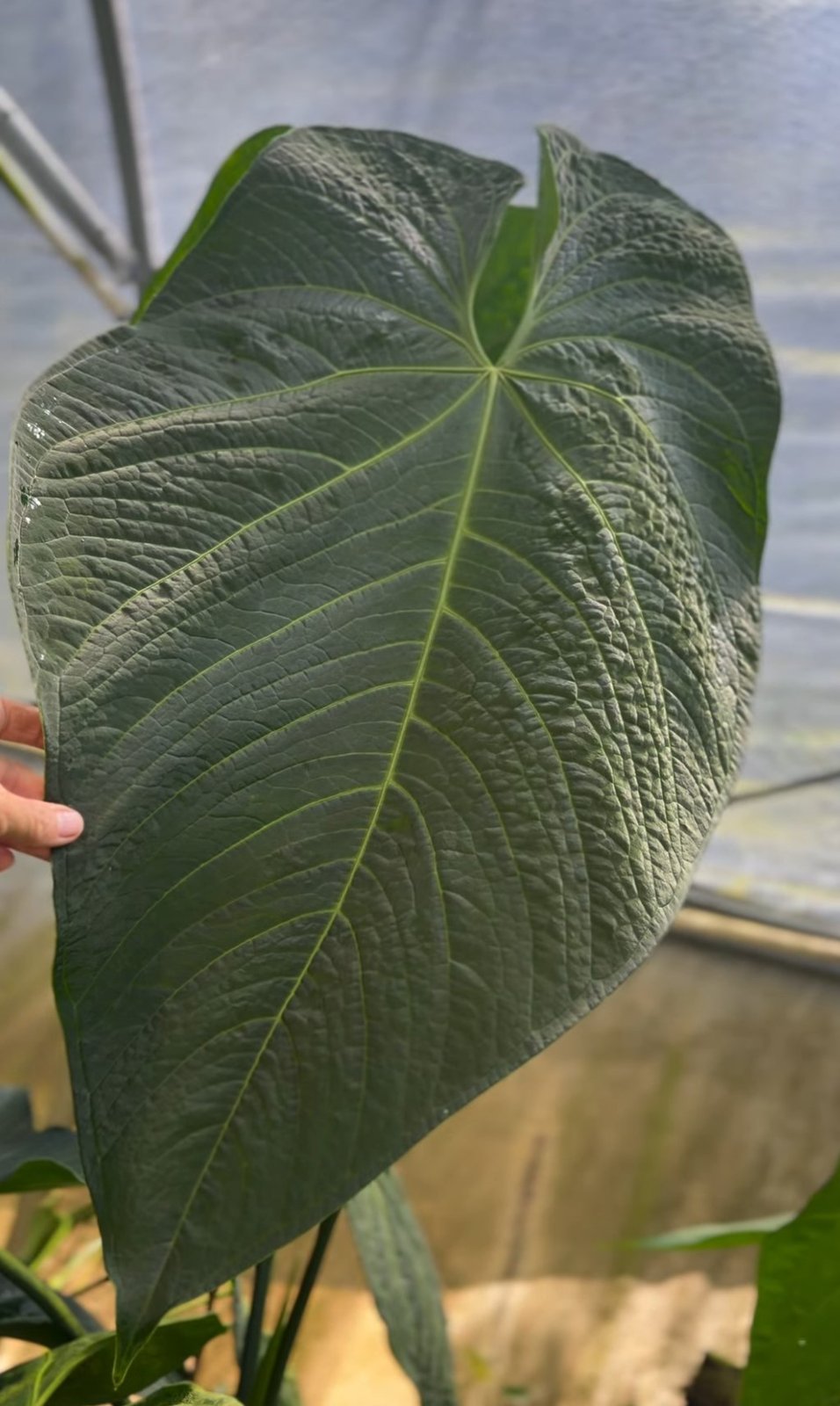
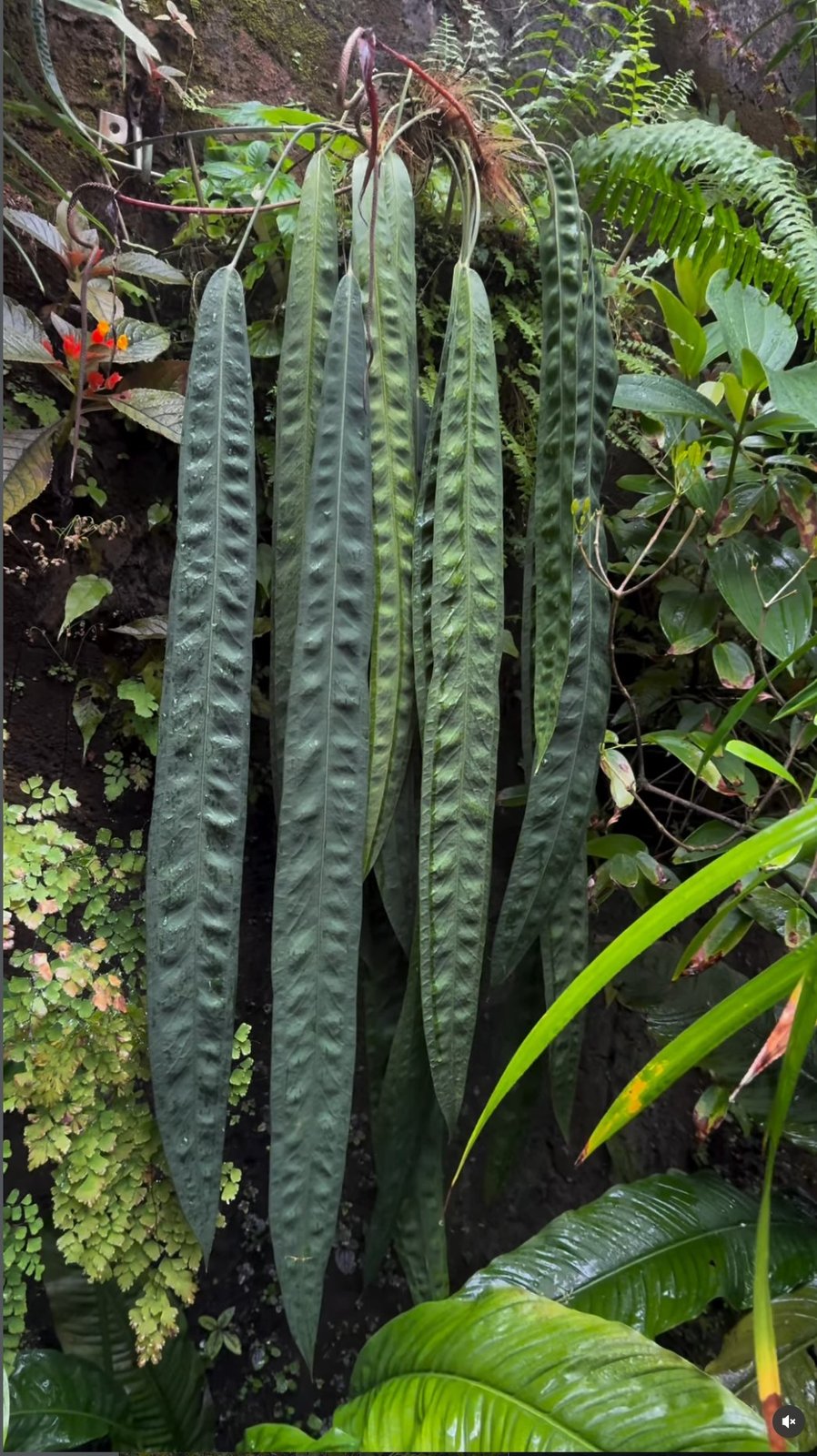
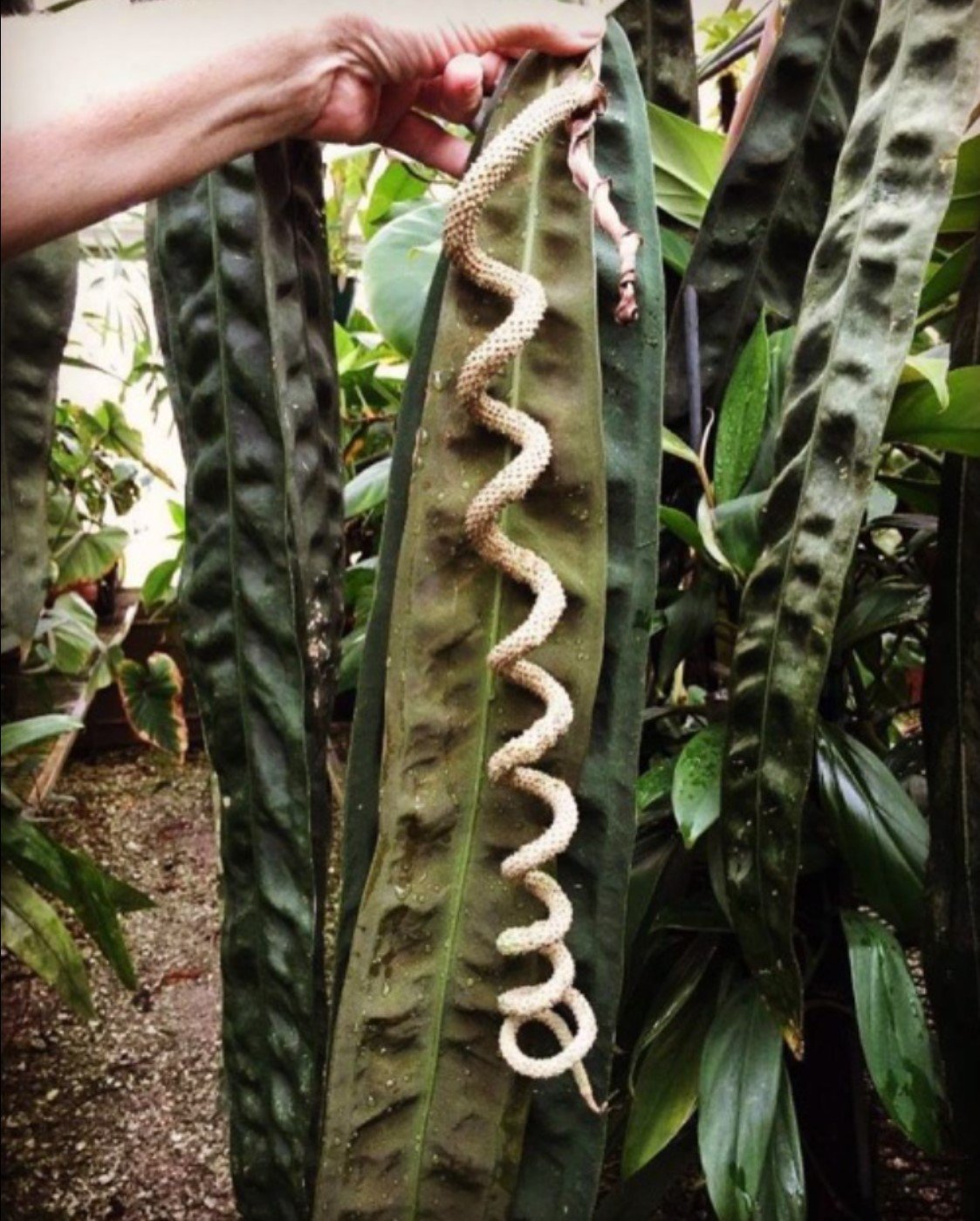
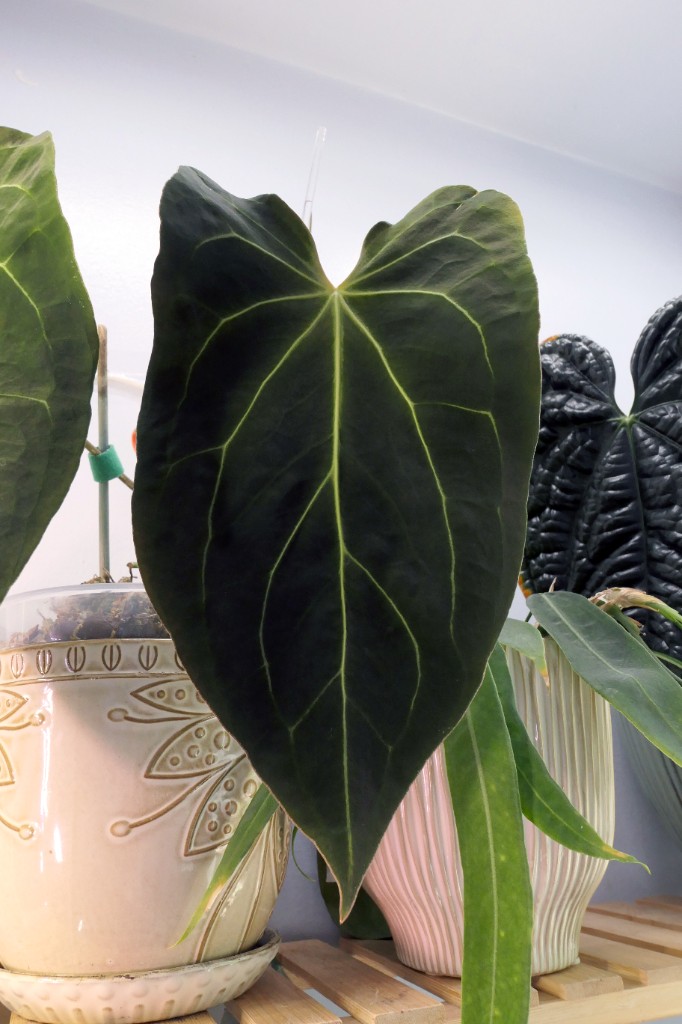
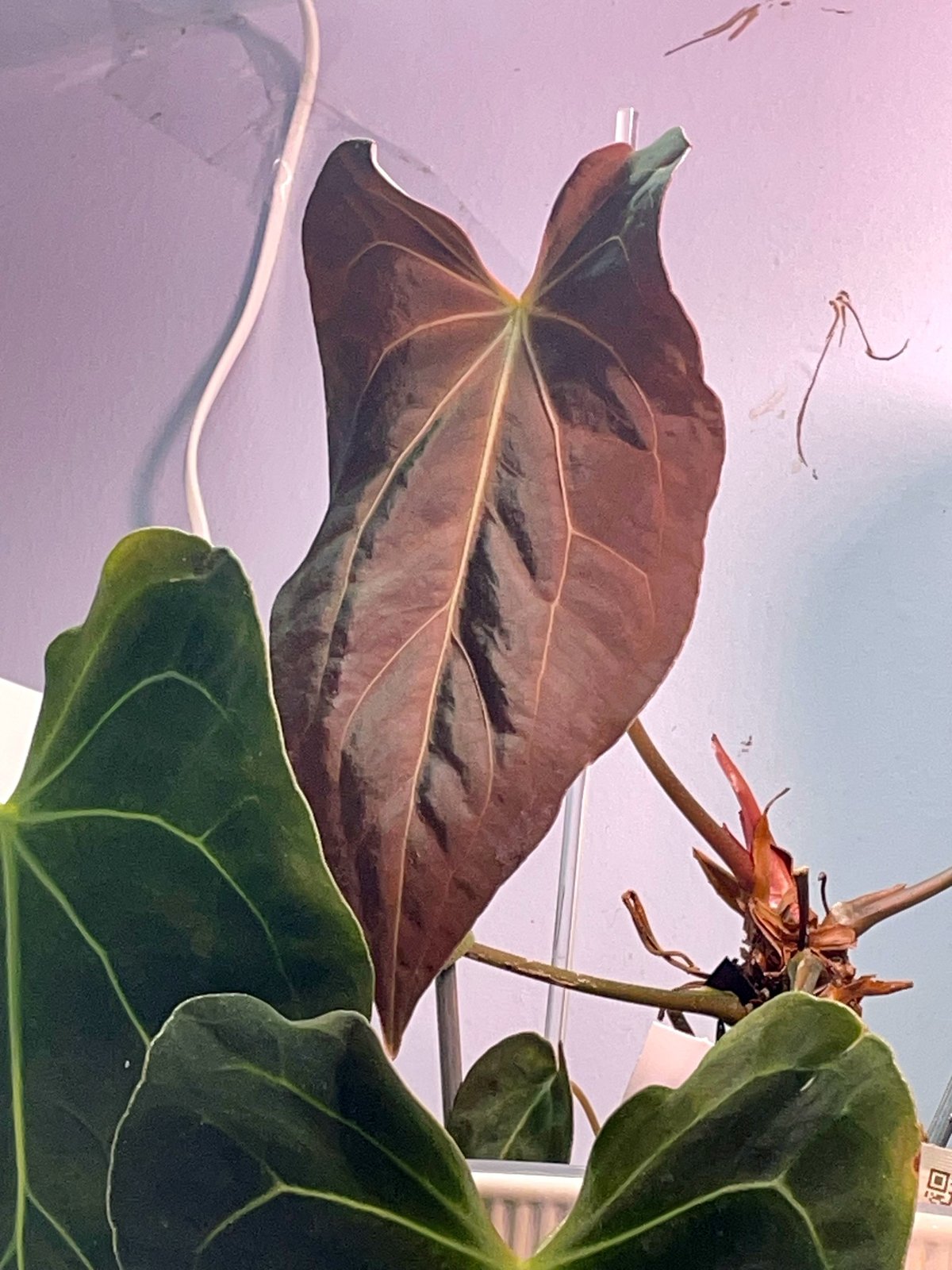
Anthurium Collector Cards with Interactive Family Tree
Explore anthurium ancestry and related hybrids.
This site currently has only 180+ plants listed. Help me improve it by submitting plants, photos, plant descriptions, or text for care guides. I will be happy to credit you and link to your website or social media. See mistakes? Let me know!
NOTE: This reference is assembled from public sources and community knowledge for fun; Gaps or errors are expected.
Get quick facts about specific plants and explore it's interactive family tree.
All entries
All characteristics
All morphology
All species
All hybrids
All other hybrids
All breeders
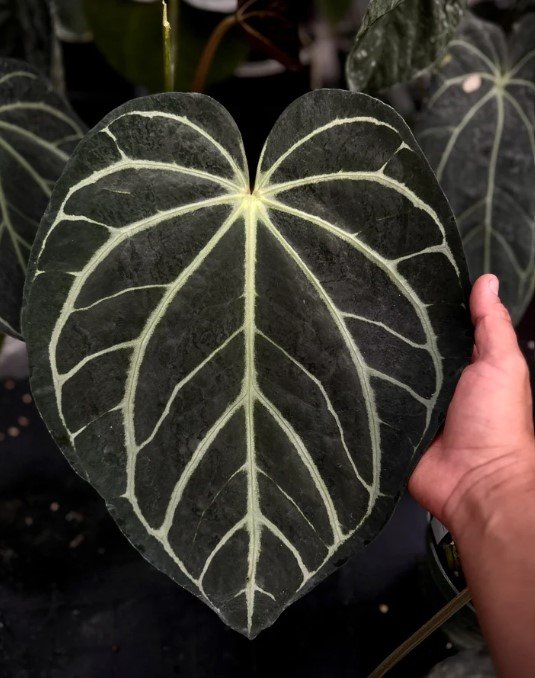
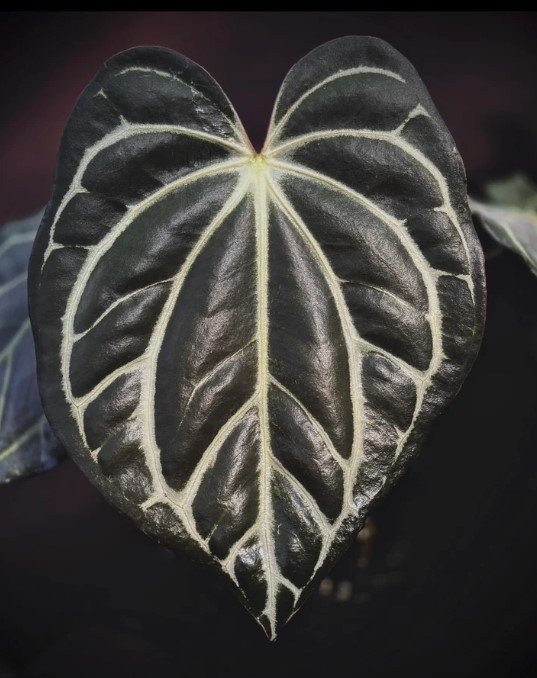
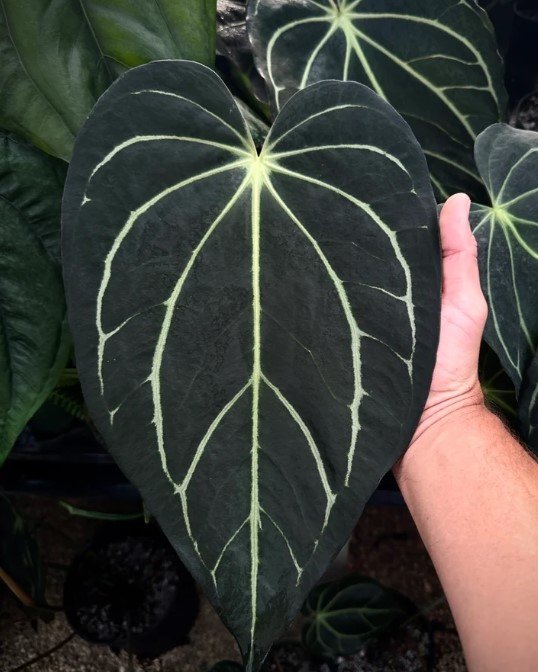
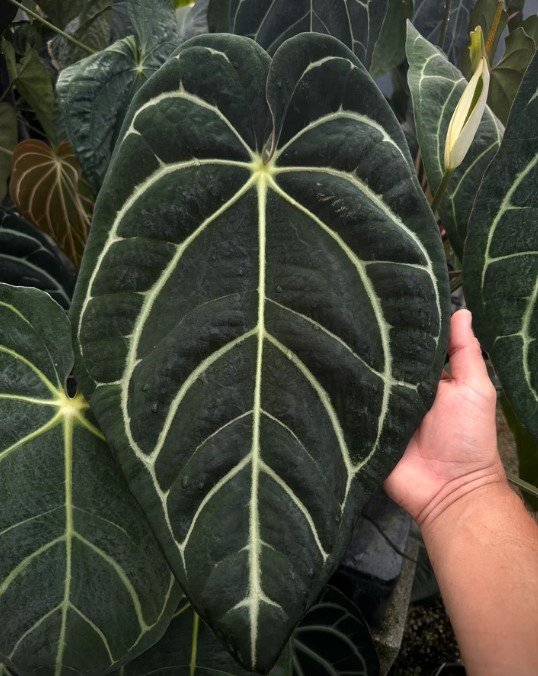
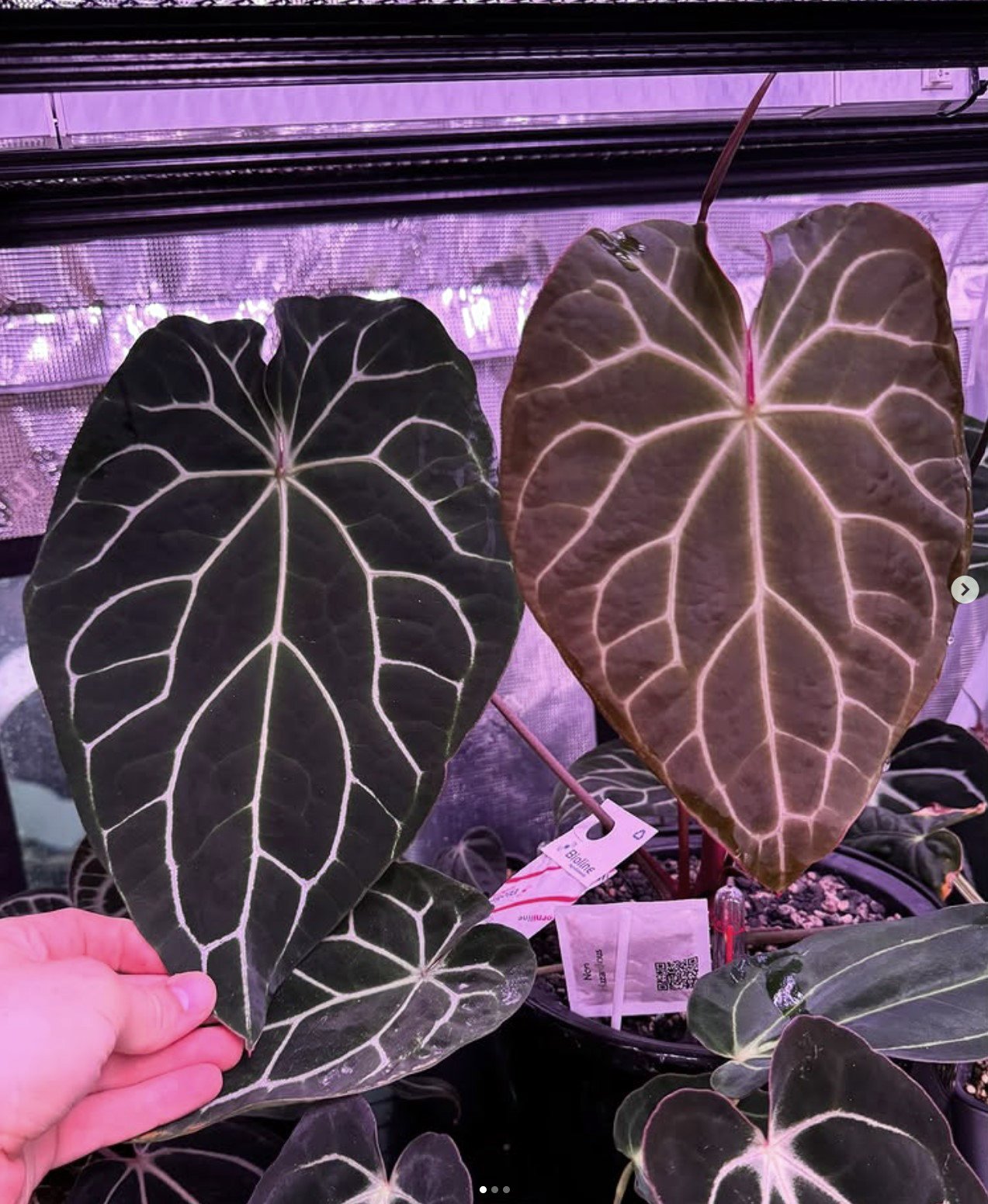
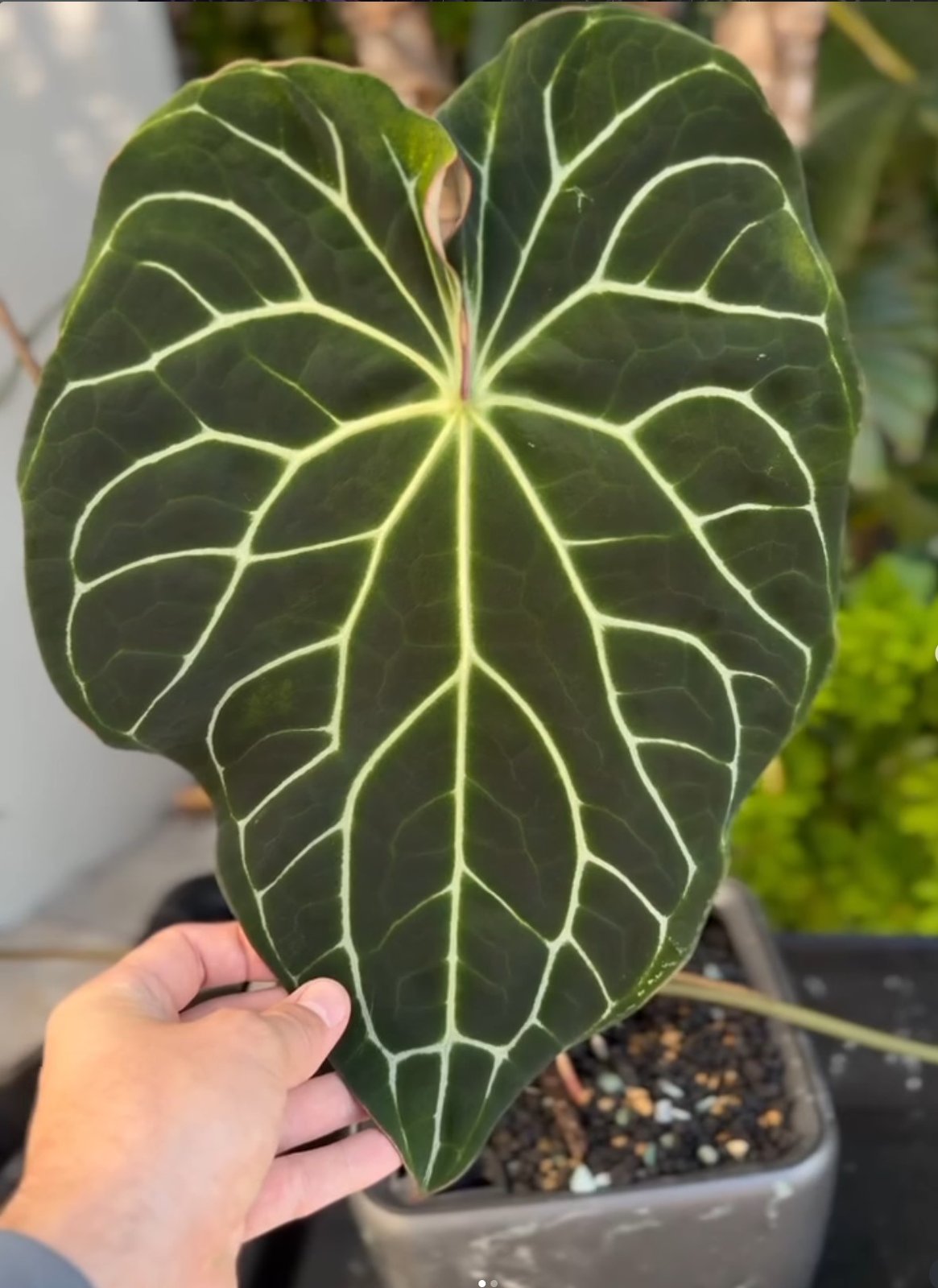
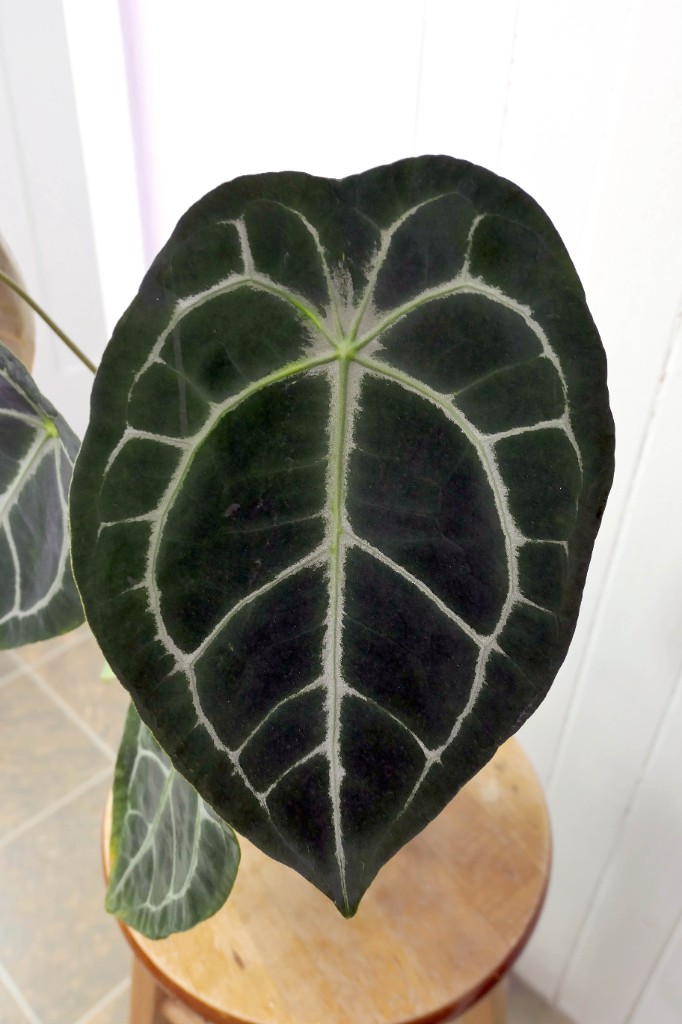
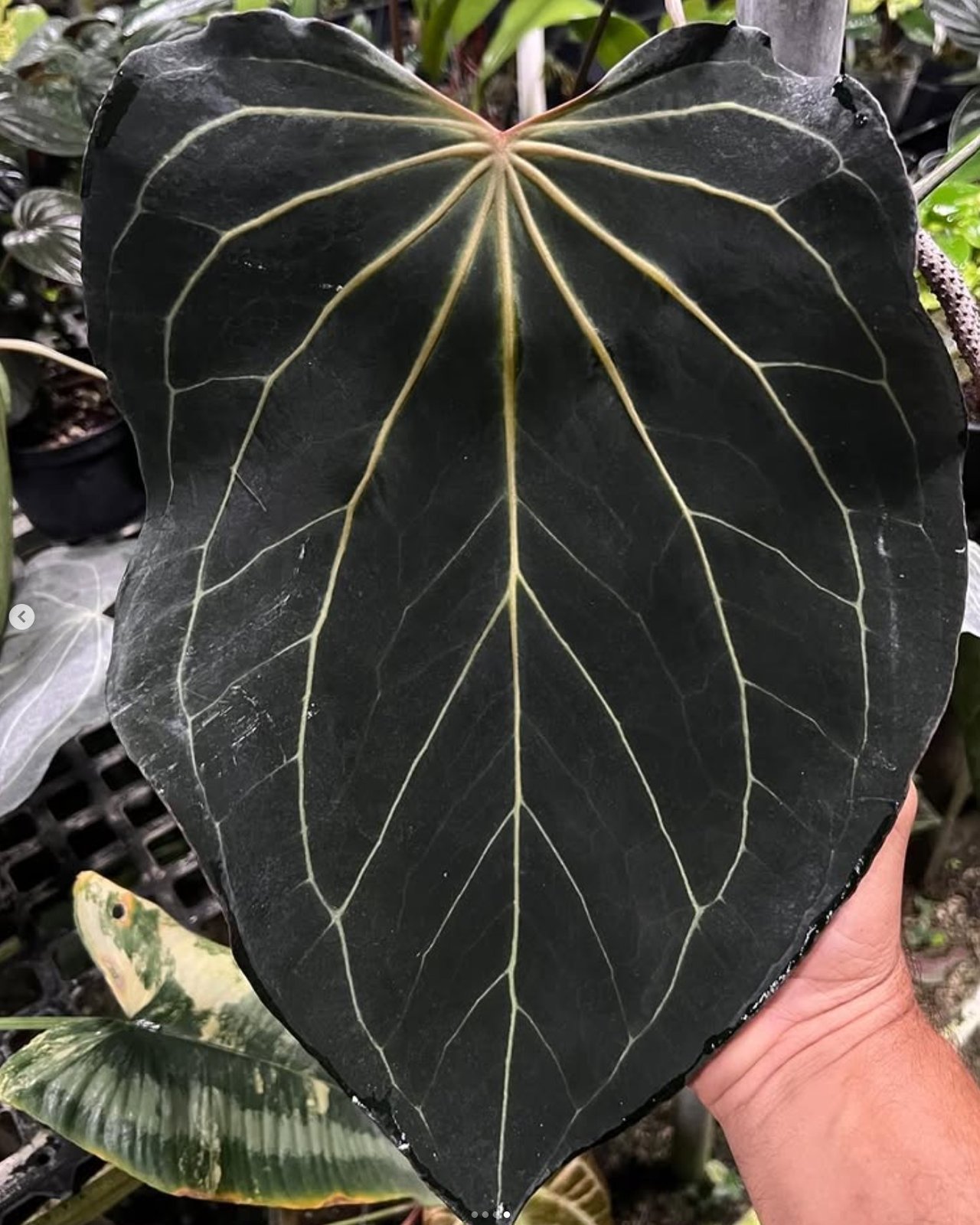
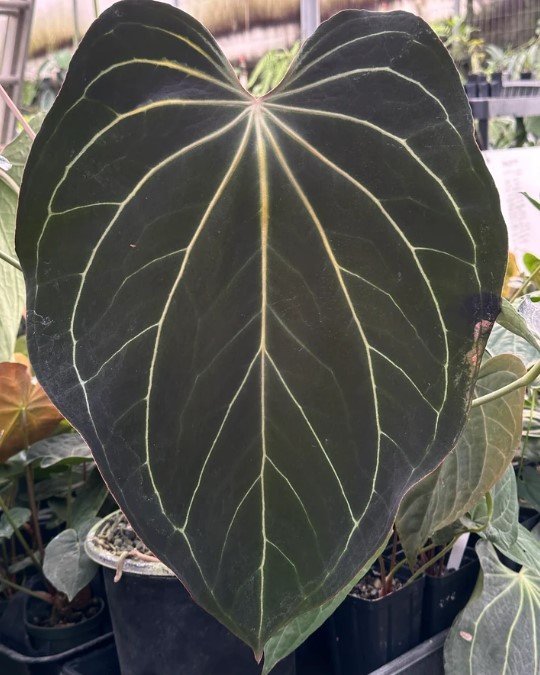
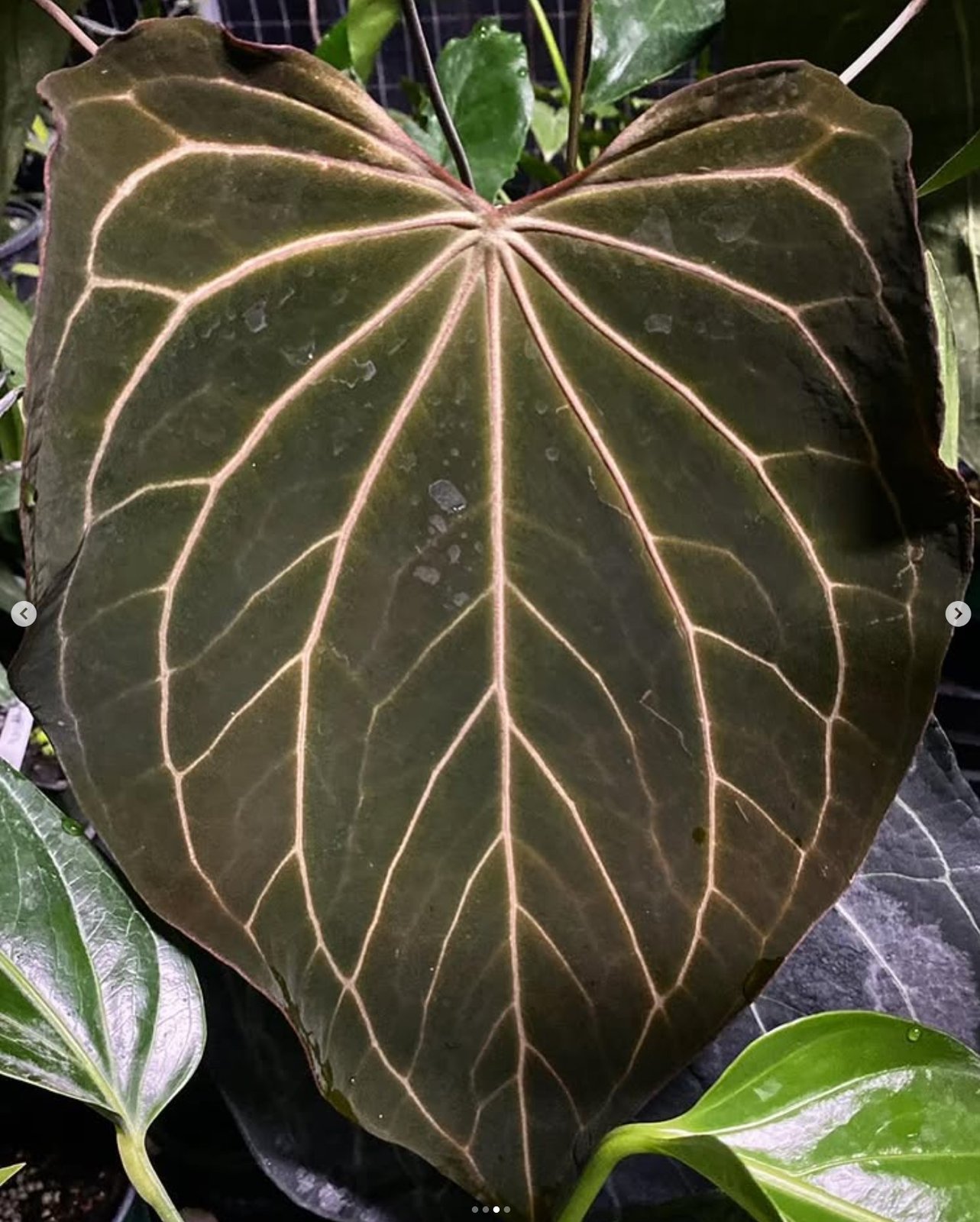
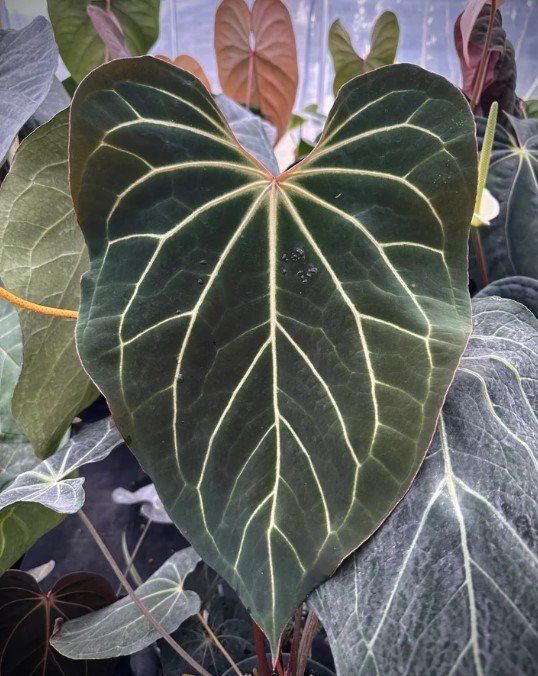
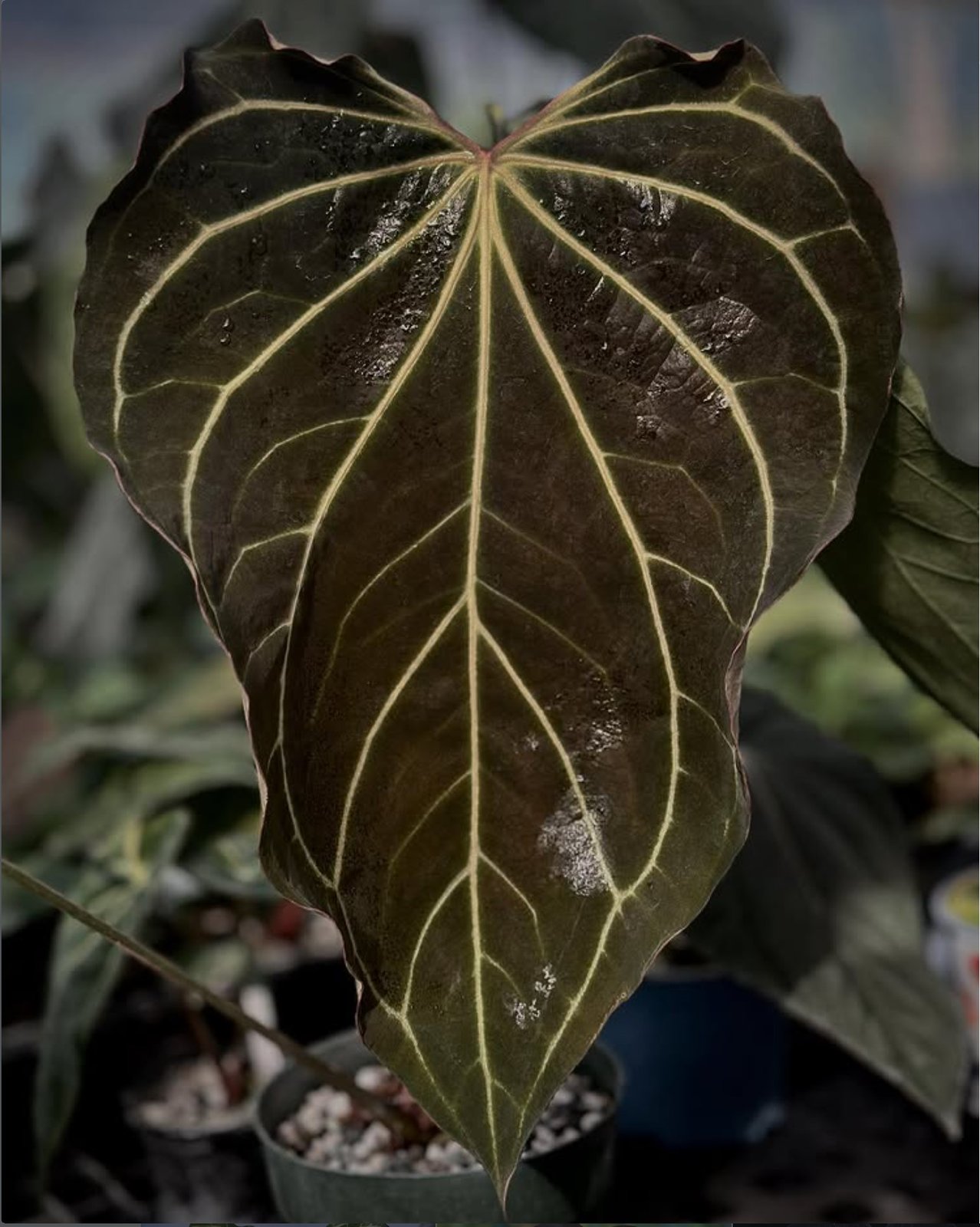
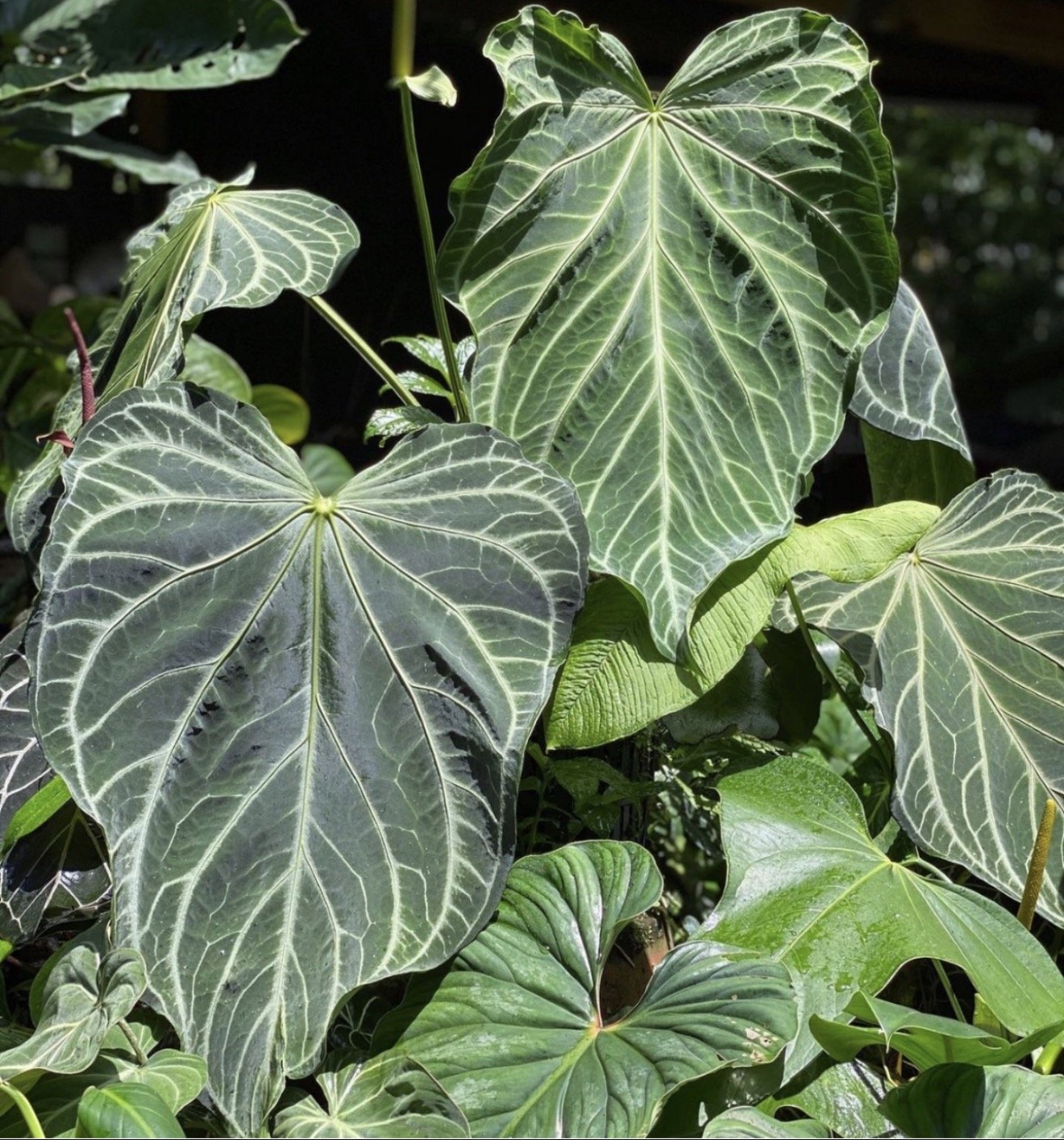
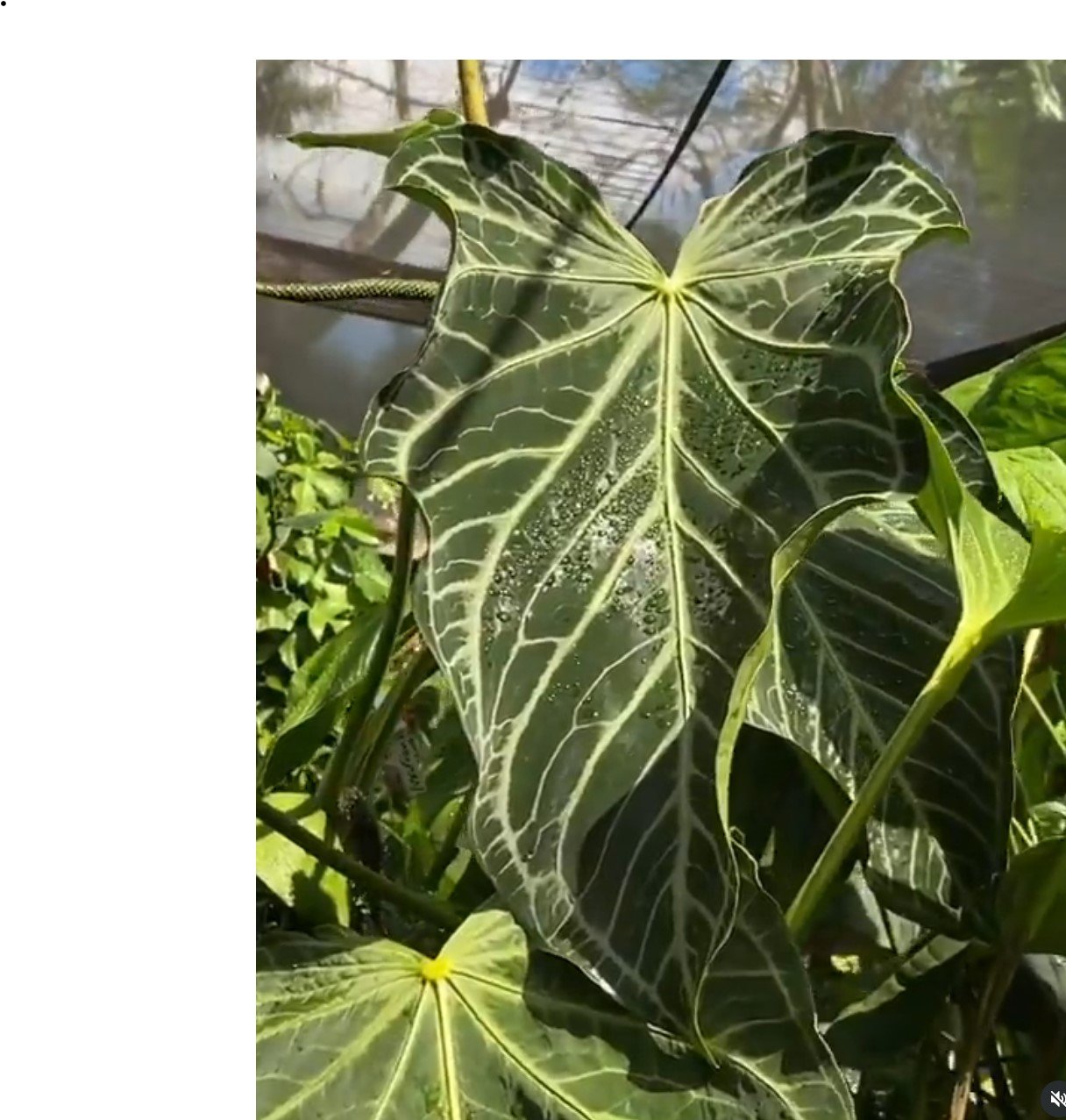
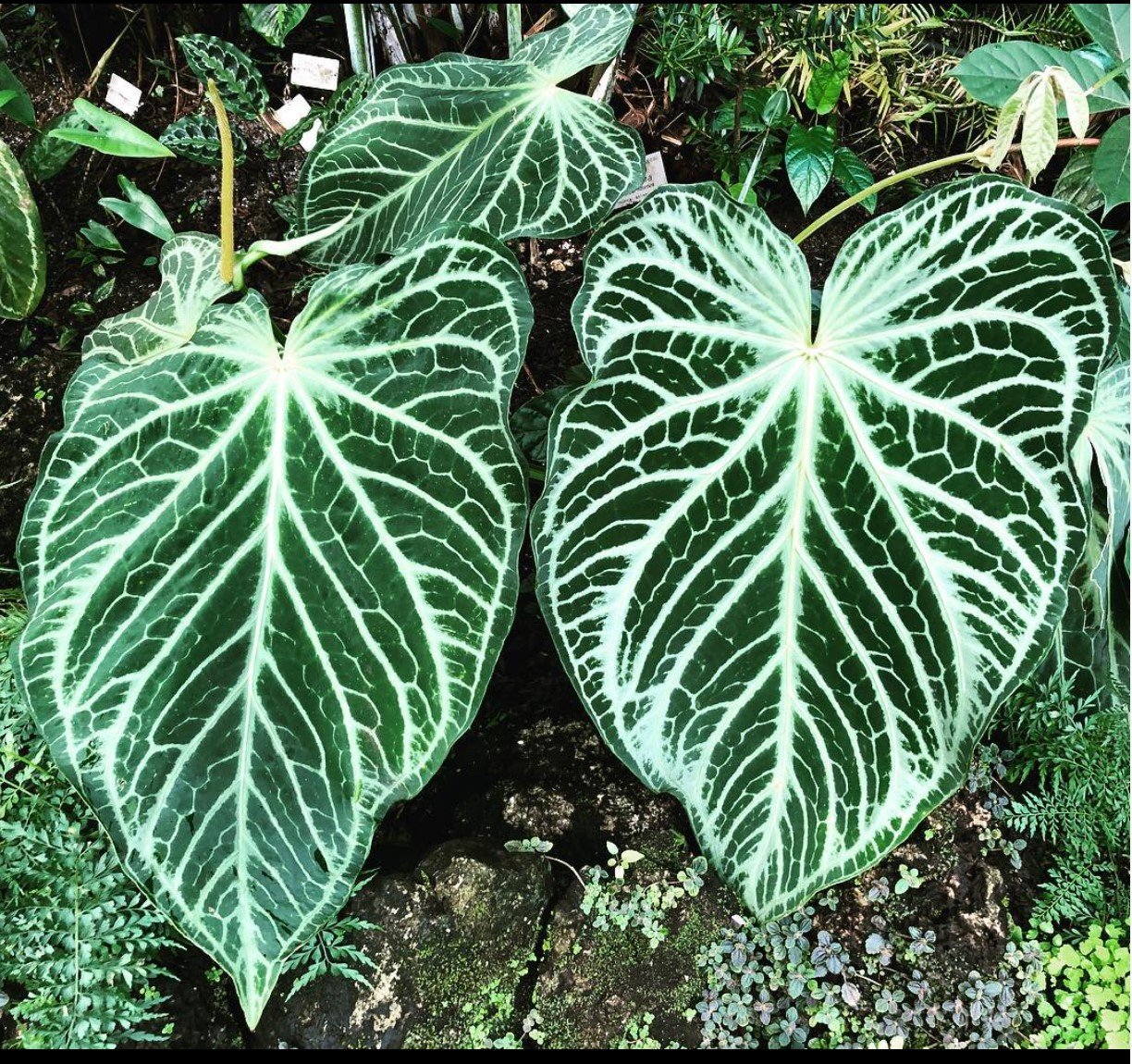
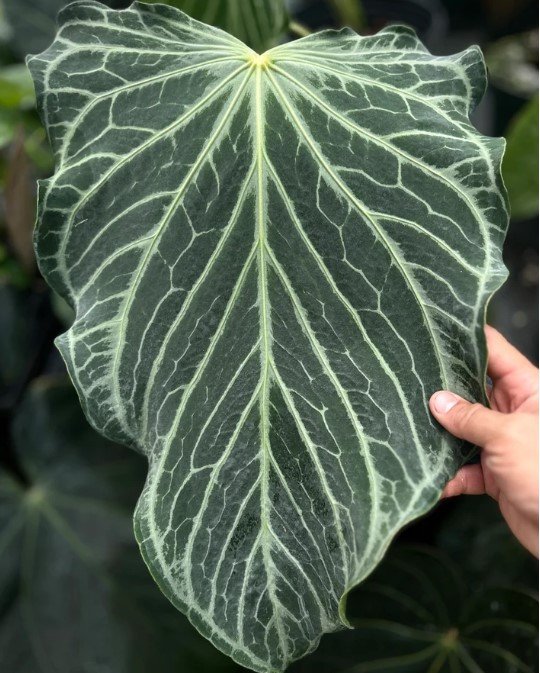
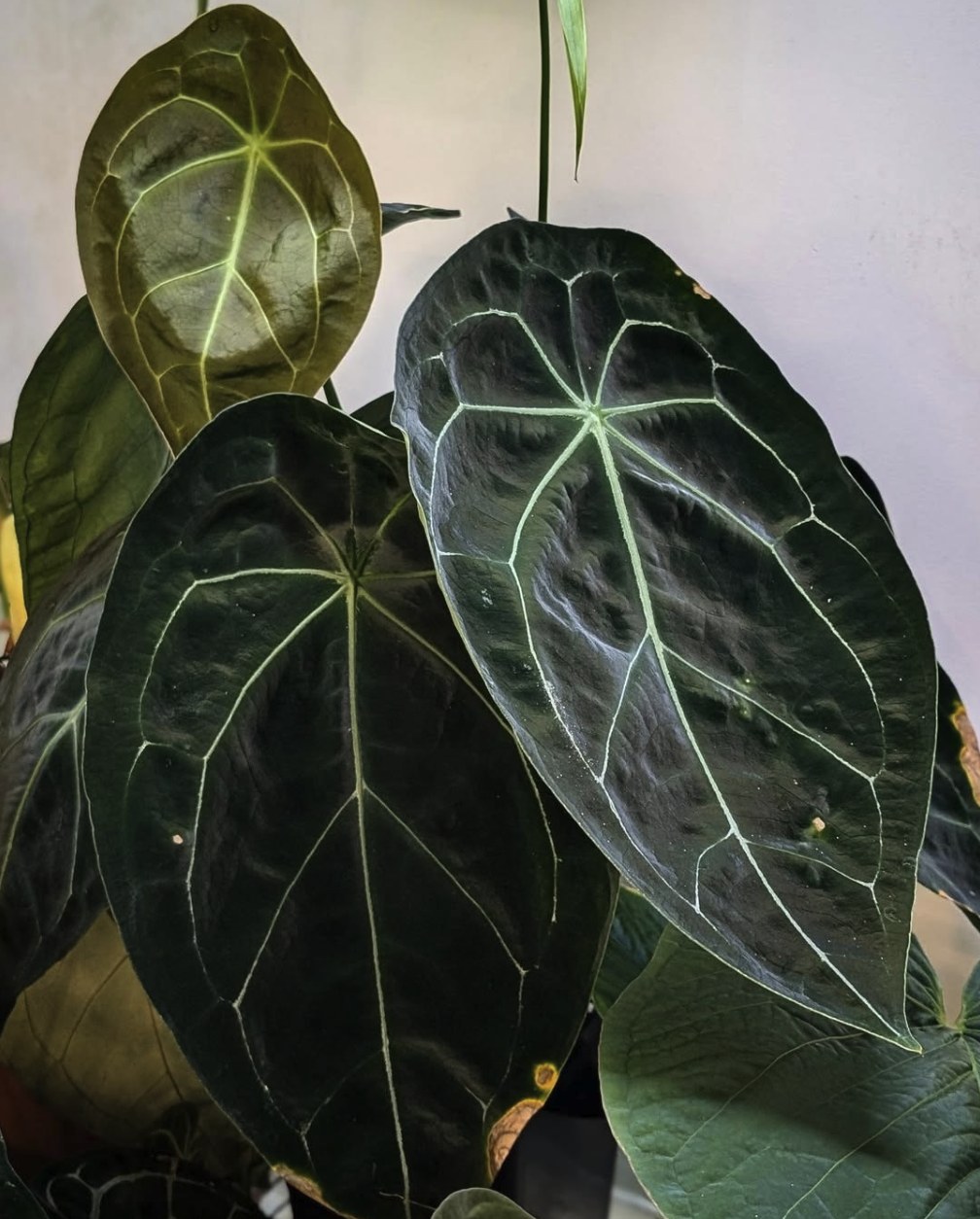
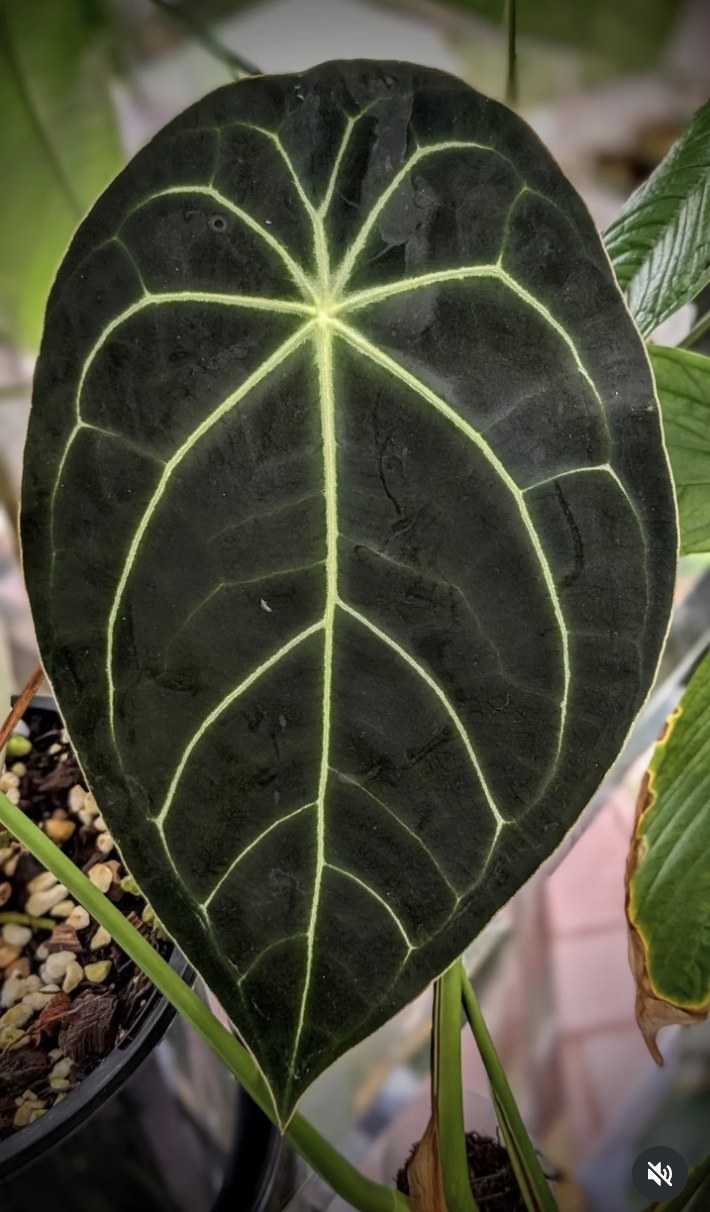
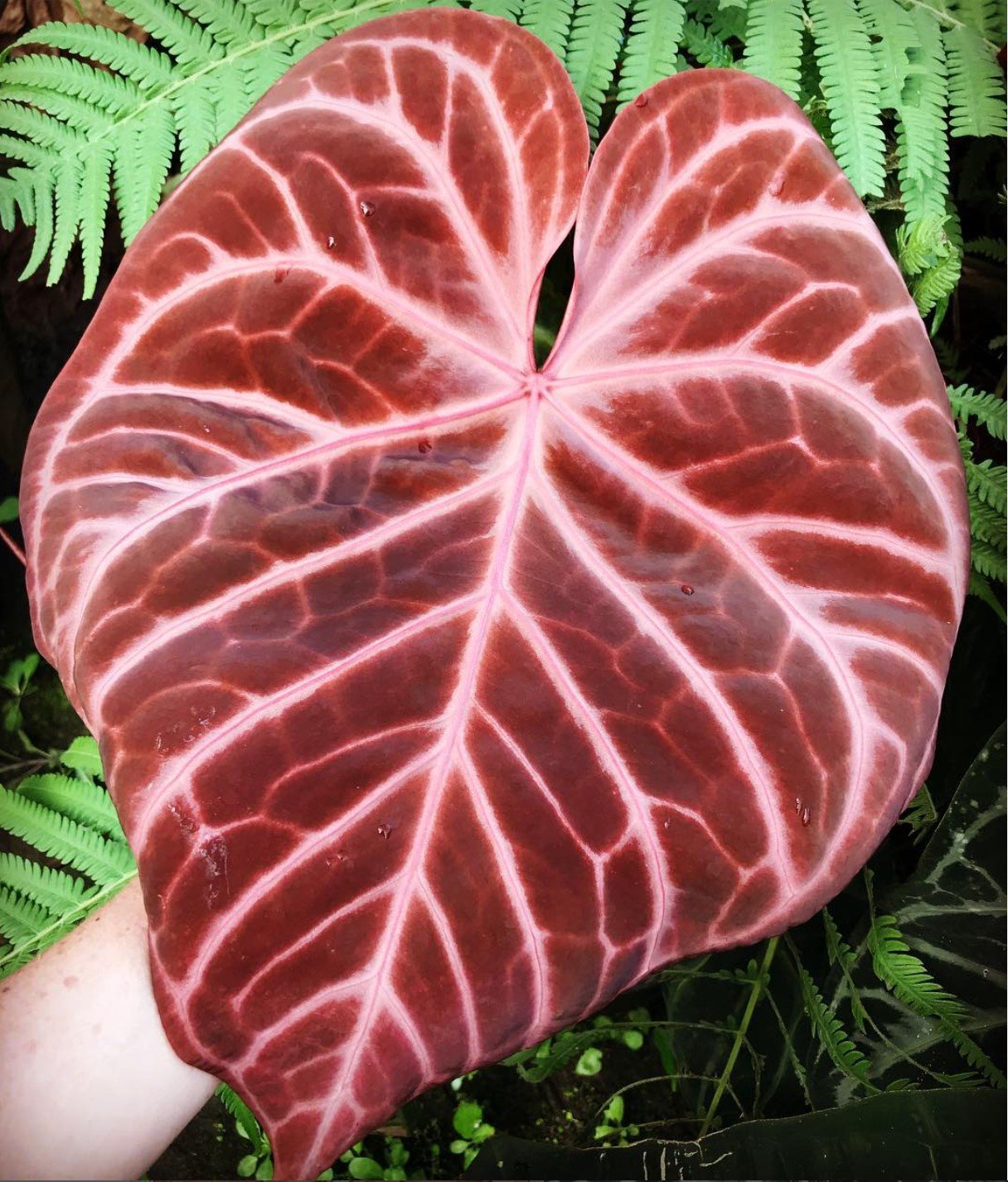
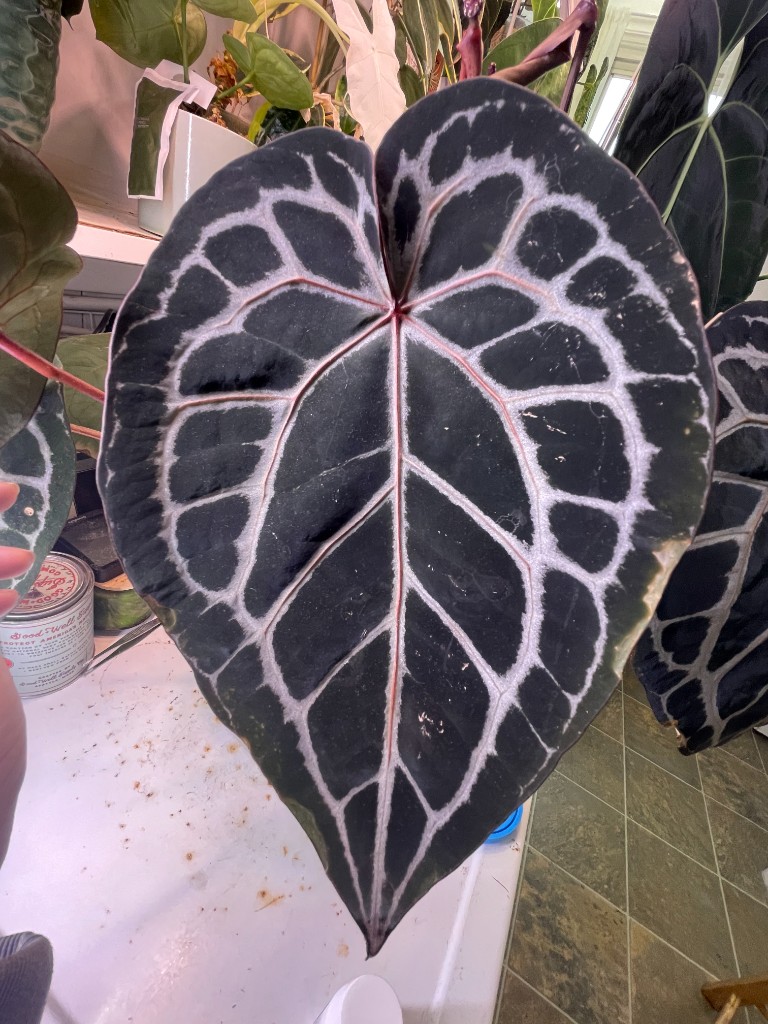
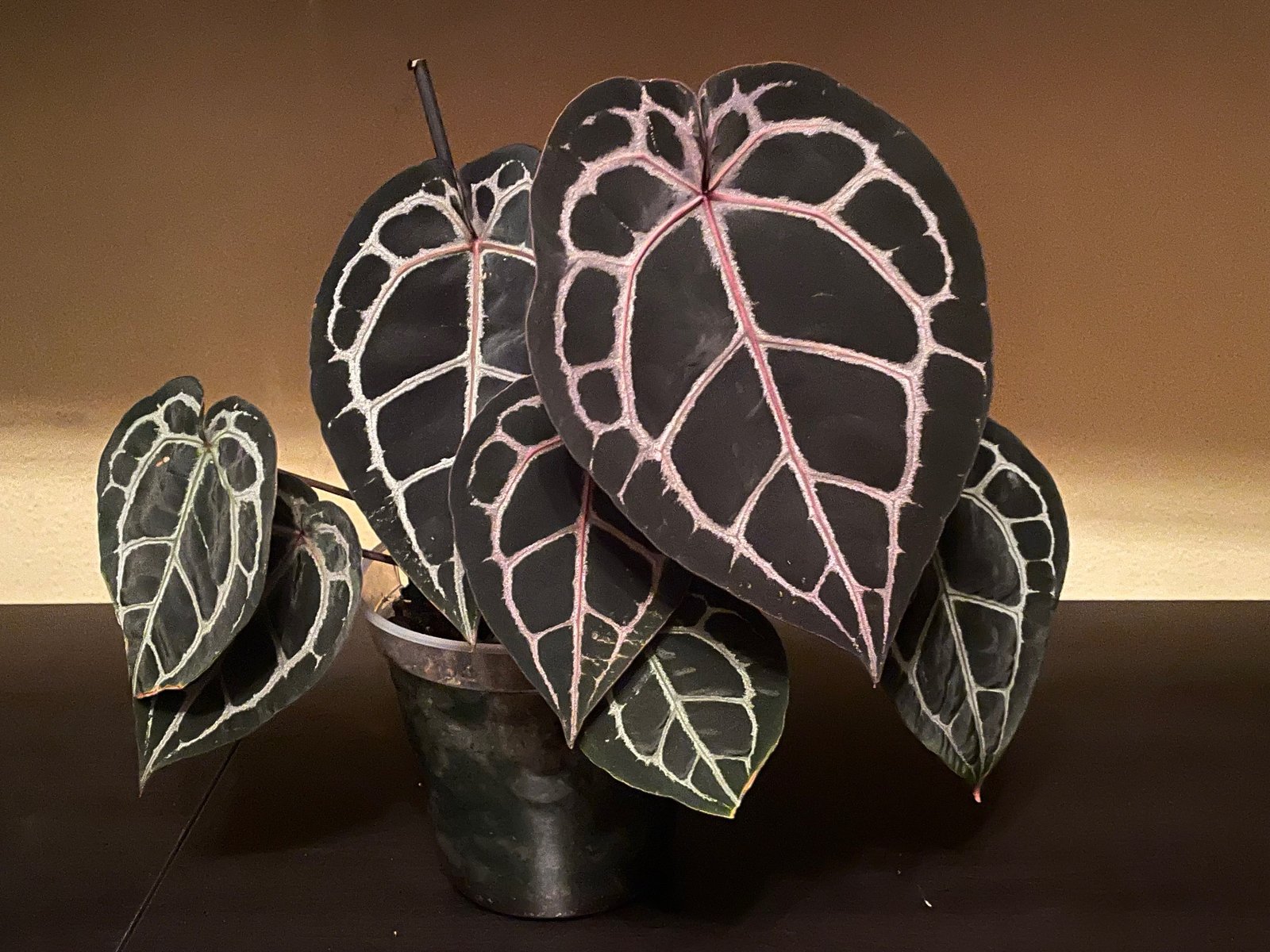
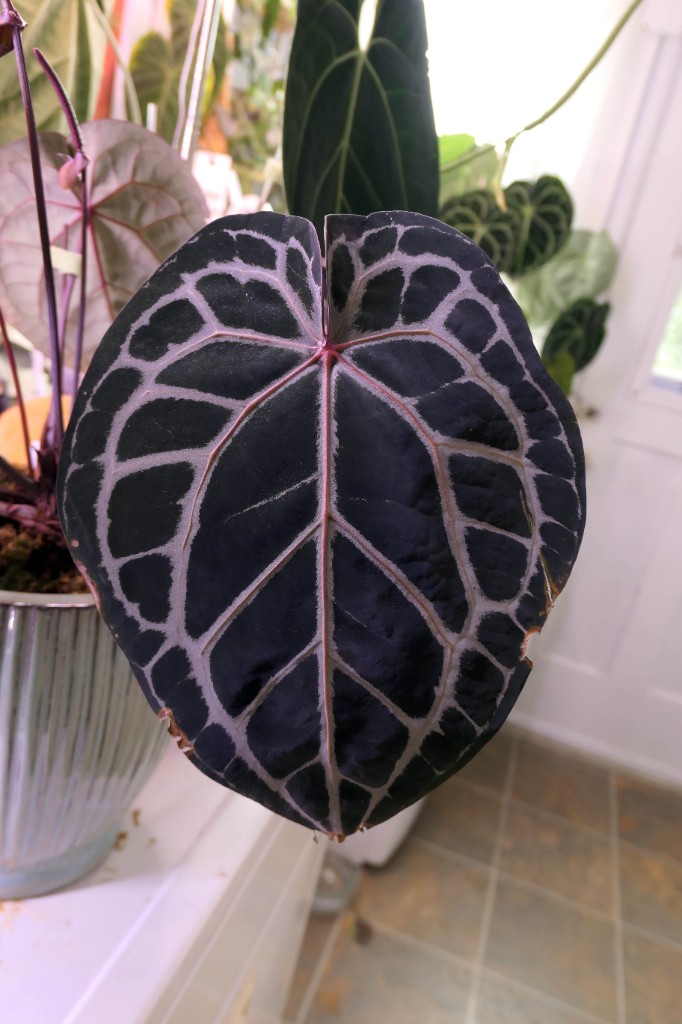
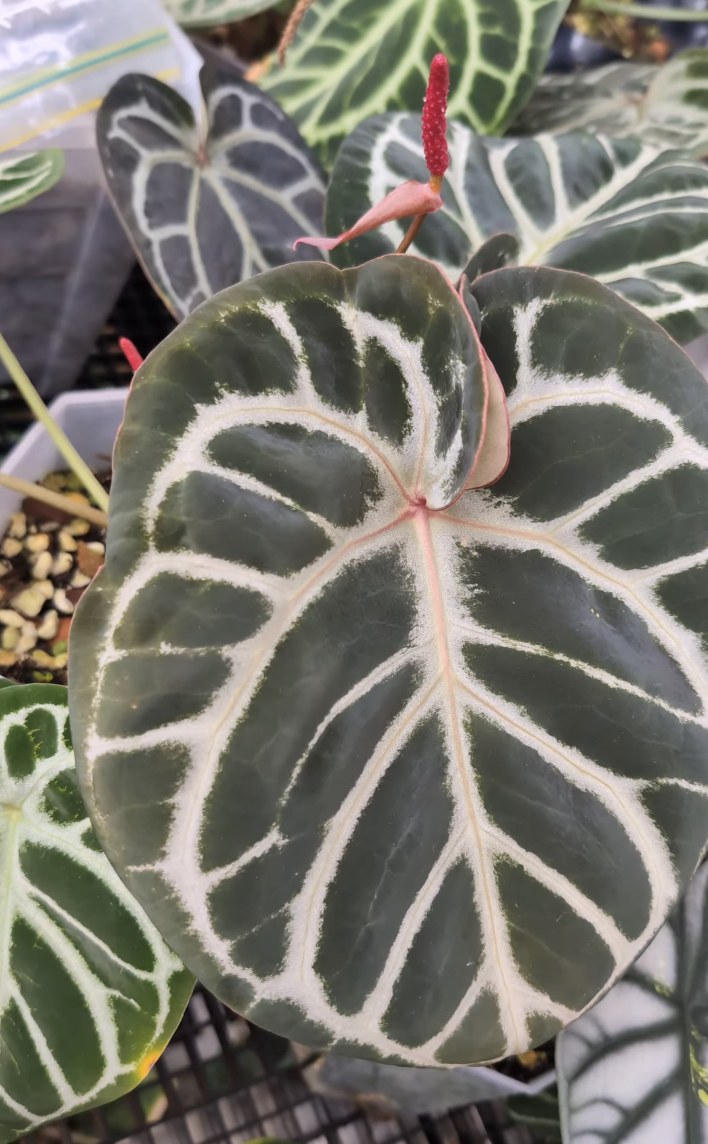
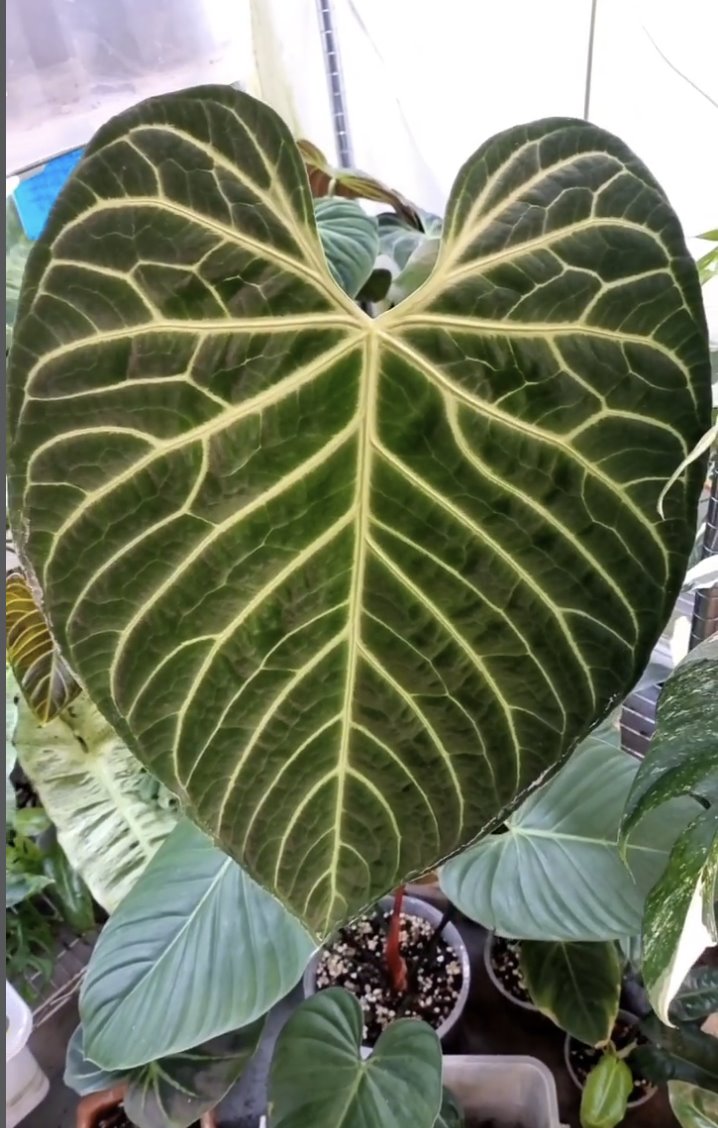
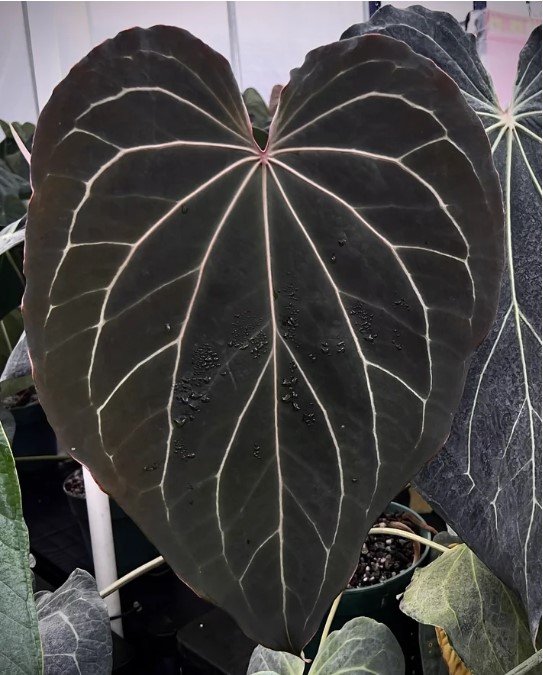
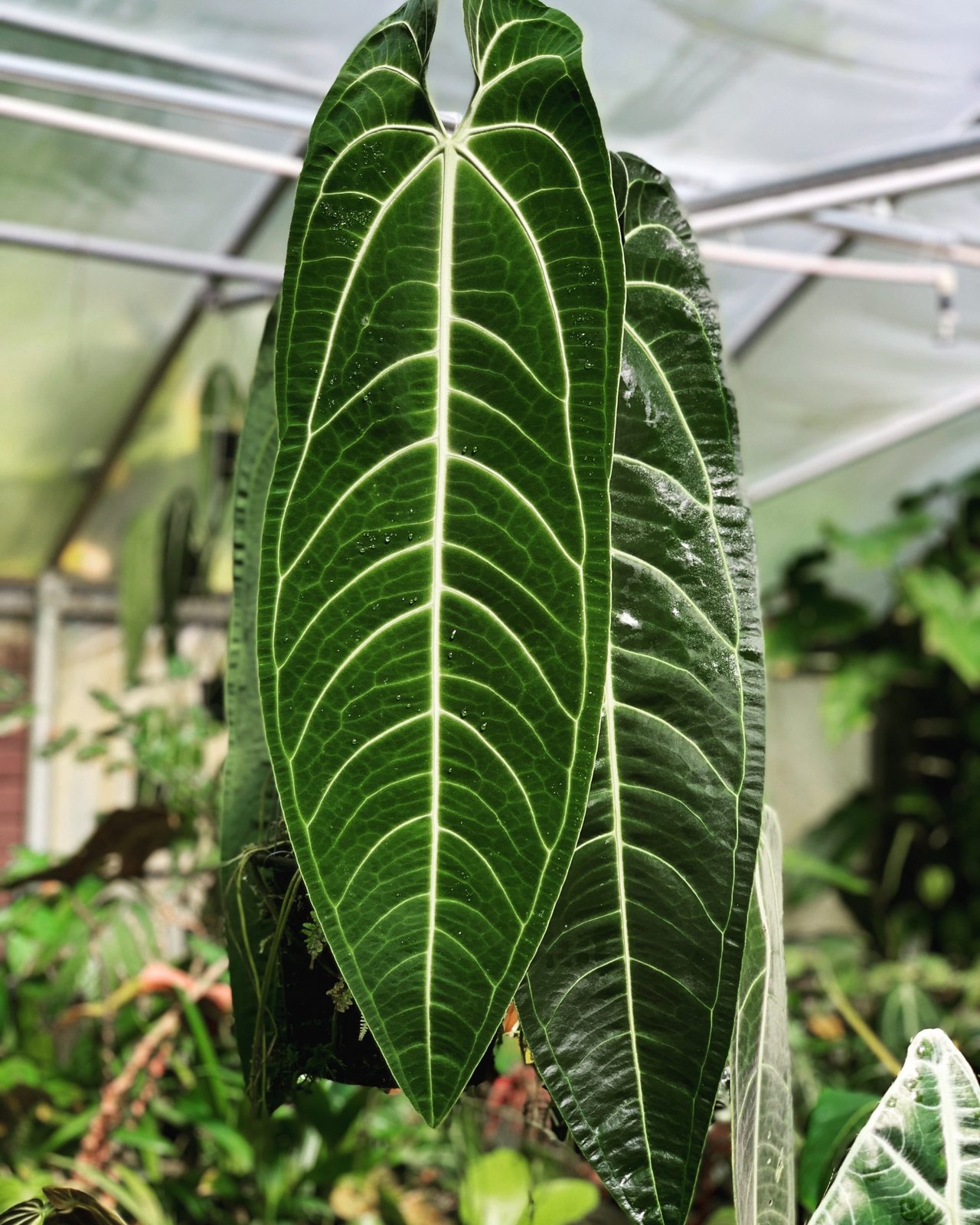
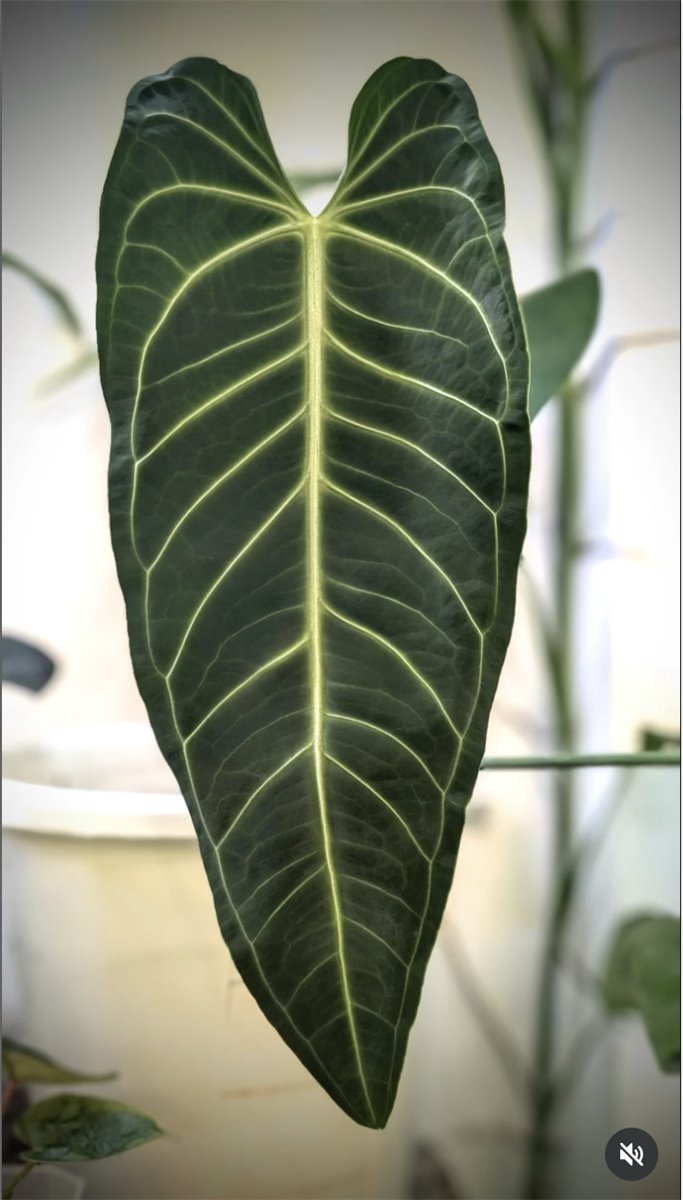
Veiny
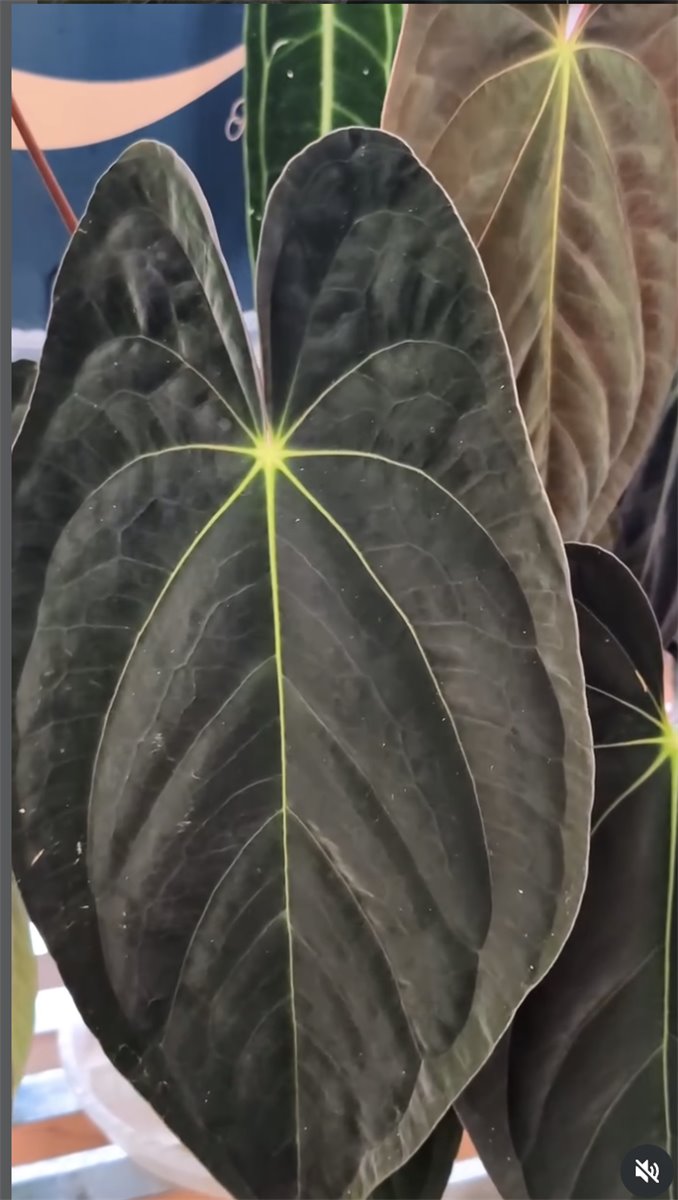
Veiny — Contrast Venation
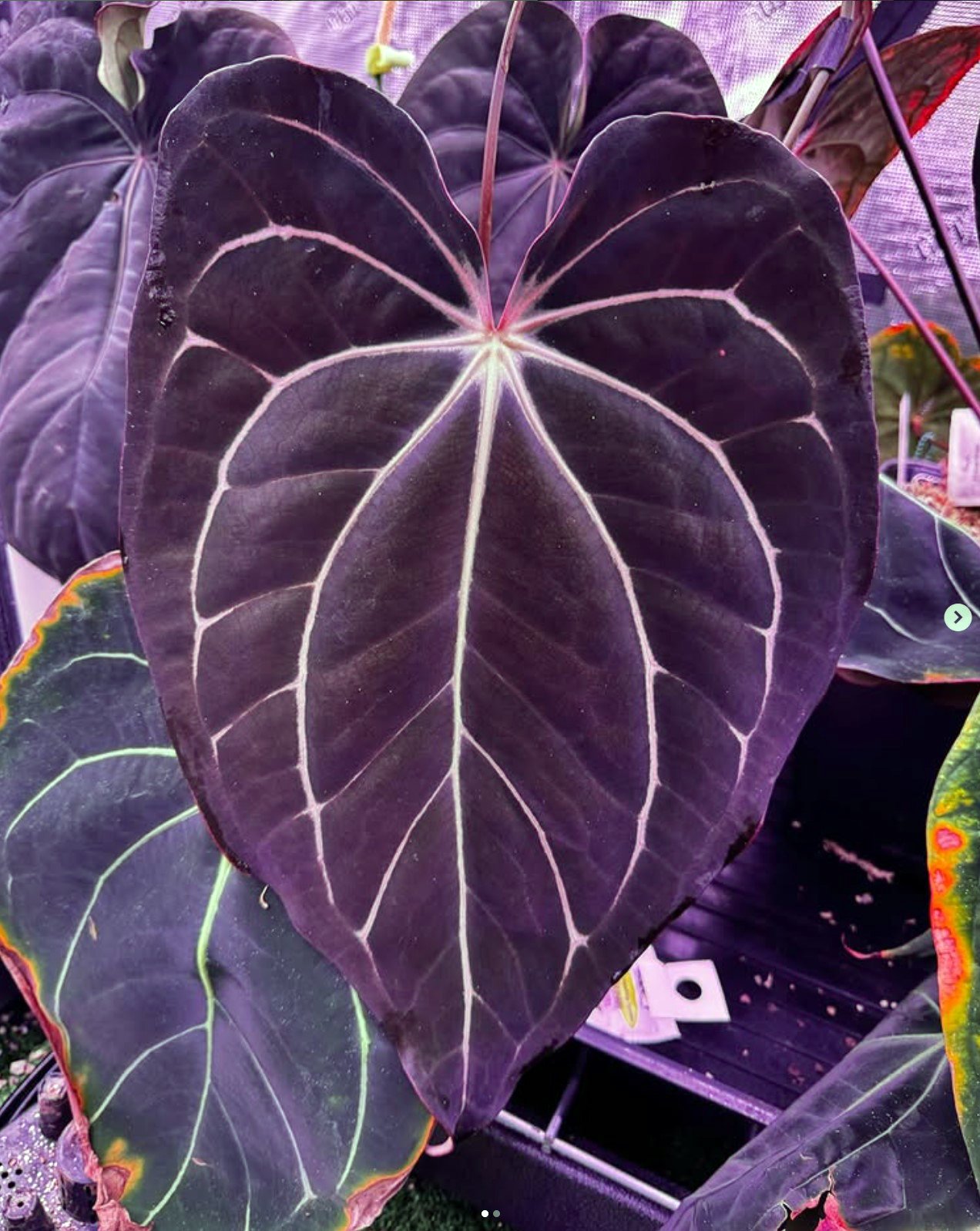
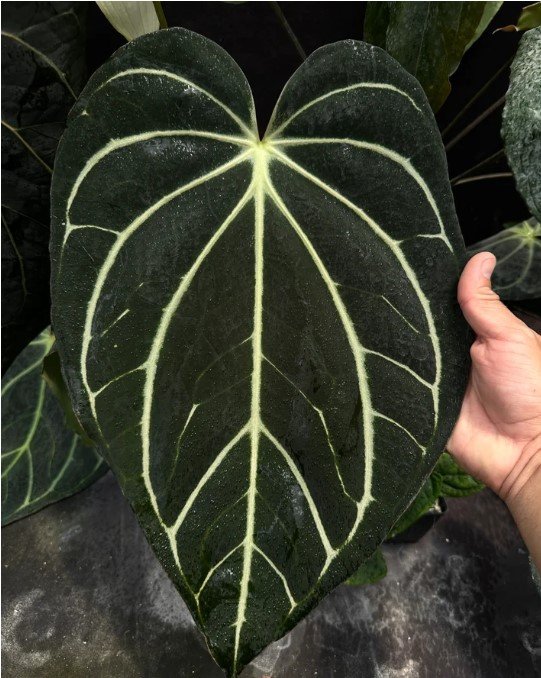
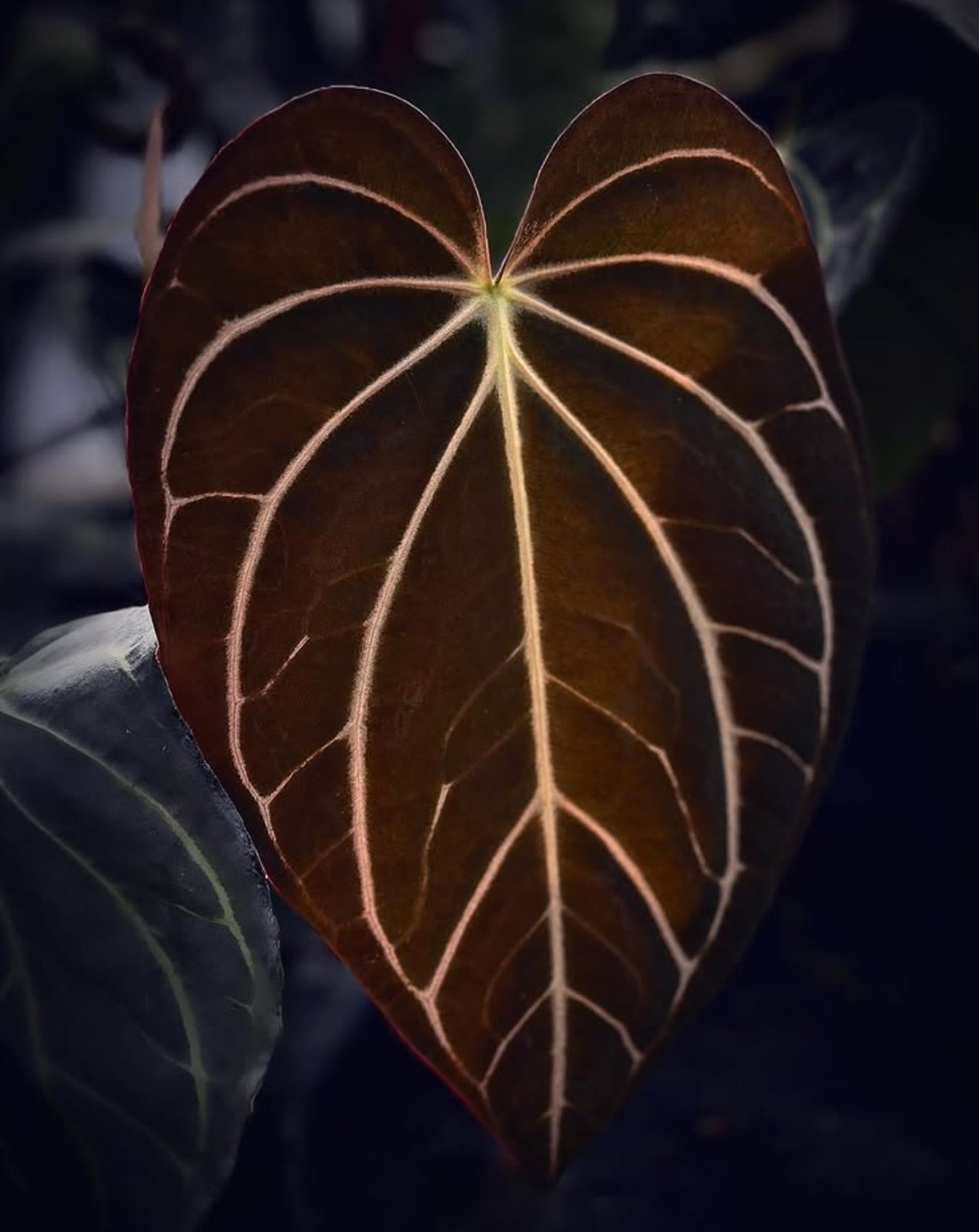
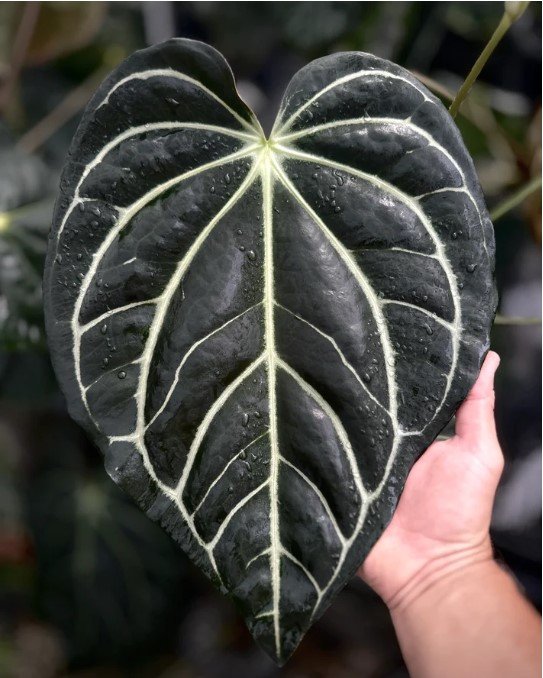
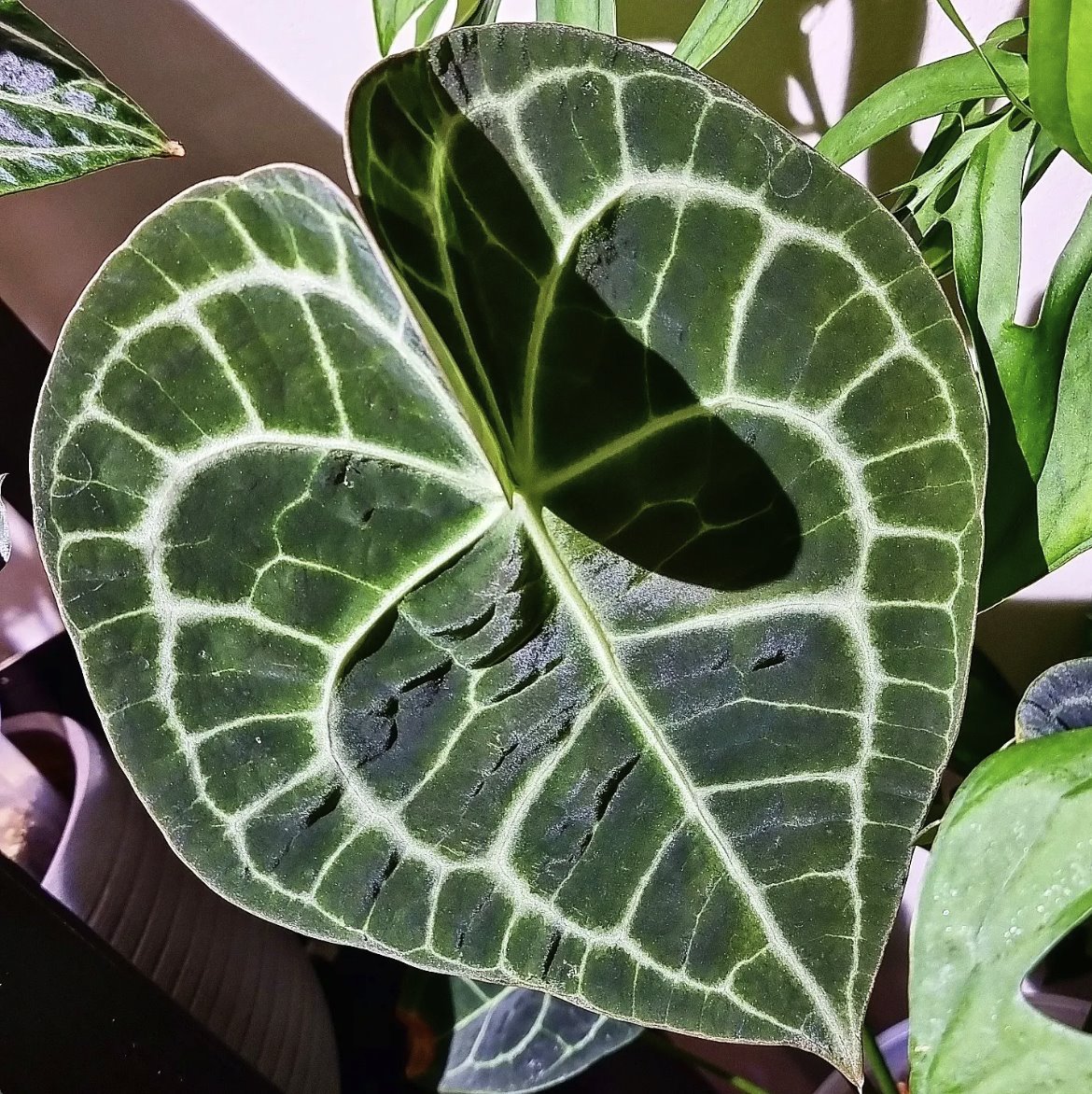
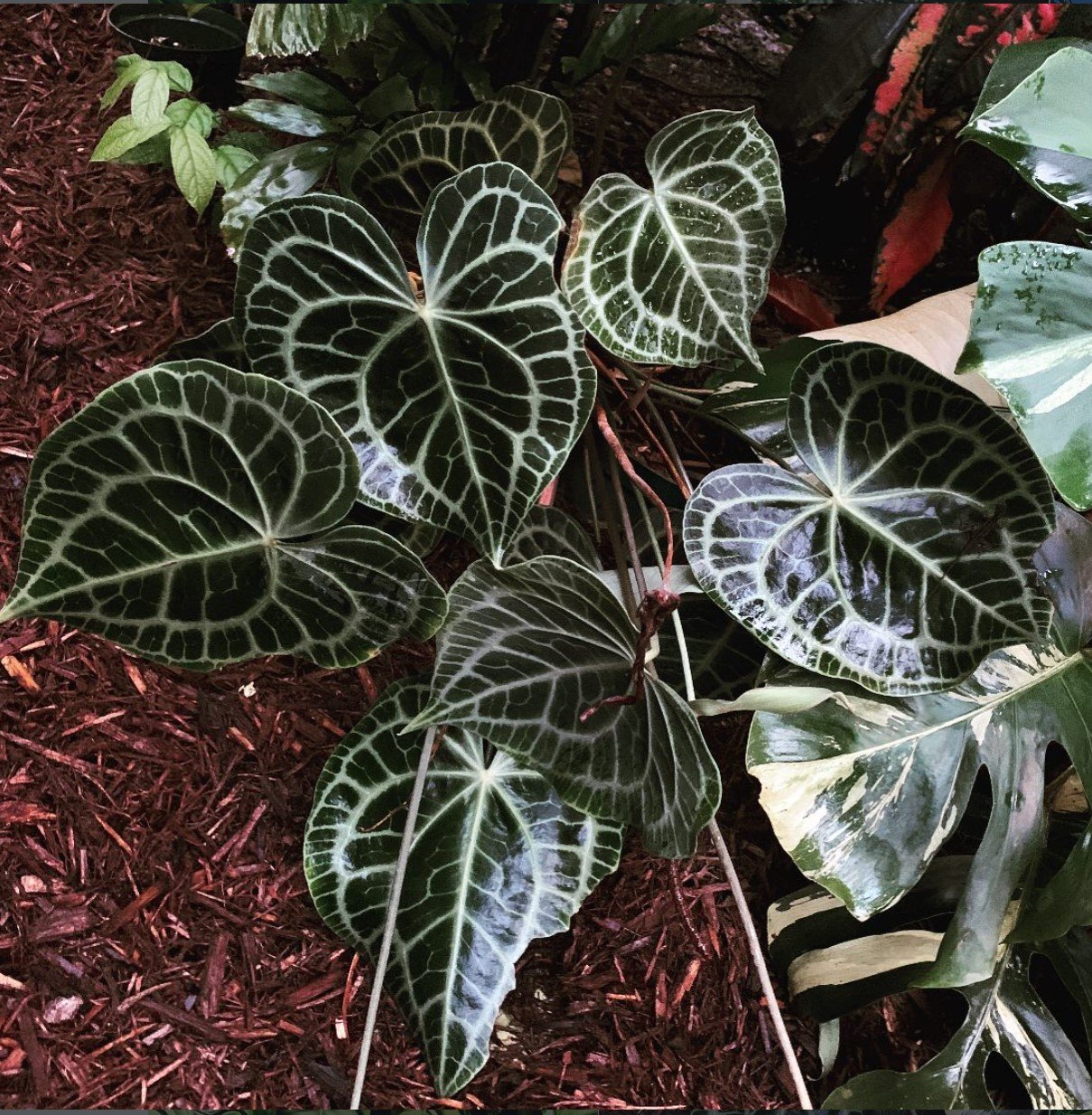
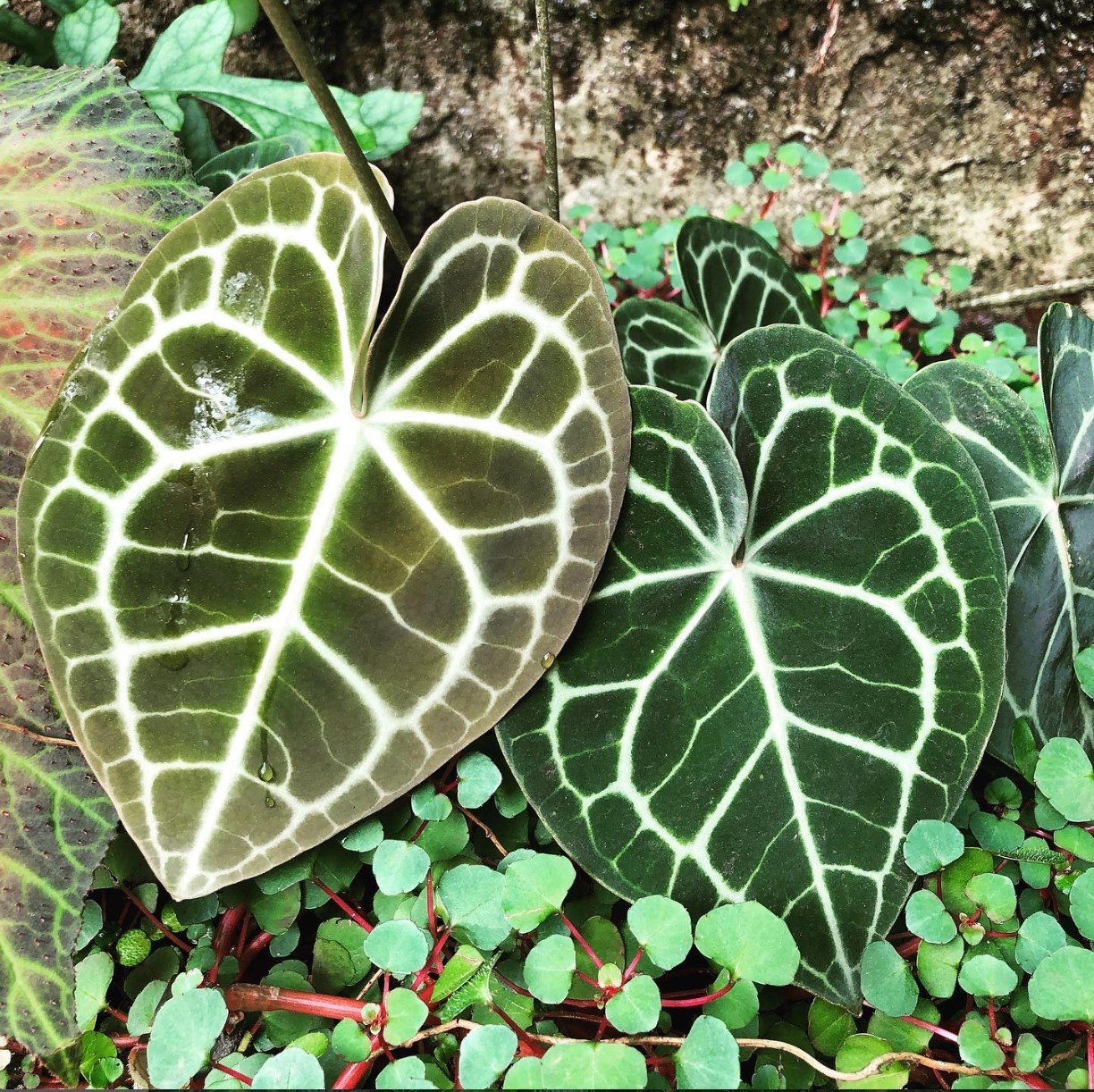
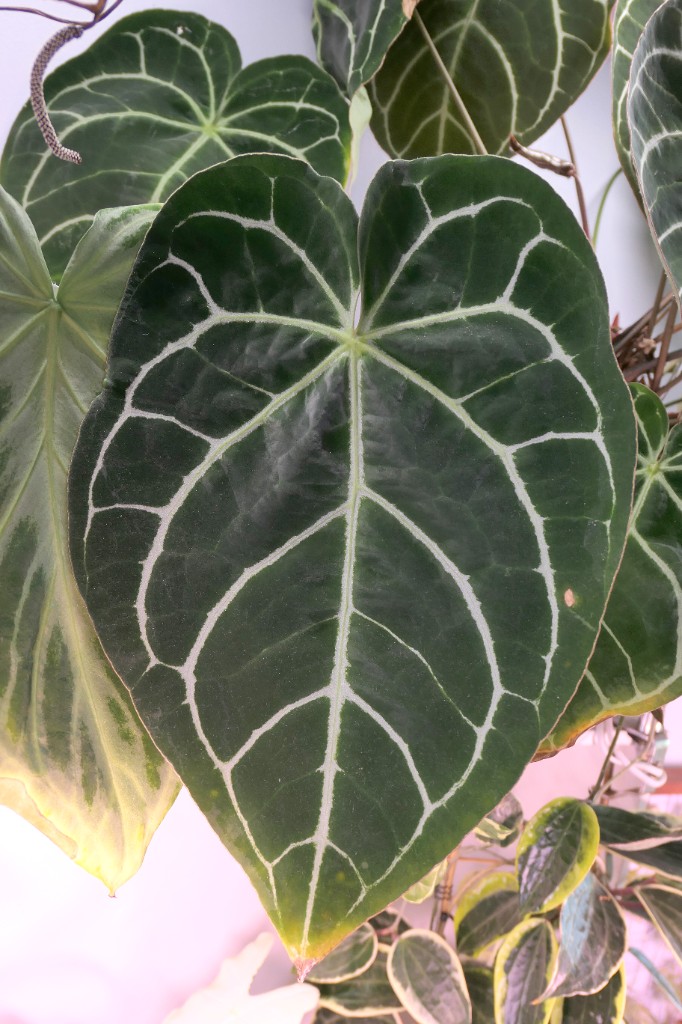
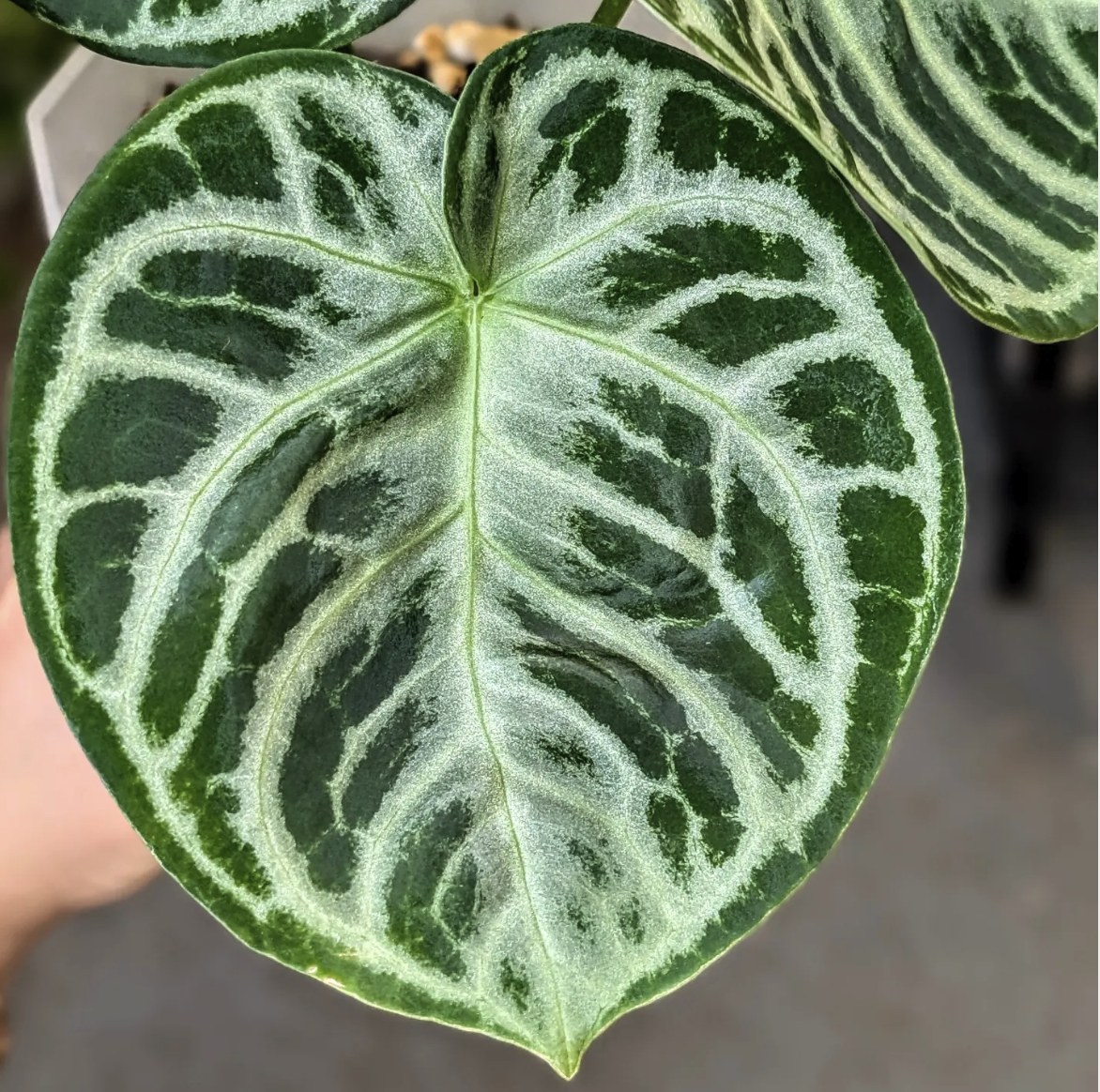
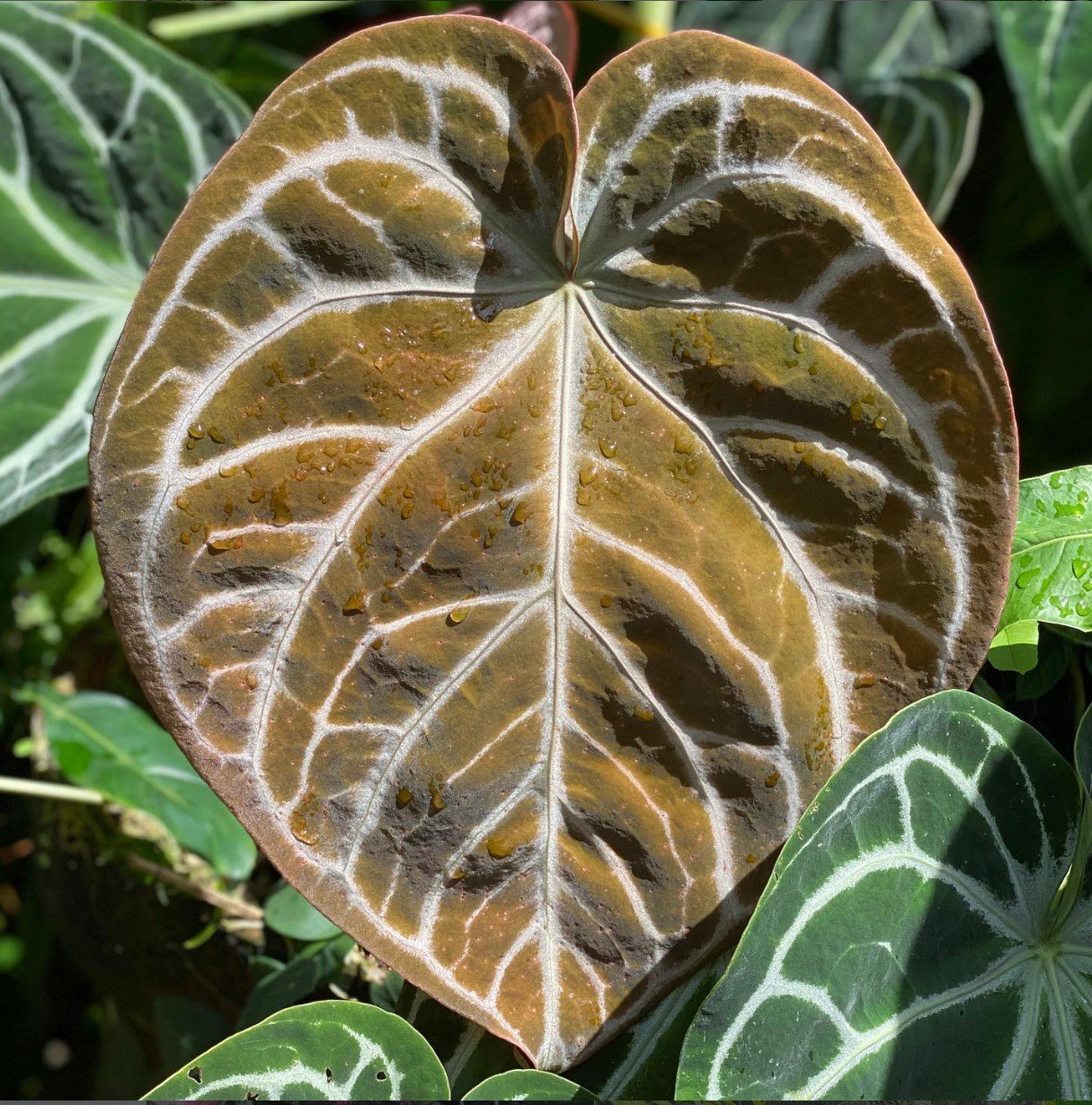
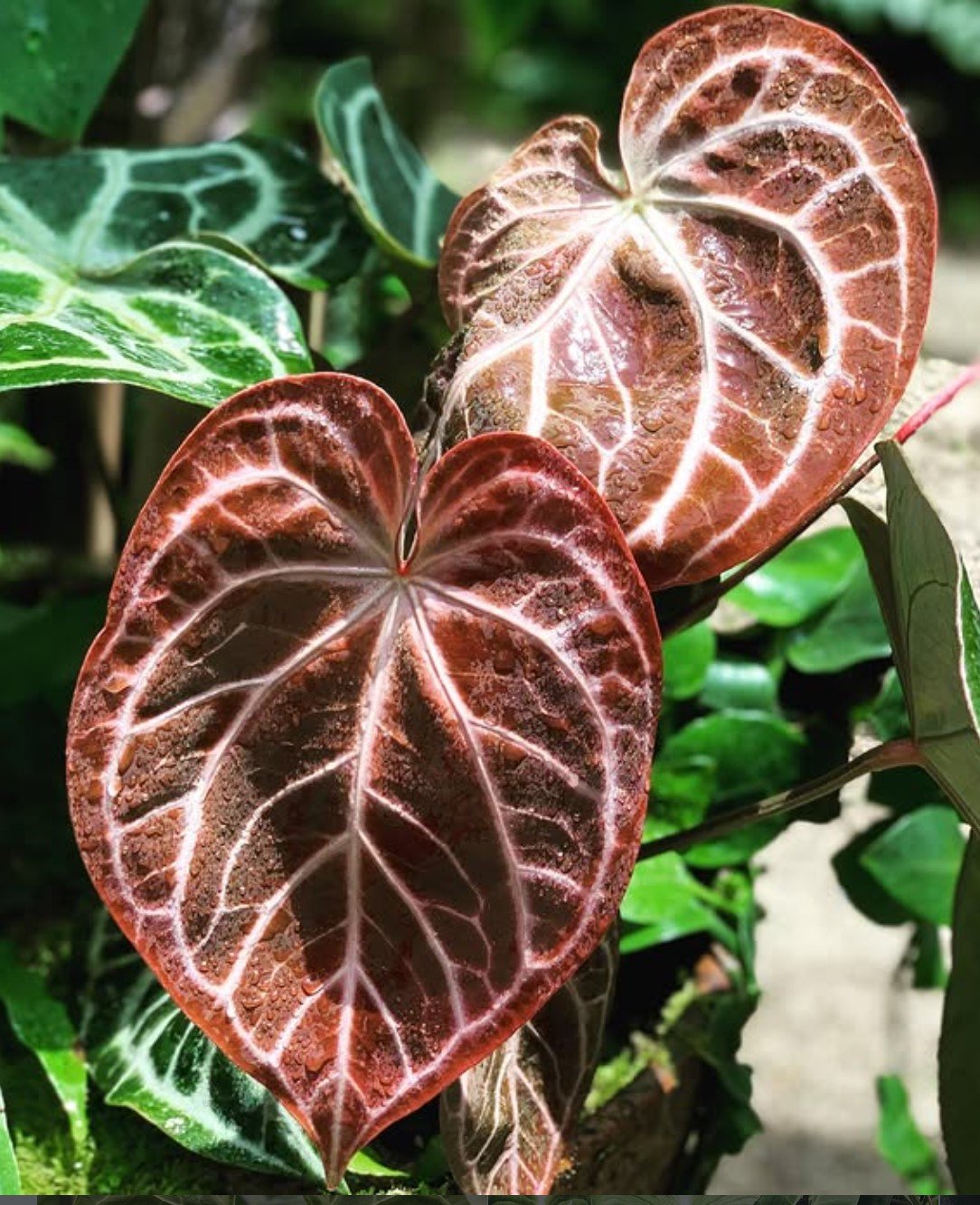
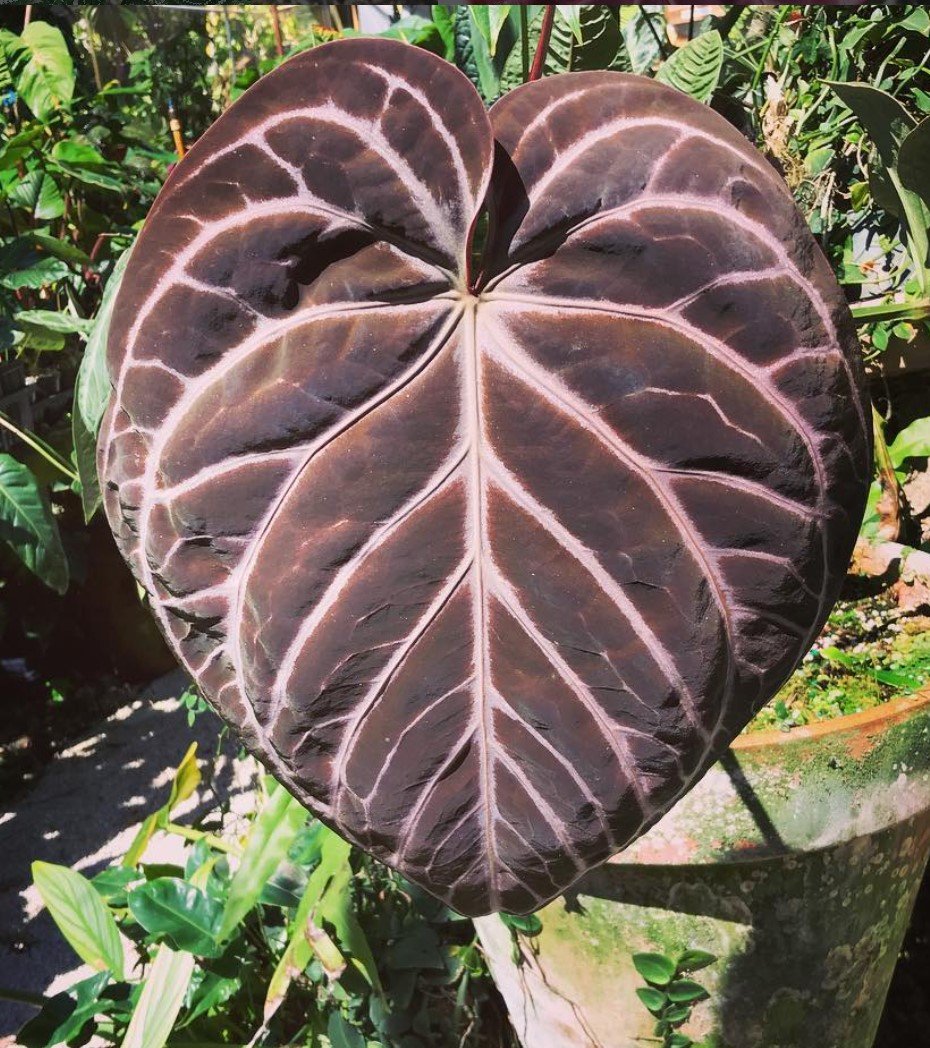
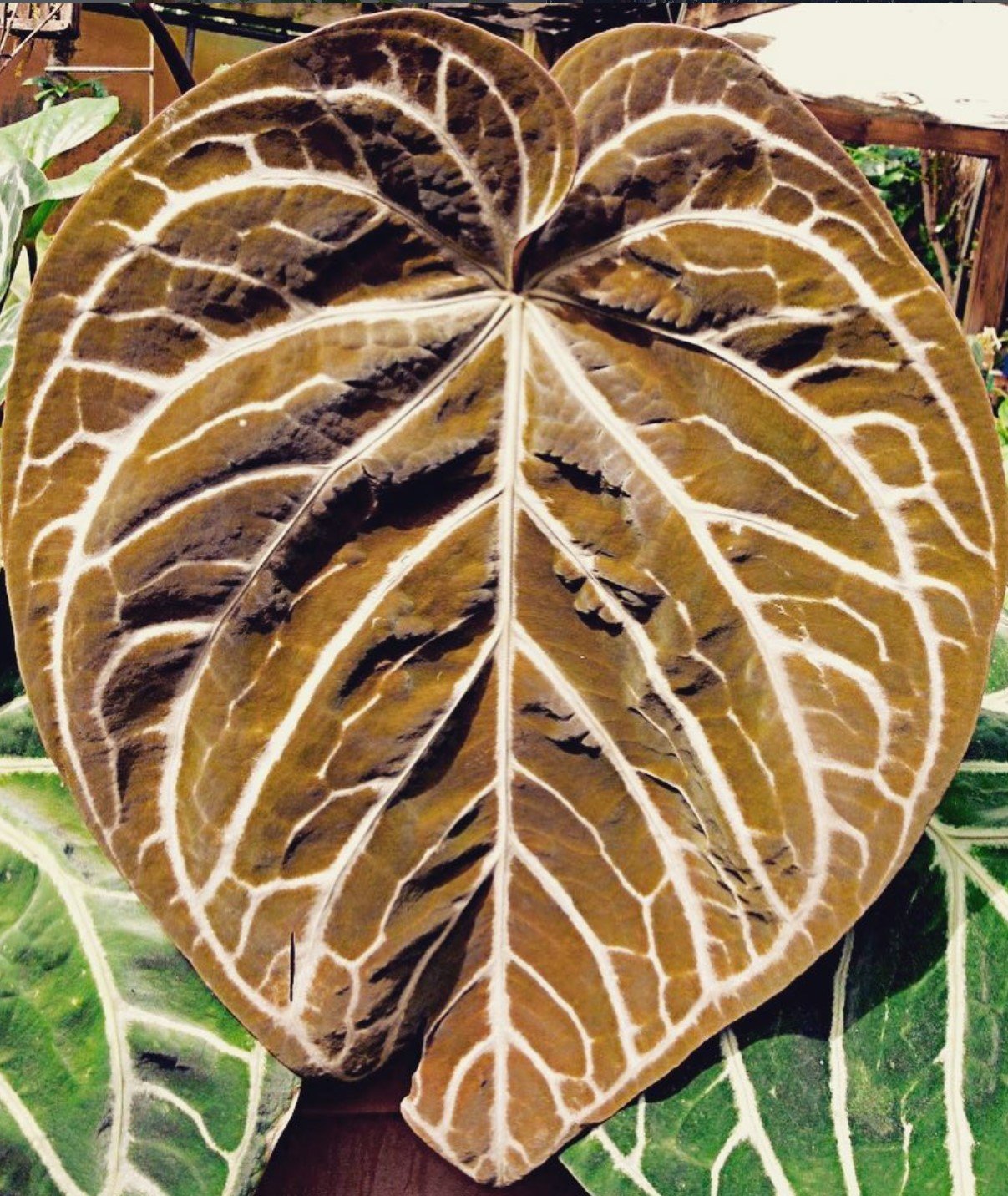
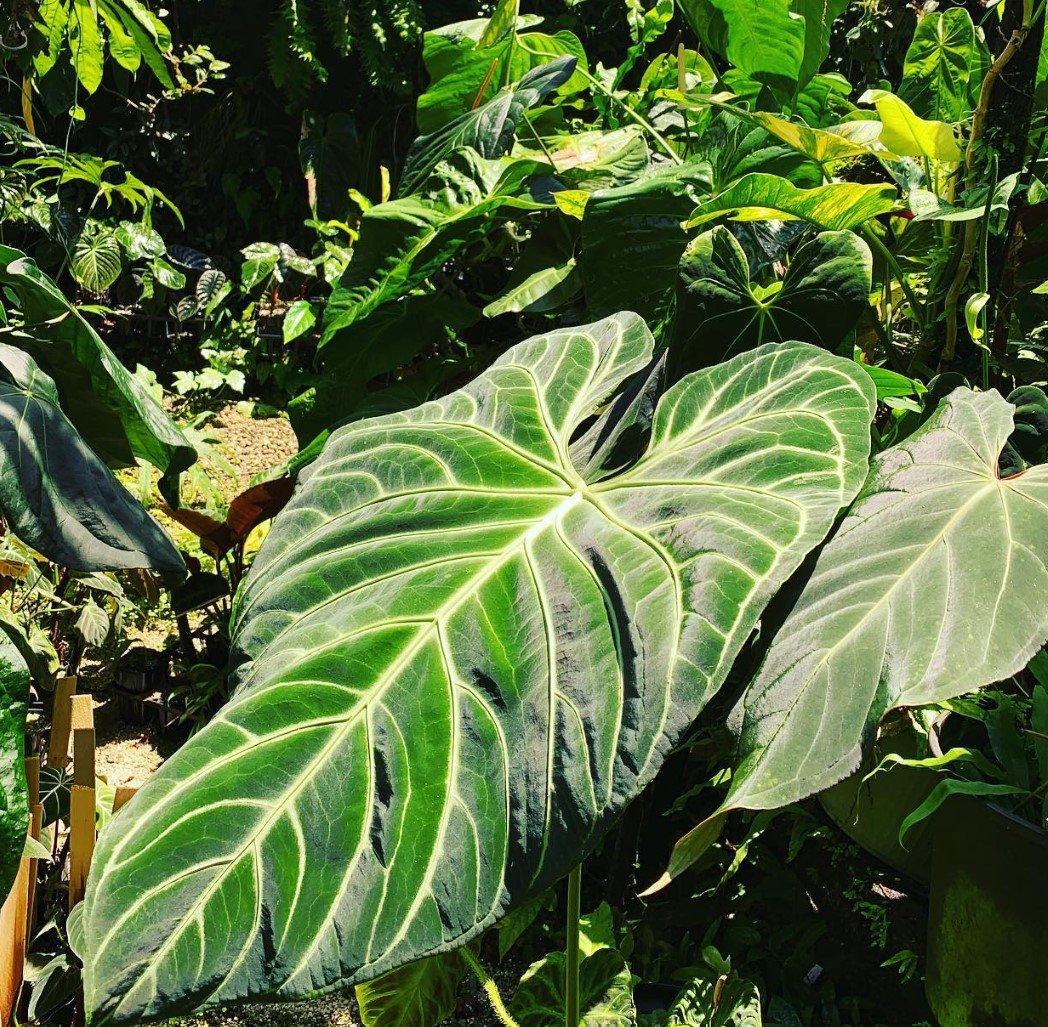
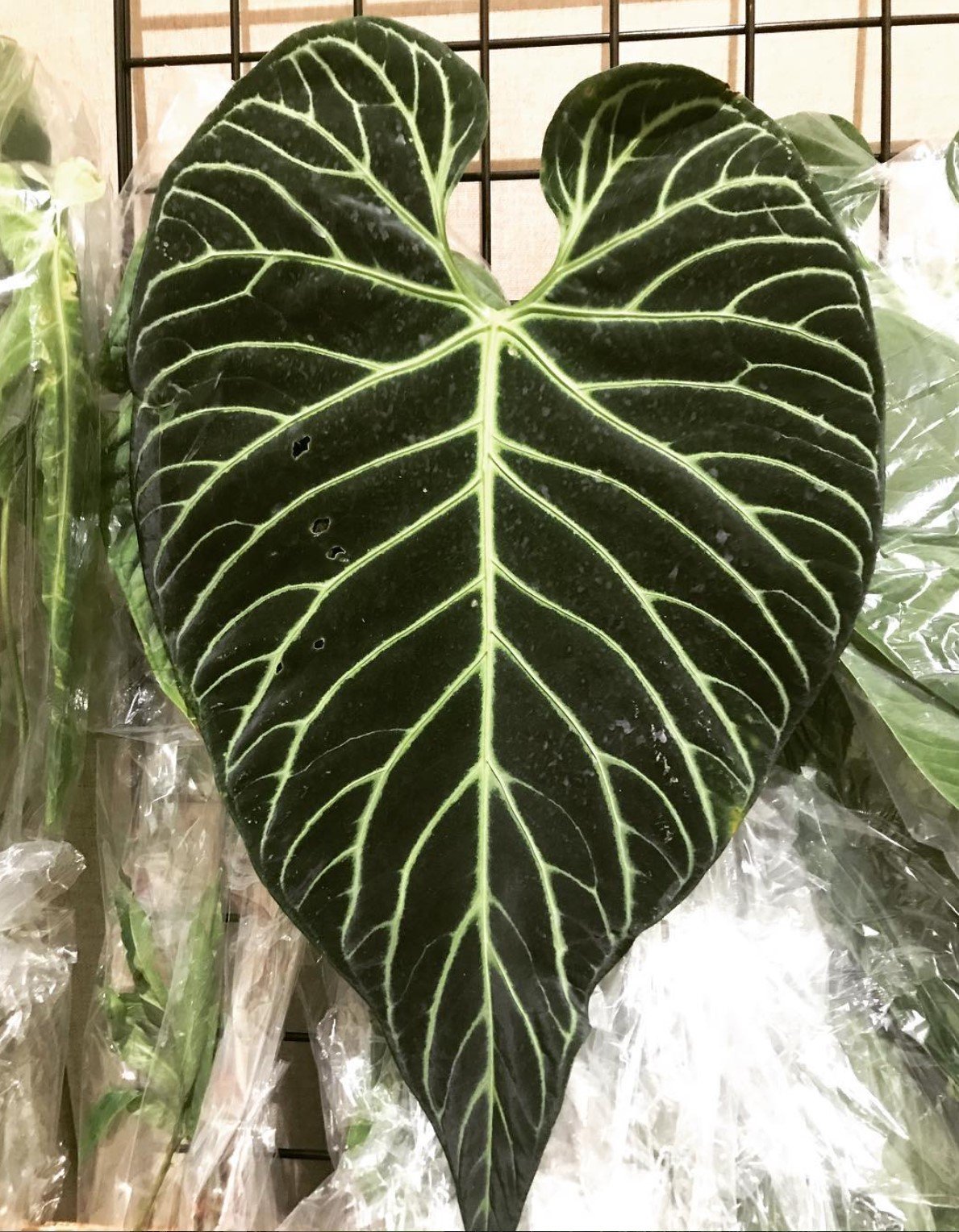
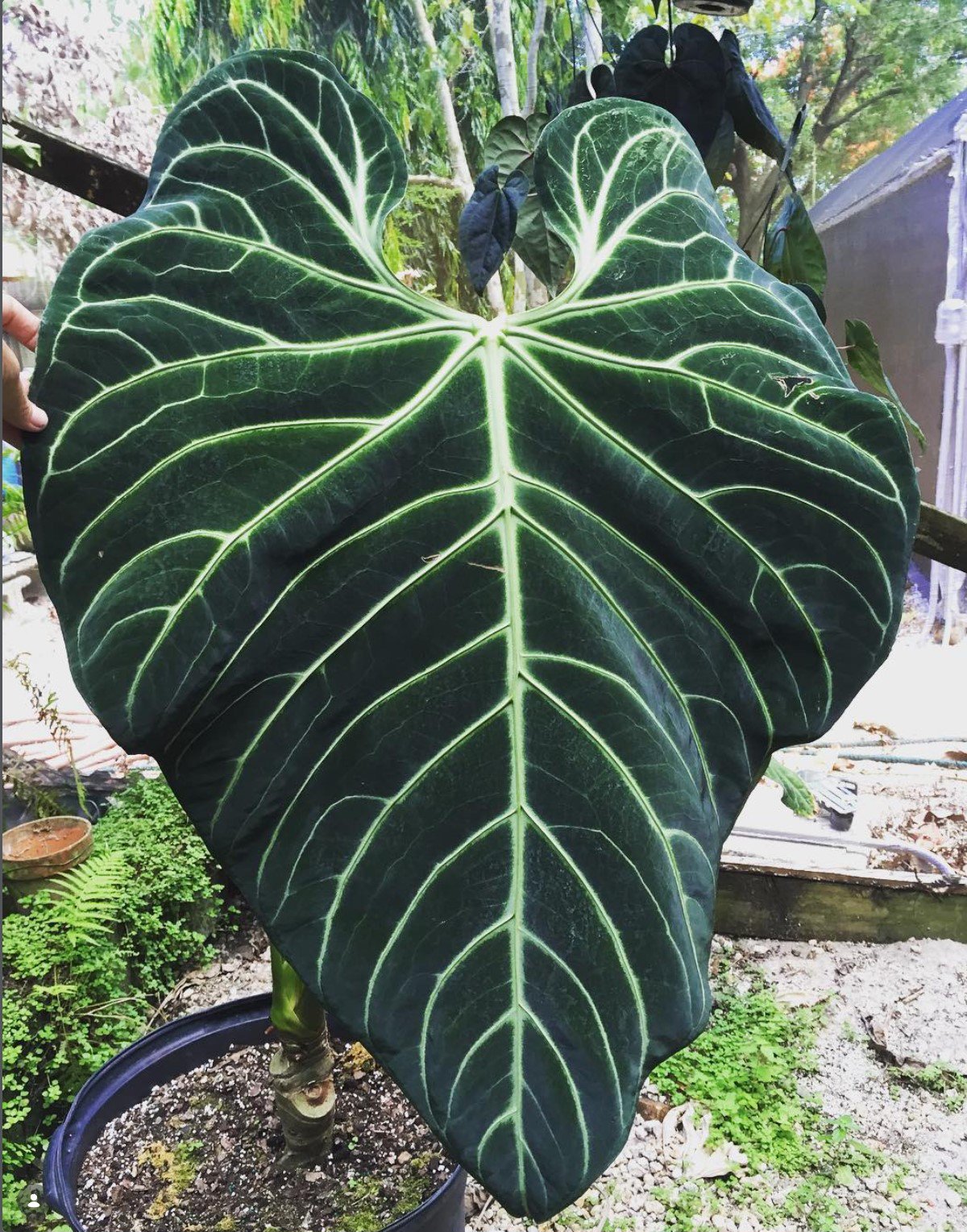
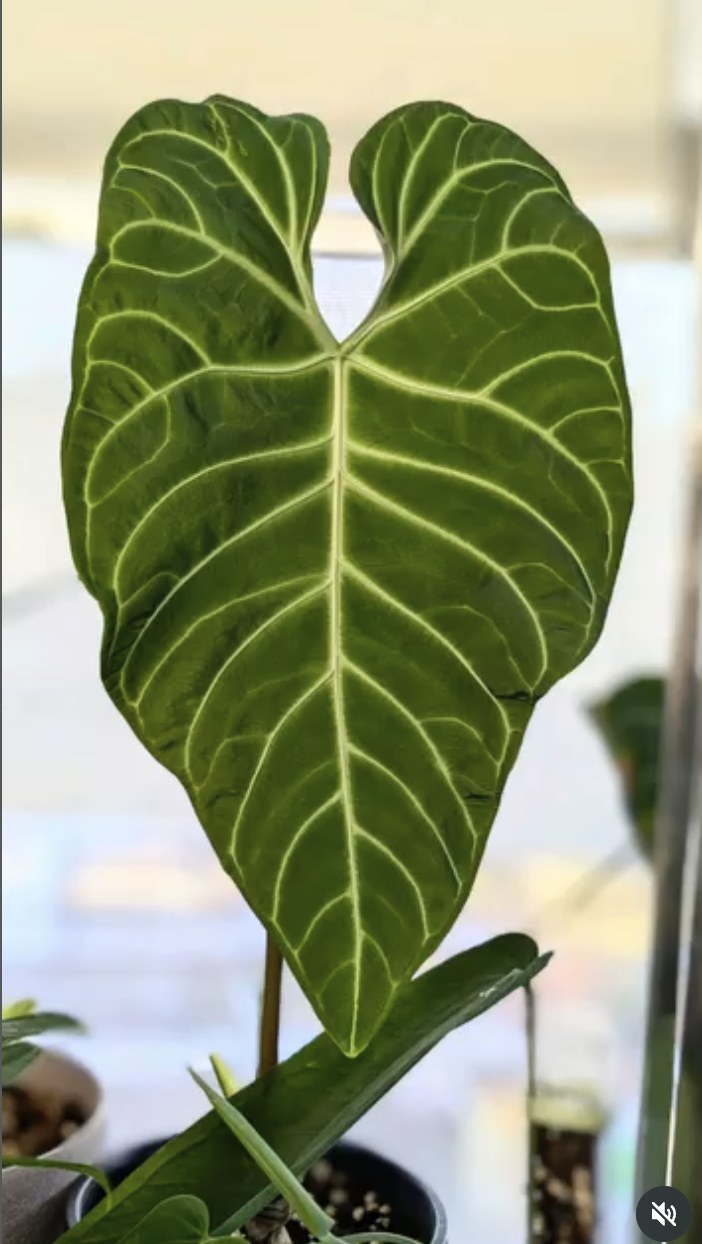
Dramatic contrast venation — bold pale veins on the
blade (clarinervium, crystallinum, forgetii,
magnificum, regale). Often on thicker stiff blades too, but
veiny tags the vein look — not cardboard/canvas hand-feel (see
Nomenclature).
Key idea: contrast veins
Veiny tags contrast veins only. Surface finish
(velvet / sub-velvet / canvas) and blade stiffness (cardboard) are separate —
see Leaf surface terms.
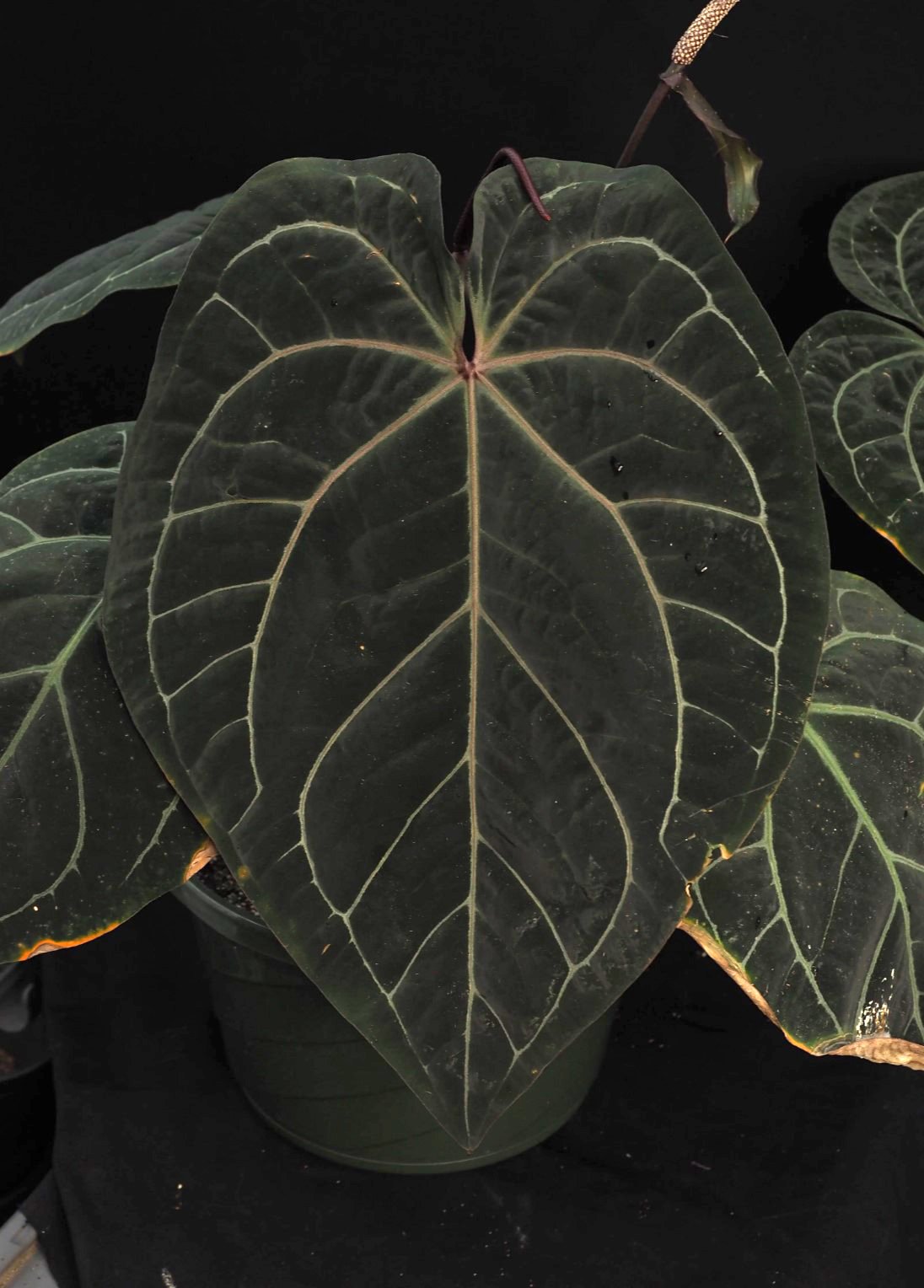
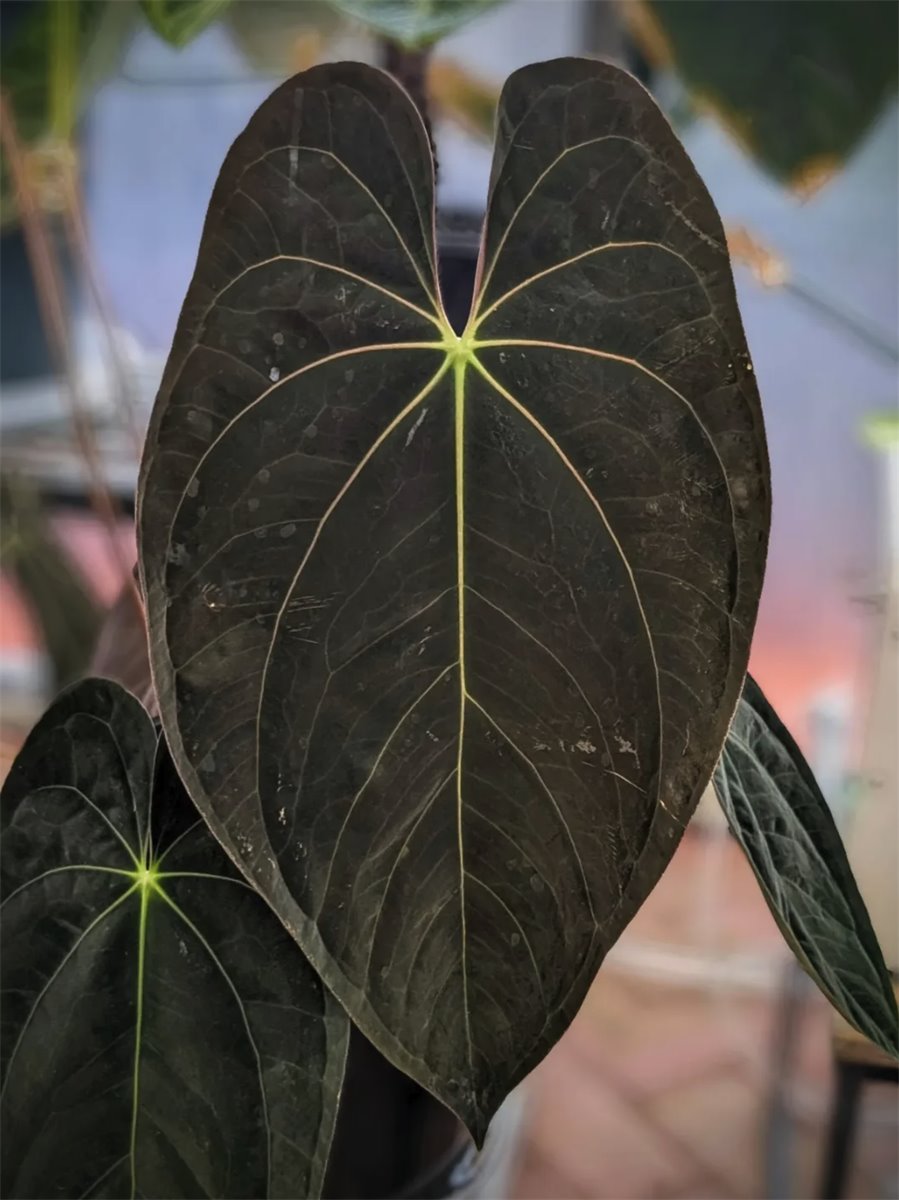
Dark
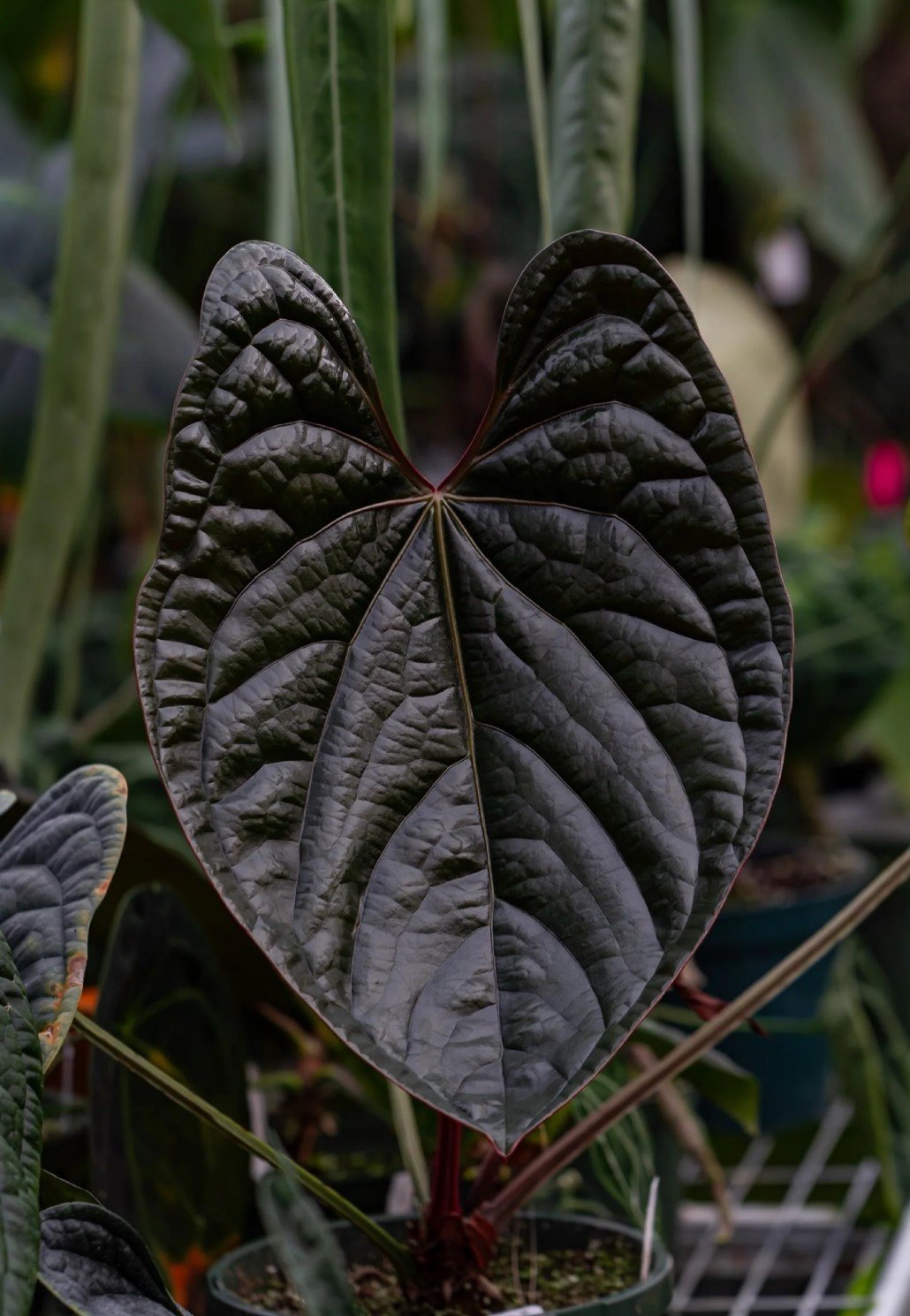
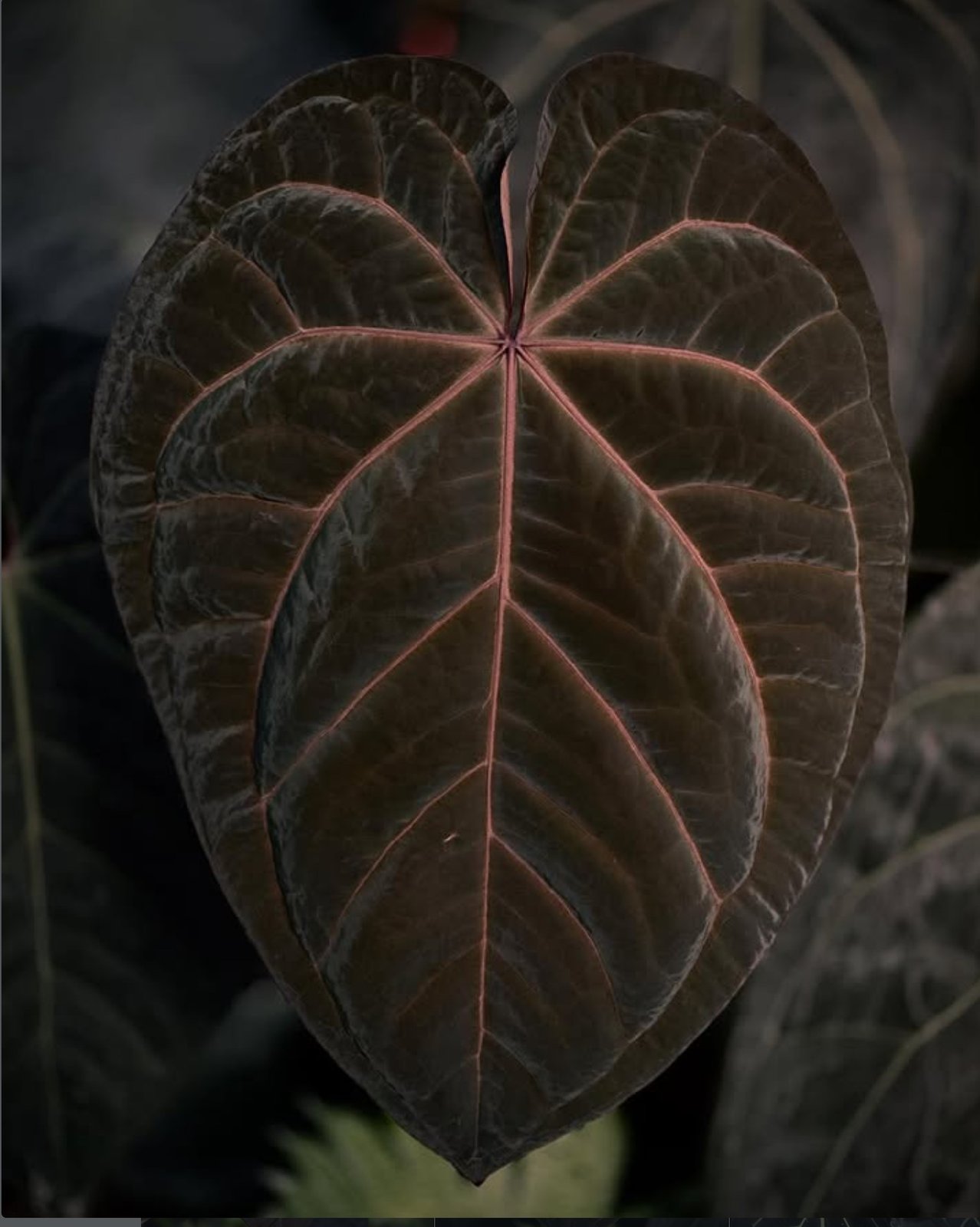
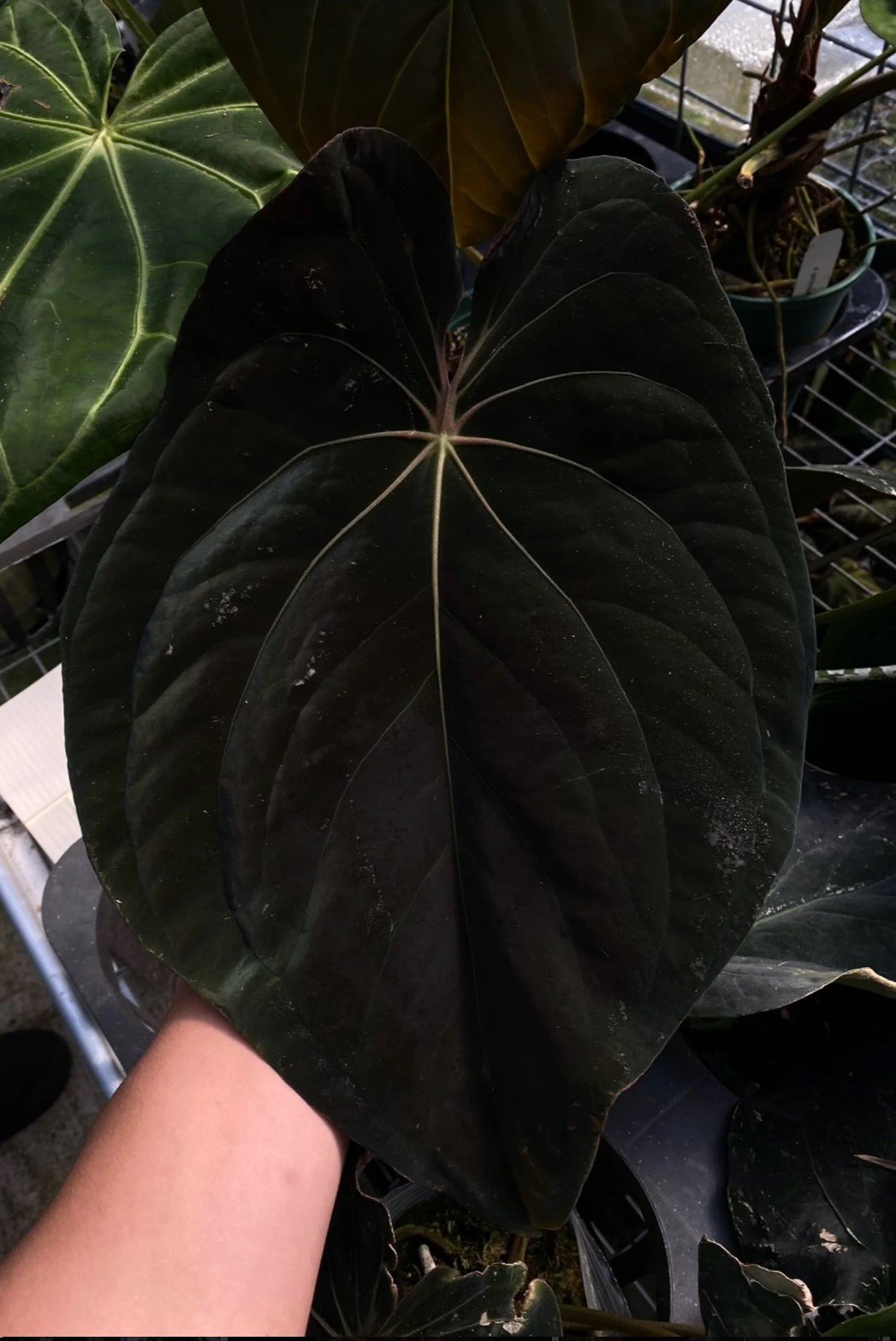
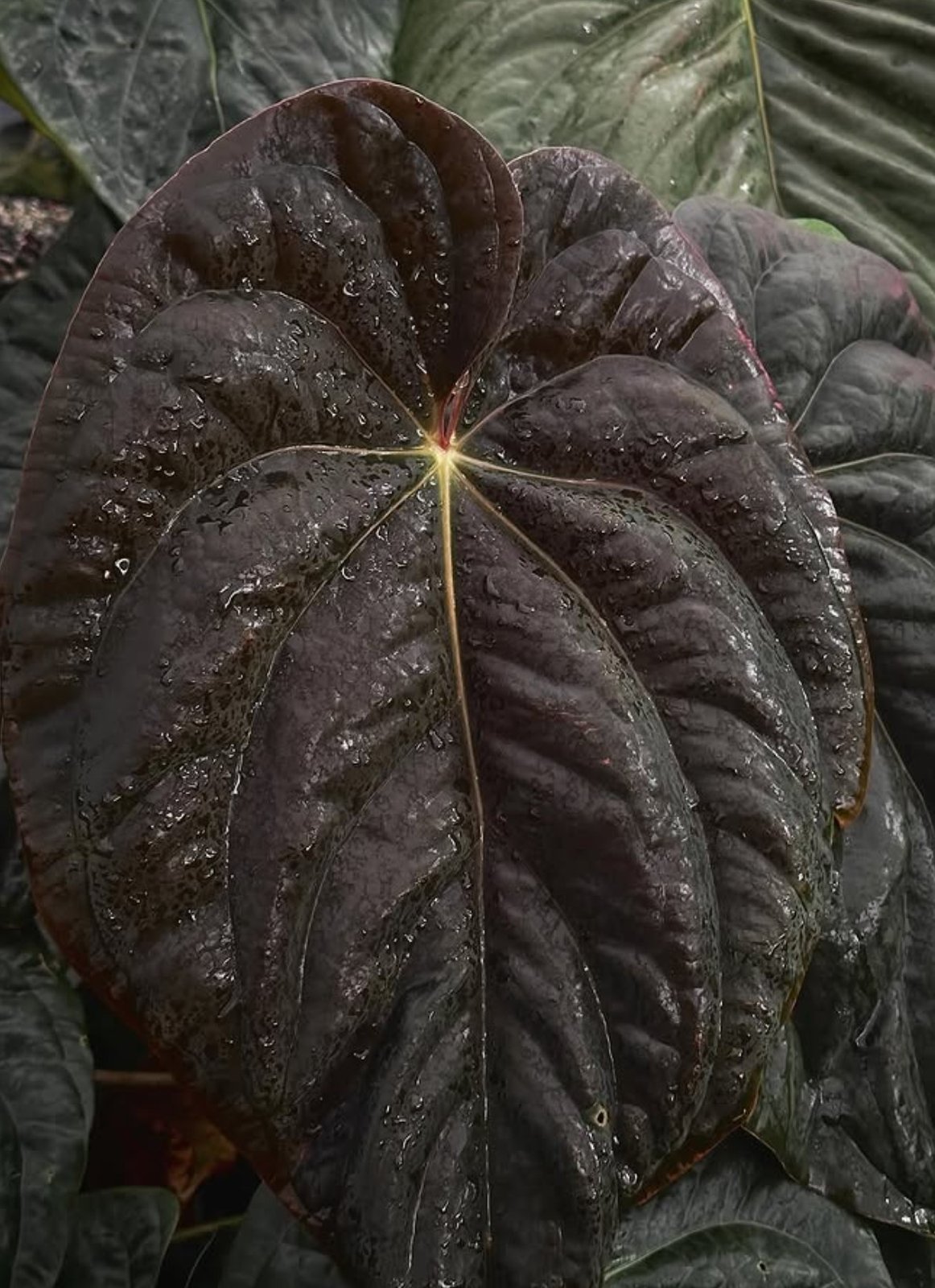
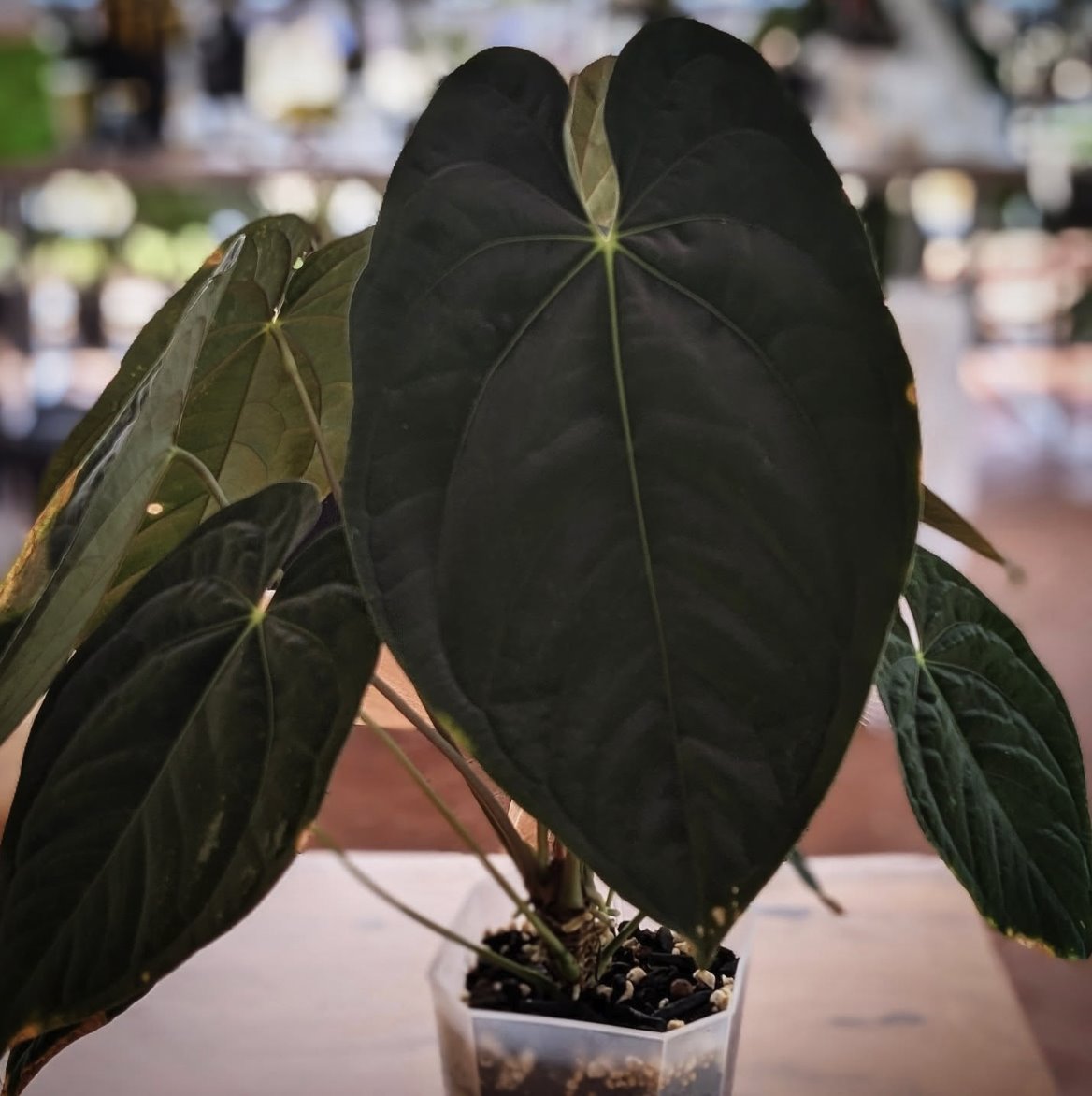
Dark — Velvet & Near-Black
Velvety blacks and chocolate browns. Papillilaminum, dressleri, warocqueanum, antolakii, and many
hybrids fall here.
Key idea: near-black velvets
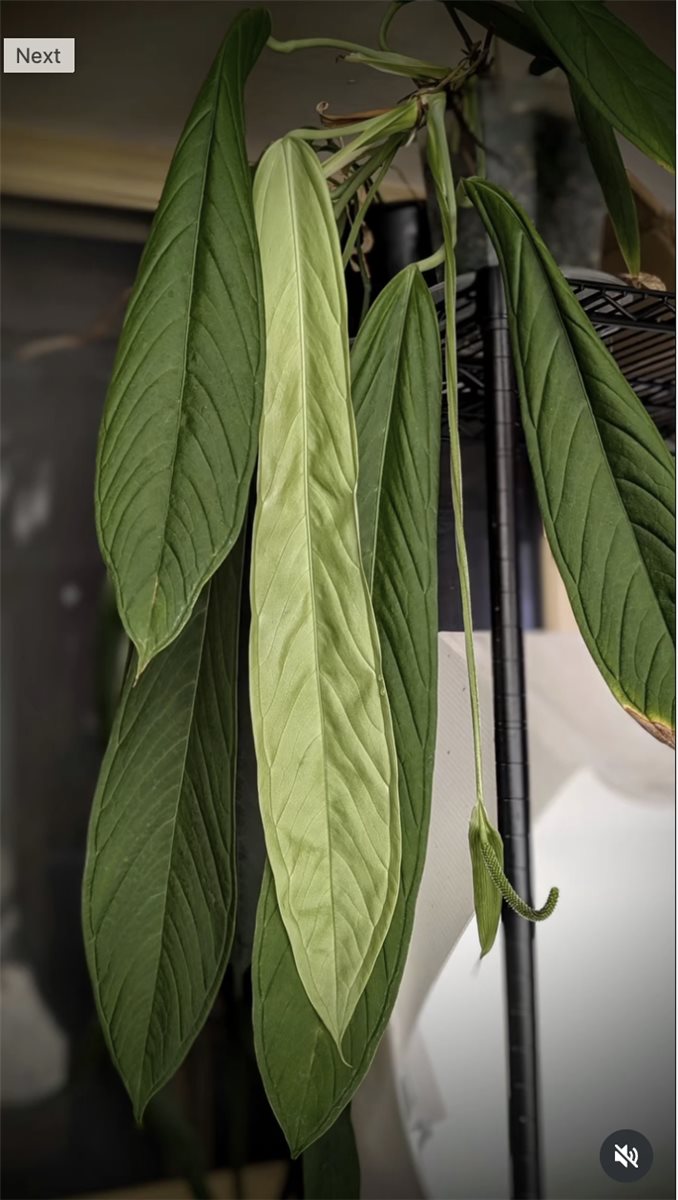
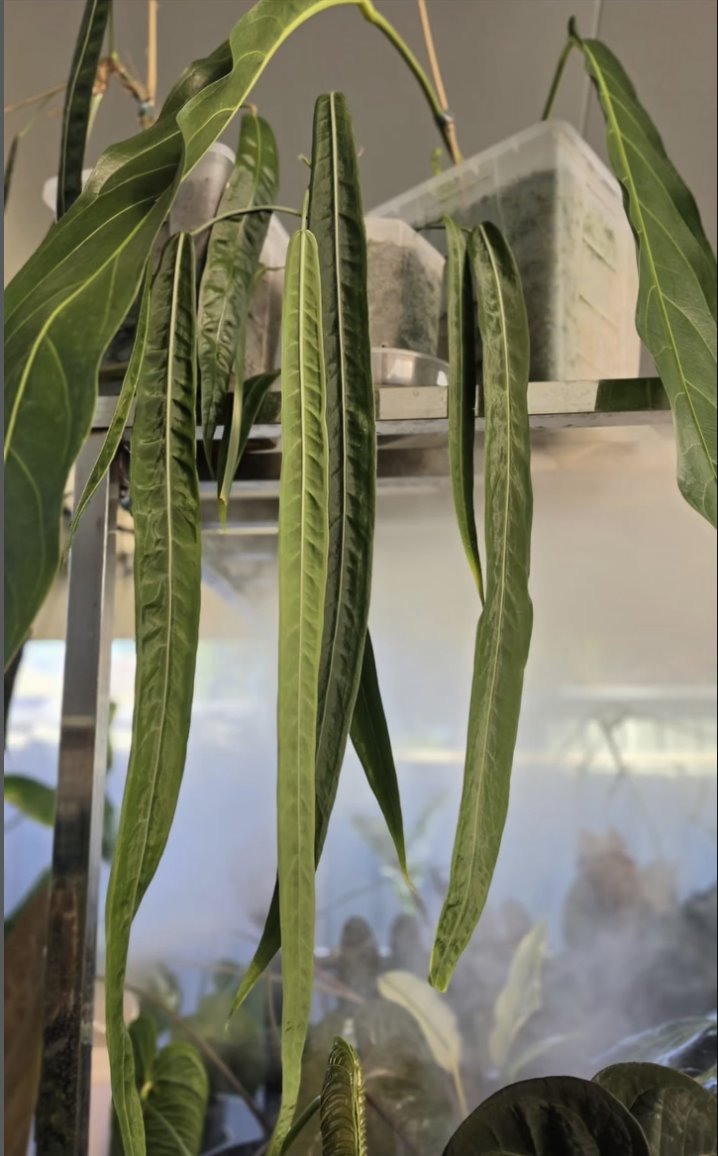
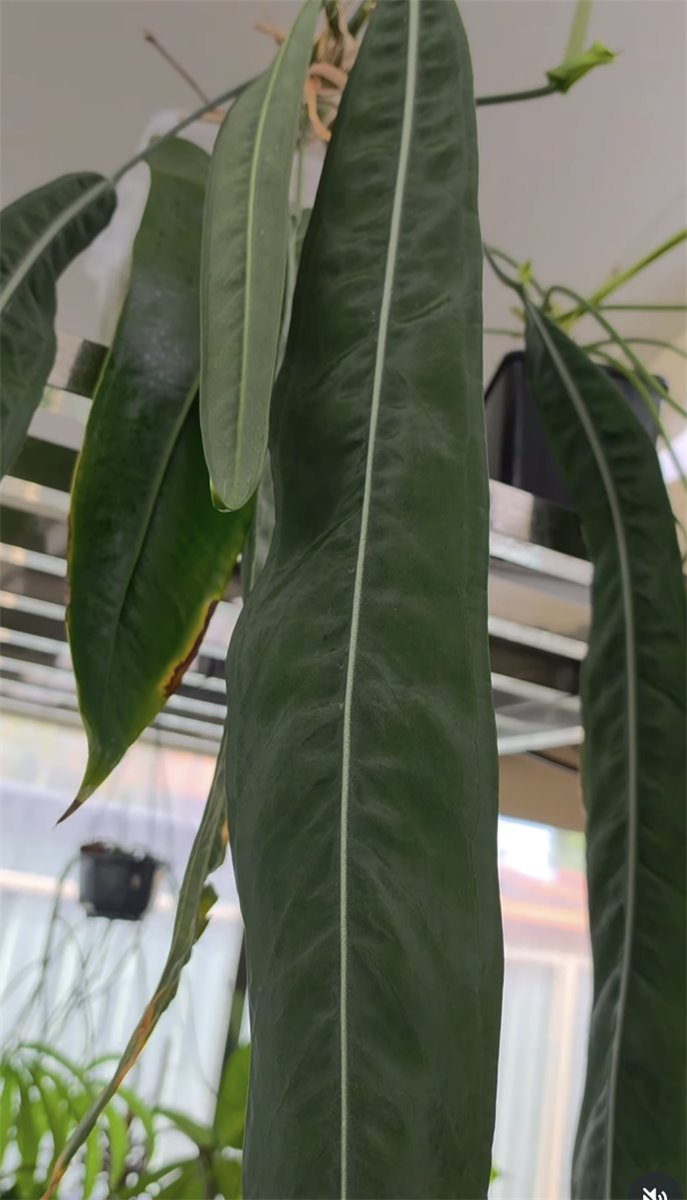
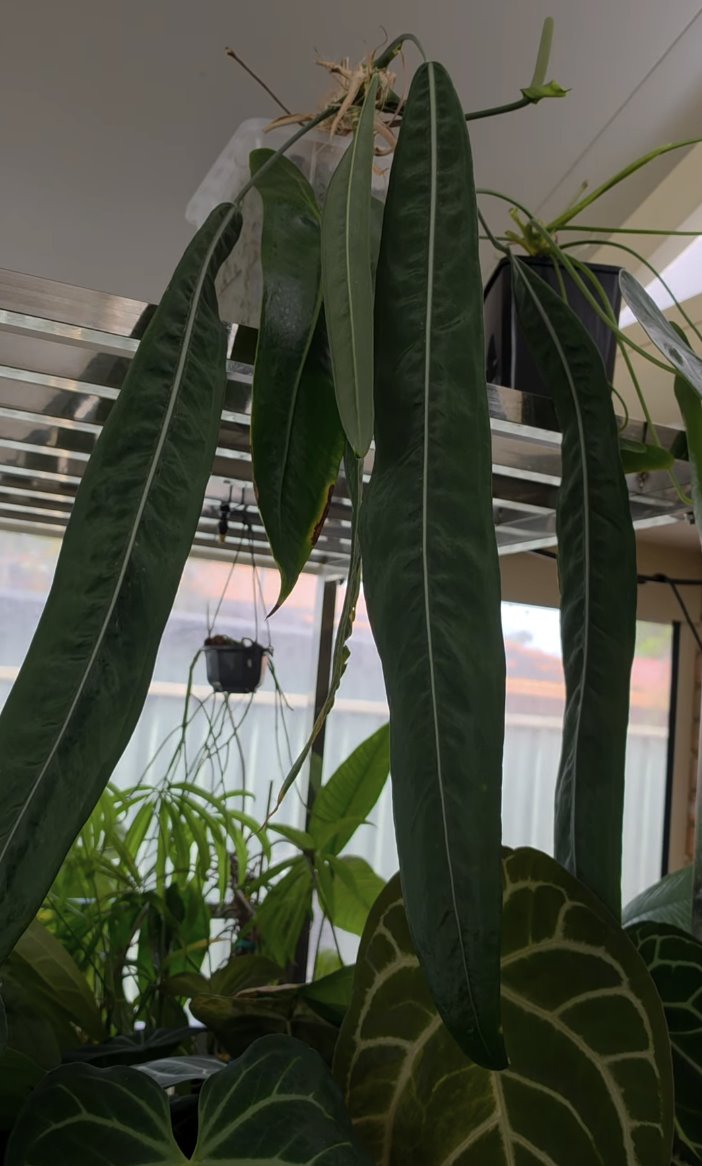
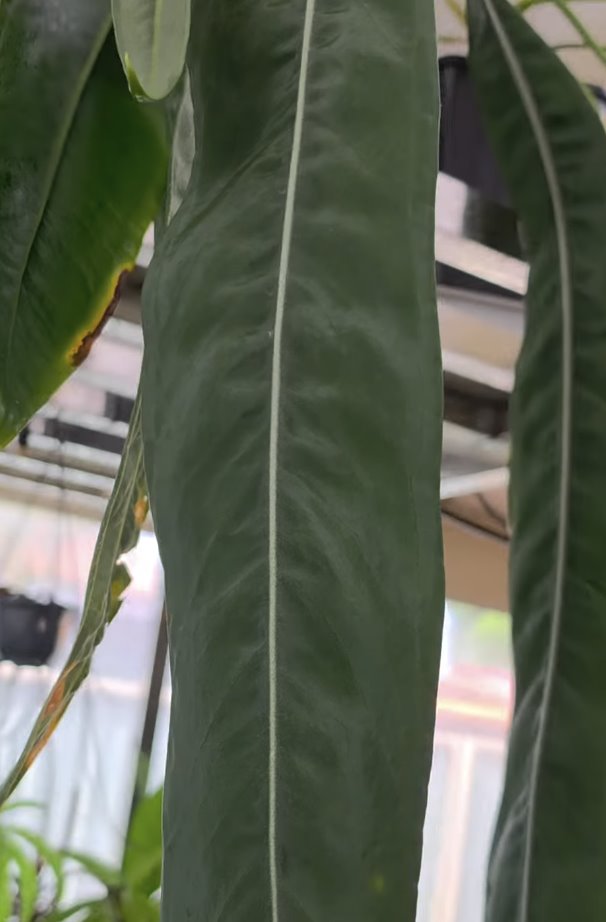
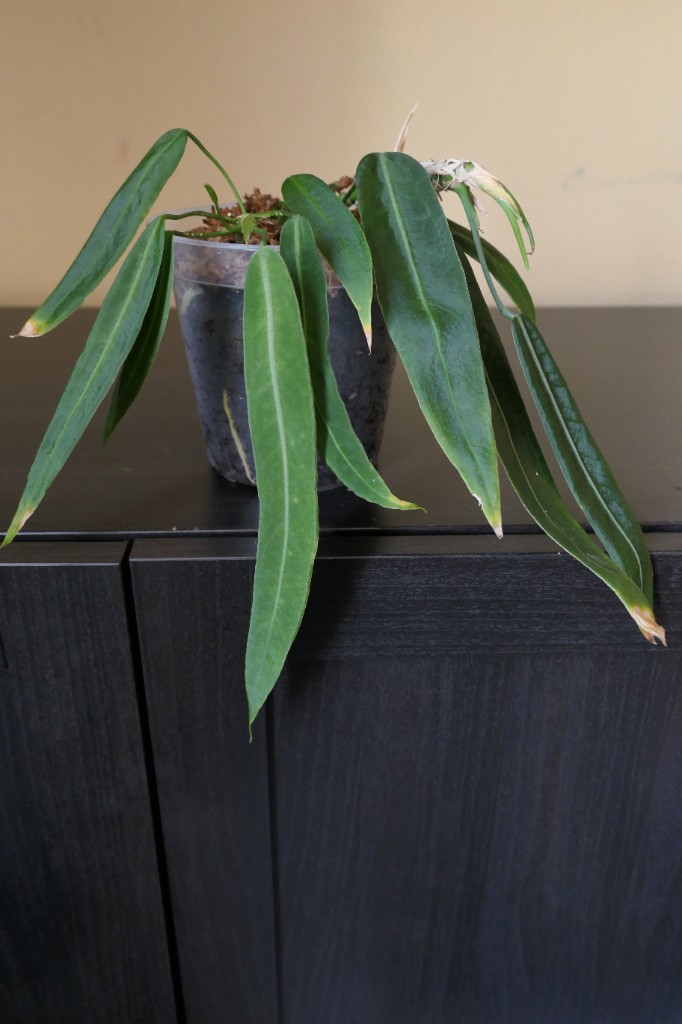
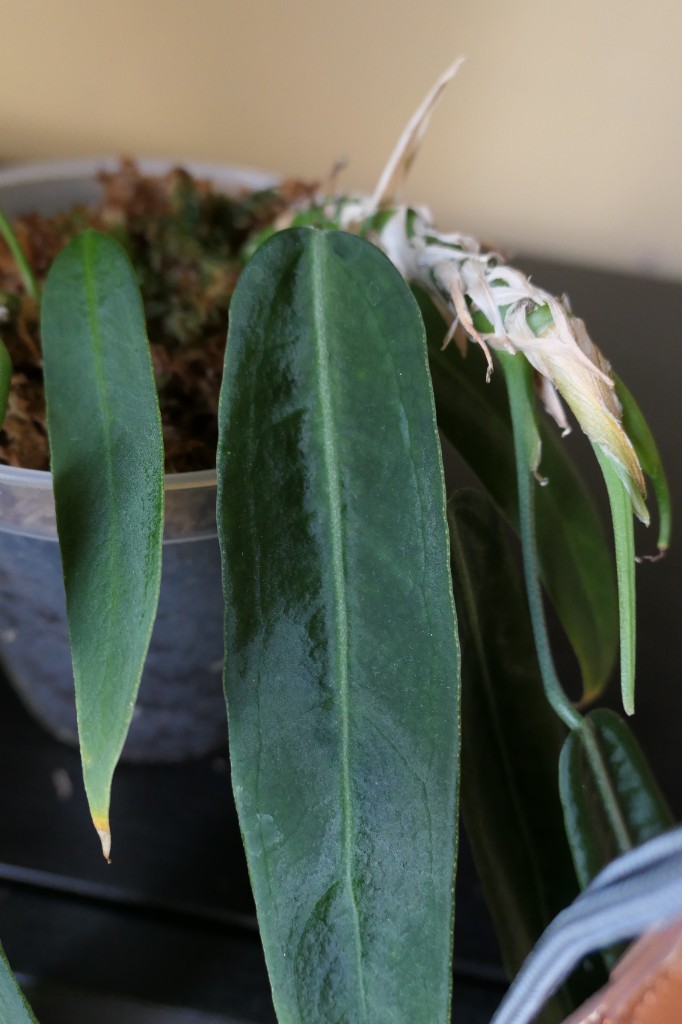
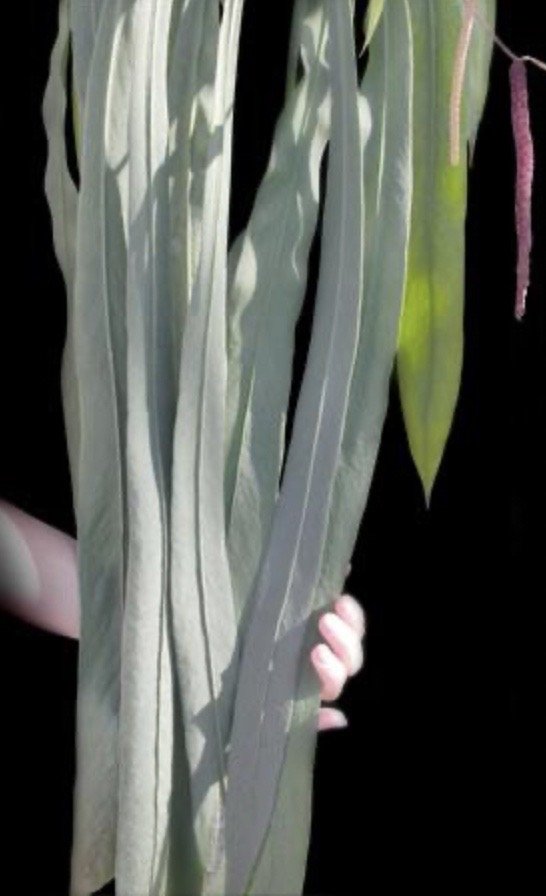
Strap Leaf
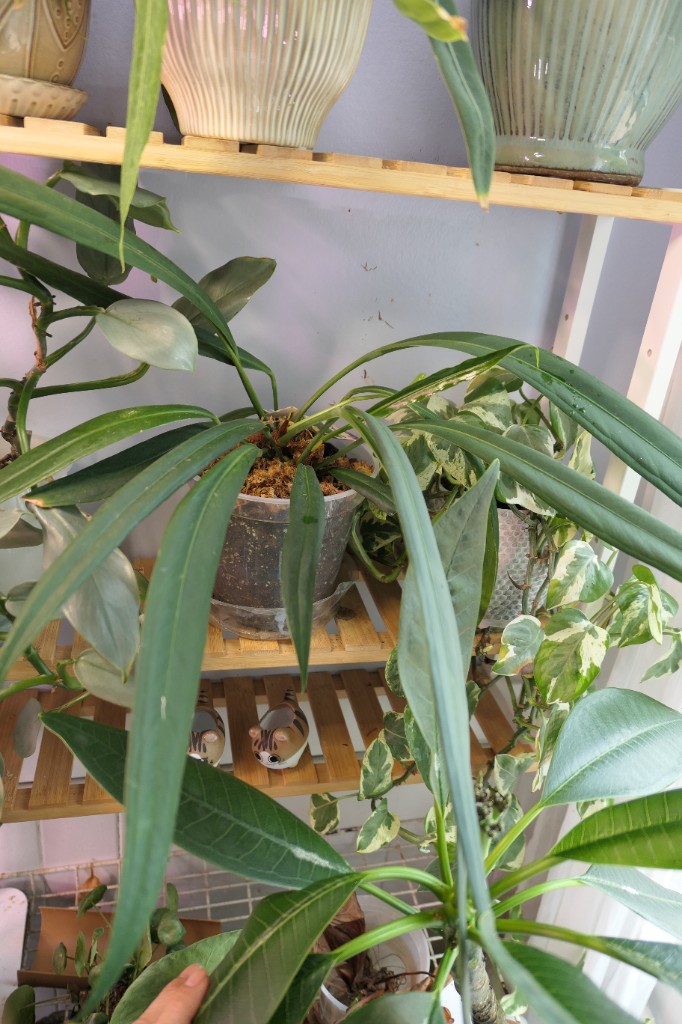
Strap Leaf — Long & Pendant
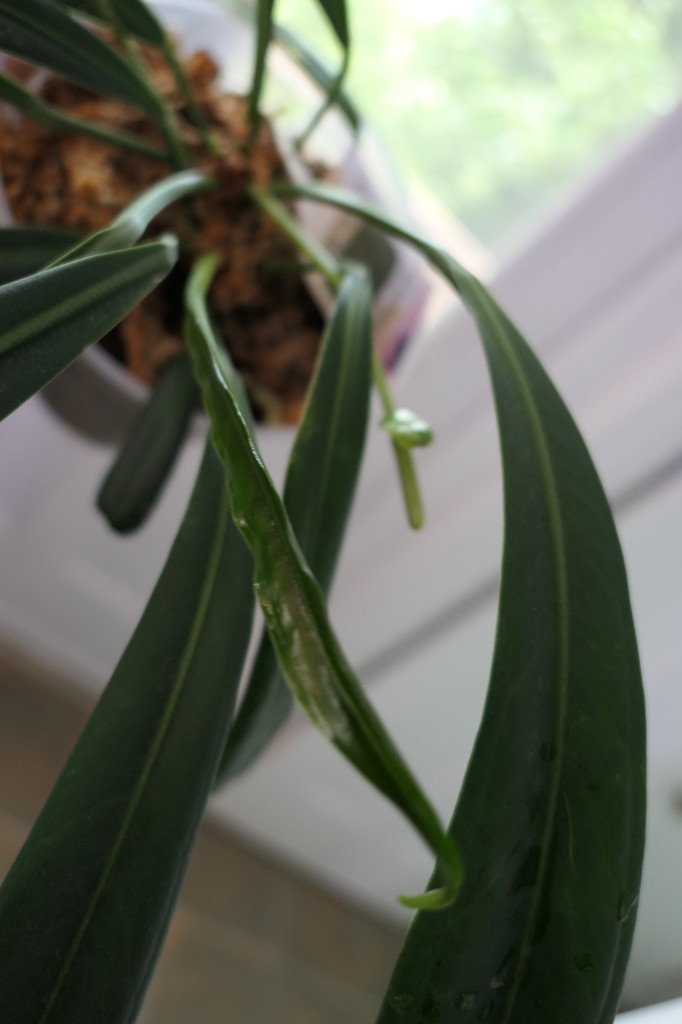
Narrow, elongated, often pendant leaves. vittarifolium, wendlingeri, pallidiflorum. Mount
or basket; needs airflow along full leaf length.
Key idea: long pendant blades
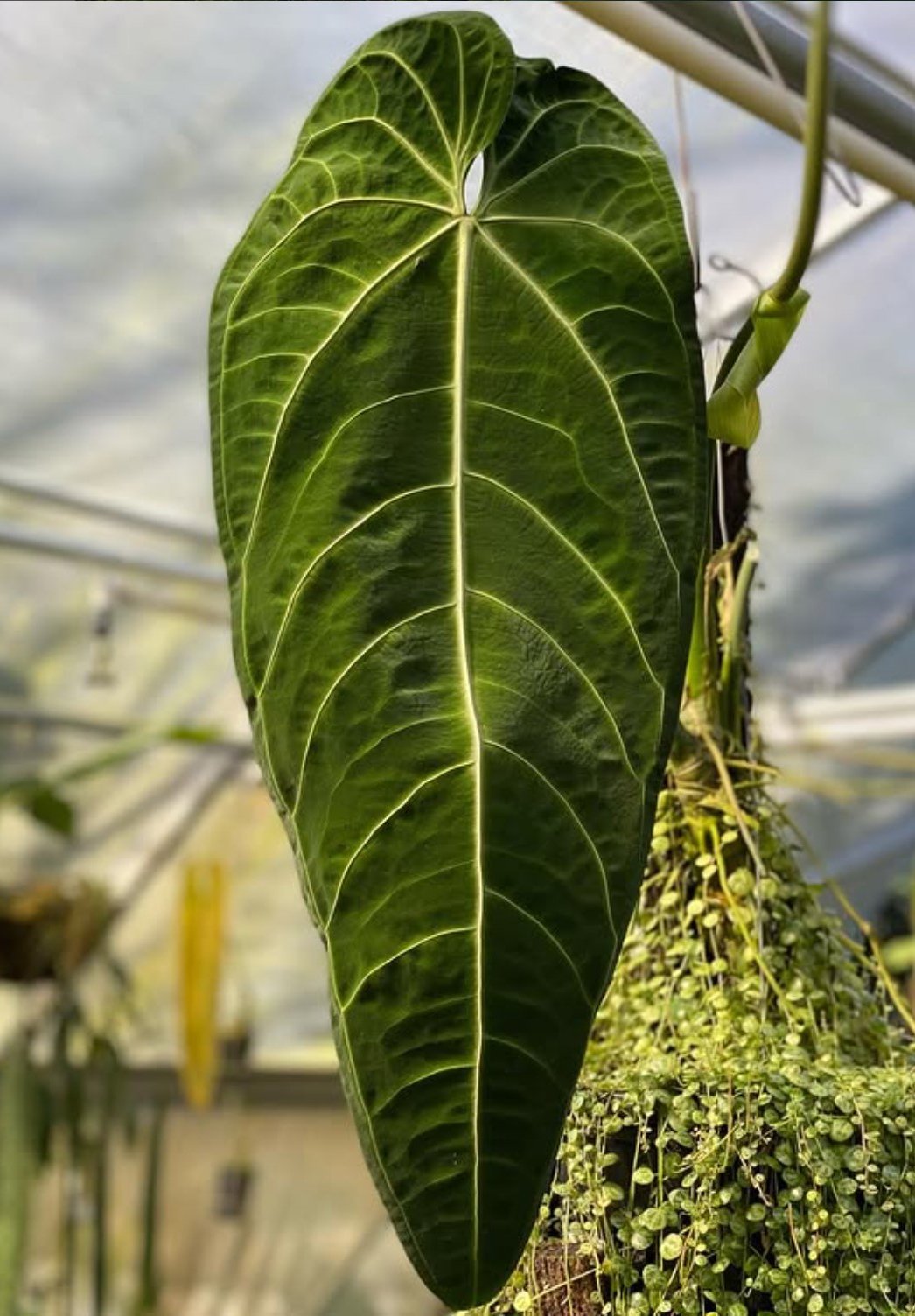
Velvet
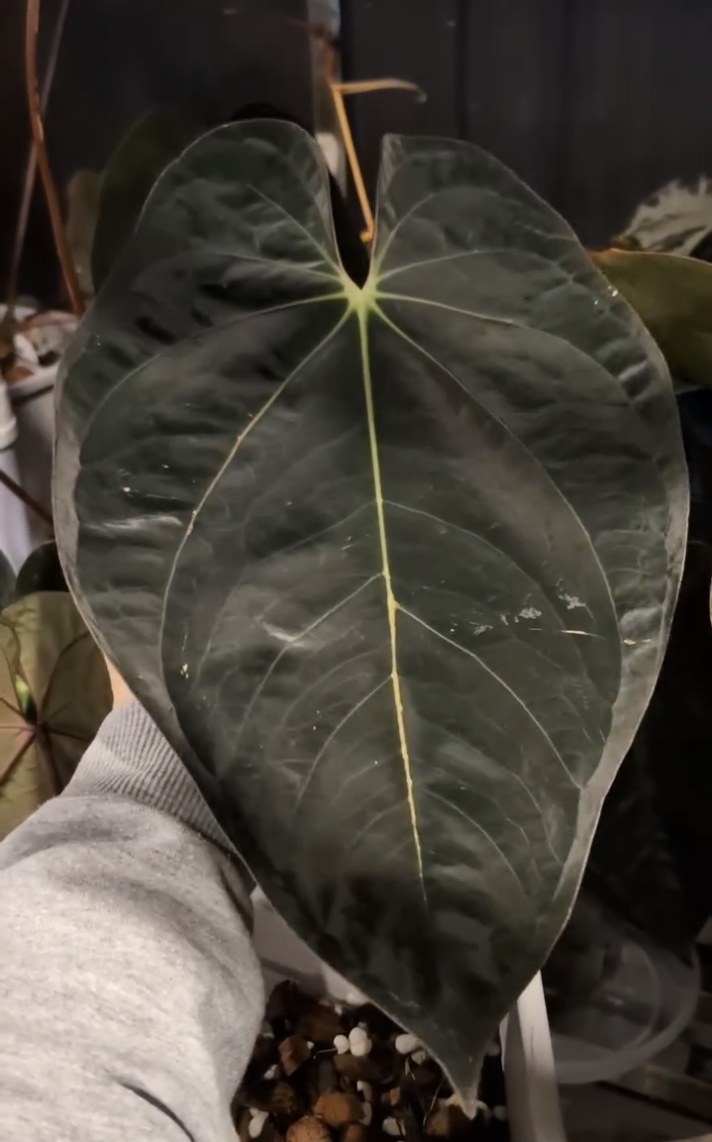
Velvet — Surface Optics
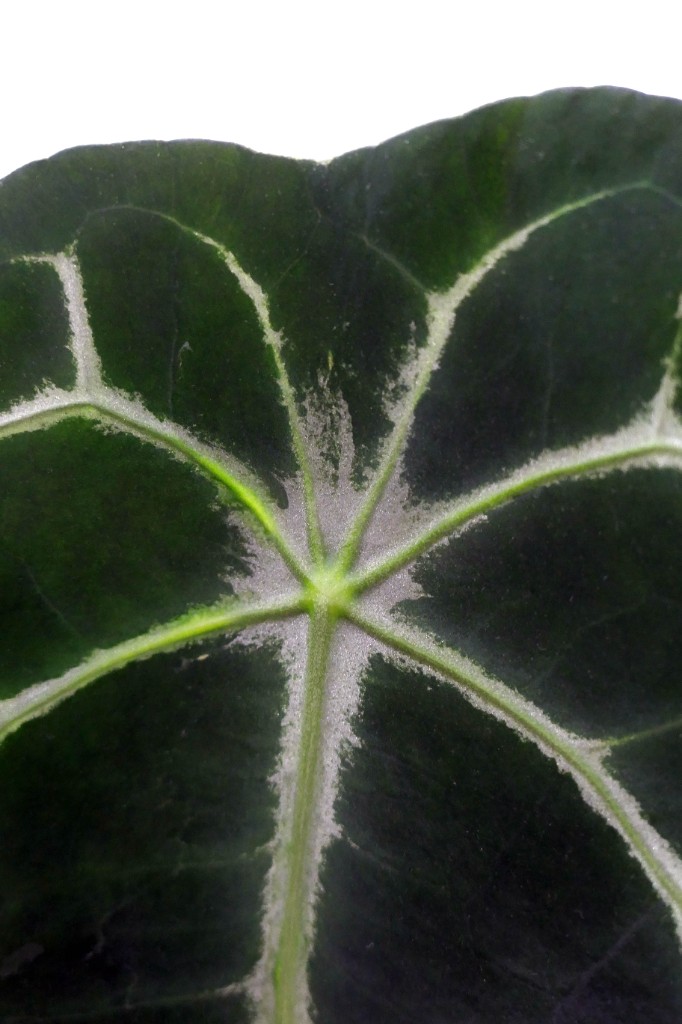
Velutinous surface — micropapillose epidermal cells
(convex, cone-shaped) trap and scatter light instead of reflecting it. Deep matte
nap that shifts sheen as you move the leaf; feels soft, like short pile fabric.
Blade is usually thinner and more pliable. Reference species:
warocqueanum, magnificum, regale,
papillilaminum, dressleri, crystallinum. Stacks with
dark and veiny.
Key idea: deep light-eating nap
Velvet describes surface optics —
not blade stiffness (see cardboard in Nomenclature). True velvet often photographs
almost black in shadow.
Sub-velvet
Sub-velvet — Surface Optics
Same micropapillose cell type as velvet, but shallower
and less developed — subvelutinous. Matte-to-satin finish with a faint sheen
instead of a true light-eating nap; feels smooth rather than plush. Where many
hybrids land; clarinervium and kunayalense are usual references
(clarinervium: stiff cardboard blade, softer surface — see Nomenclature).
Stacks with dark and veiny.
Key idea: satin finish, not plush nap
Bird's Nest
Bird's Nest — Rosette Form
Dense upright rosettes with broad architectural leaves —
not pendant, not heart-velvet collectors. hookeri,
superbum, plowmanii, Jungle King
types. Often sturdier in average humidity.
Key idea: upright rosettes
Bird's-nest rosettes are typically glossy
— flat waxy reflectance, not velvet pile. See Leaf
surface terms.
Giant
Giant — King & Queen Scale
Mature leaves measured in feet, not inches. warocqueanum (queen), regale, mature veitchii, coriaceum. Needs
space, patience, and stable humidity for full size.
Key idea: leaves in feet
Compact
Compact — Tight Growers
Small footprint, short petioles, shelf-sized maturity. besseae, carlablackiae, forgetii, villenaorum. Heavily
crossed because they fit more grow tents and cabinet setups.
Key idea: tent shelf size
Variegated
Variegated — Sectoral & Mint
Chimeric or unstable variegation — papillilaminum
variegata, crystallinum
variegata, Thai/Indo mint releases. Stability and reversions are major value
drivers.
Key idea: chimeric sectors
Blister Variegation
Blister Variegation — Reflective Veins
Veins that emboss and blister outward from the leaf
surface — raised puckered tissue that pops off dark velvet, not chimeric sector
variegation. Contrast can be white, silver, or pink depending on the plant; can
be heritable in species crosses.
Key idea: silver vein pop
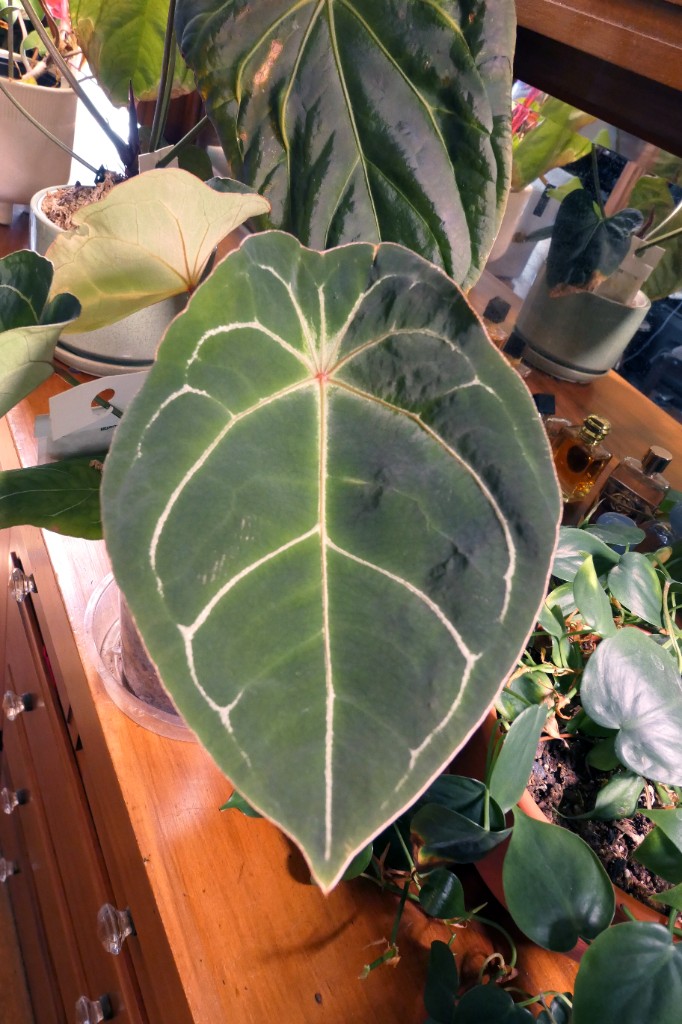
clarinervium reflective white veins
Blister variegated red crystal × pap seedlings
Wonderboy Pink bubbly leaf margins
Rippled
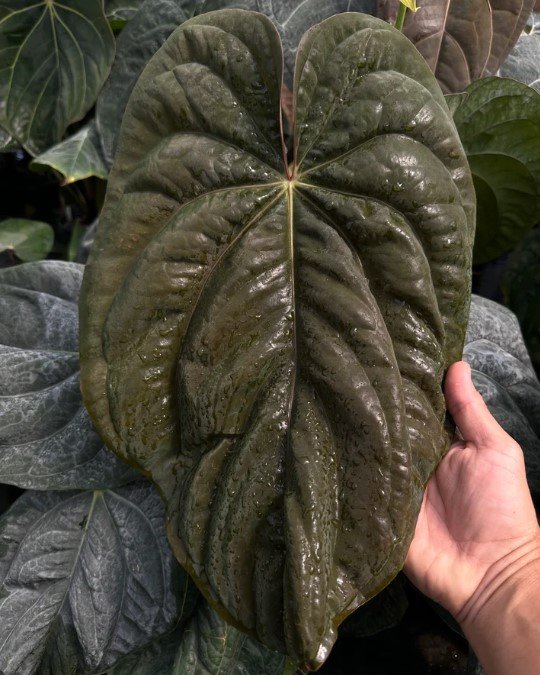
Rippled — Corrugated Texture
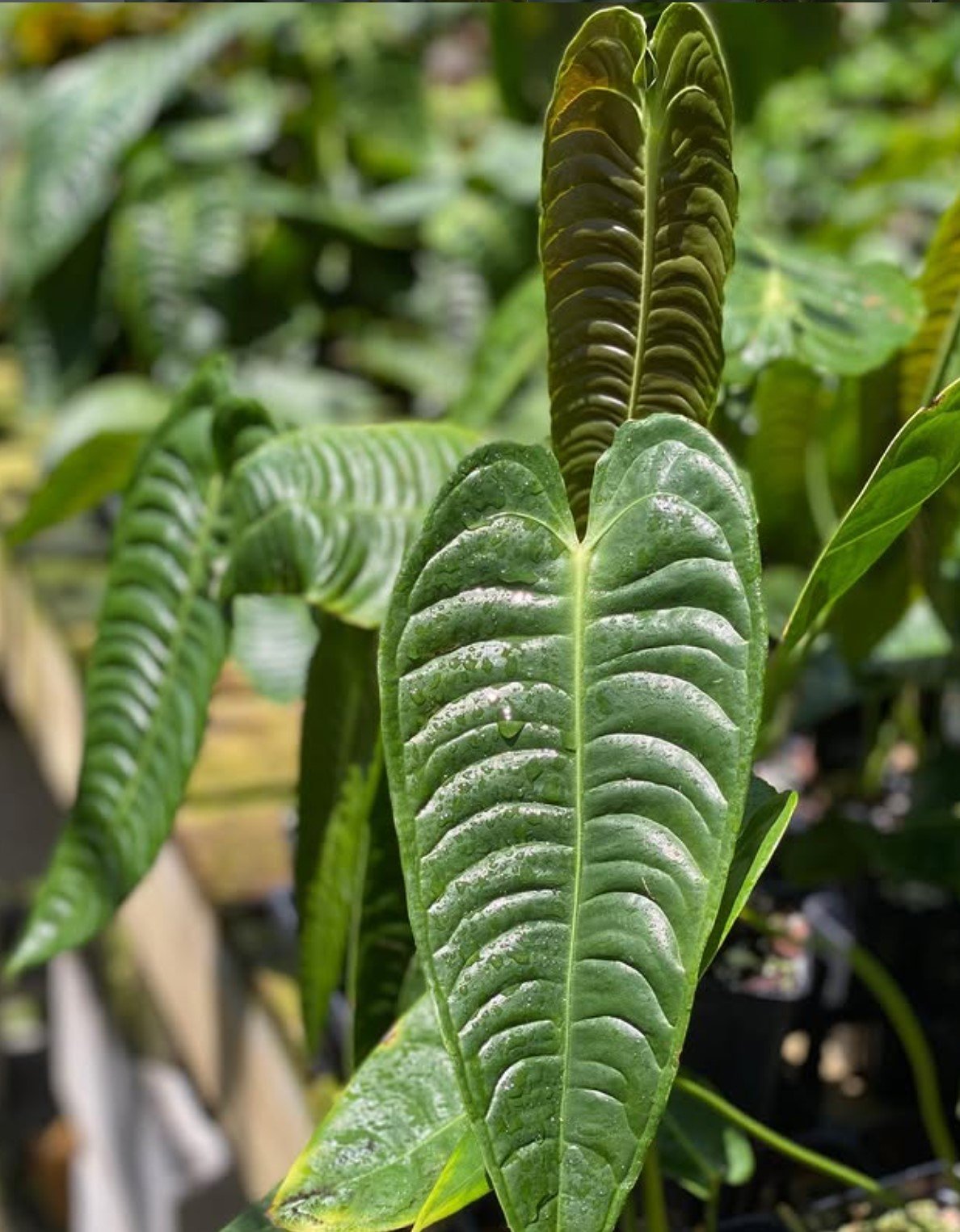
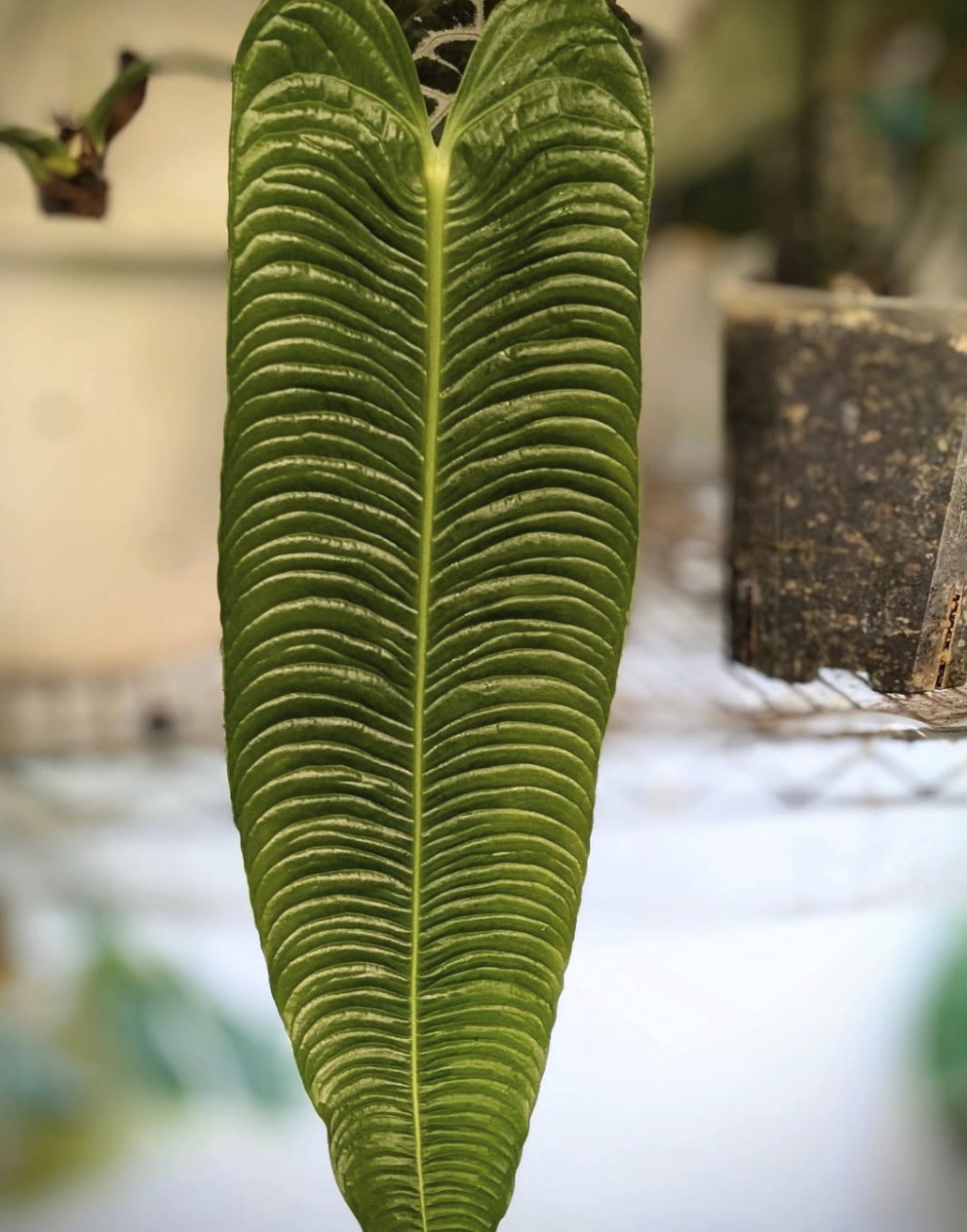
Quilted or corrugated leaf surface — raised bumps and
channels across the blade. veitchii (king anthurium), rippled
wendlingeri forms, some luxurians-adjacent bullate types.
Surface texture is the primary appeal. For wavy leaf margins, see Ruffled Edges.
Key idea: quilted surface
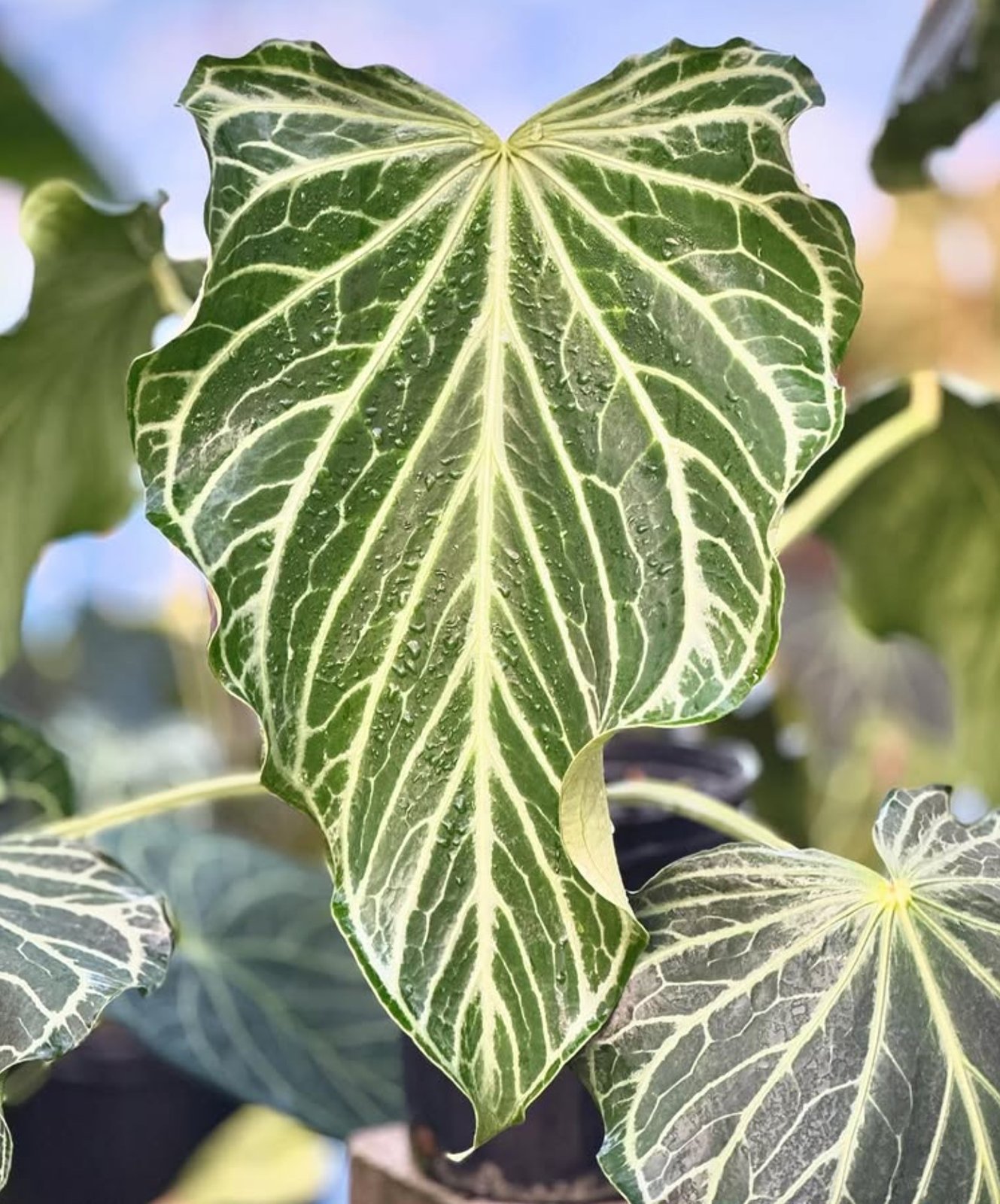
Ruffled Edges
Ruffled Edges — Wavy Margins
Leaf margins that wave, undulate, or frill instead of a
smooth outline — distinct from a quilted (rippled) leaf surface. Common on some
crystallinum-type and hybrid selections; can stack with Rippled when both texture
and margin are extreme. See Fairchild Crystallinum, Delta Force, Muchlis, and plowmanii.
Key idea: wavy leaf outline
Showy Emergent
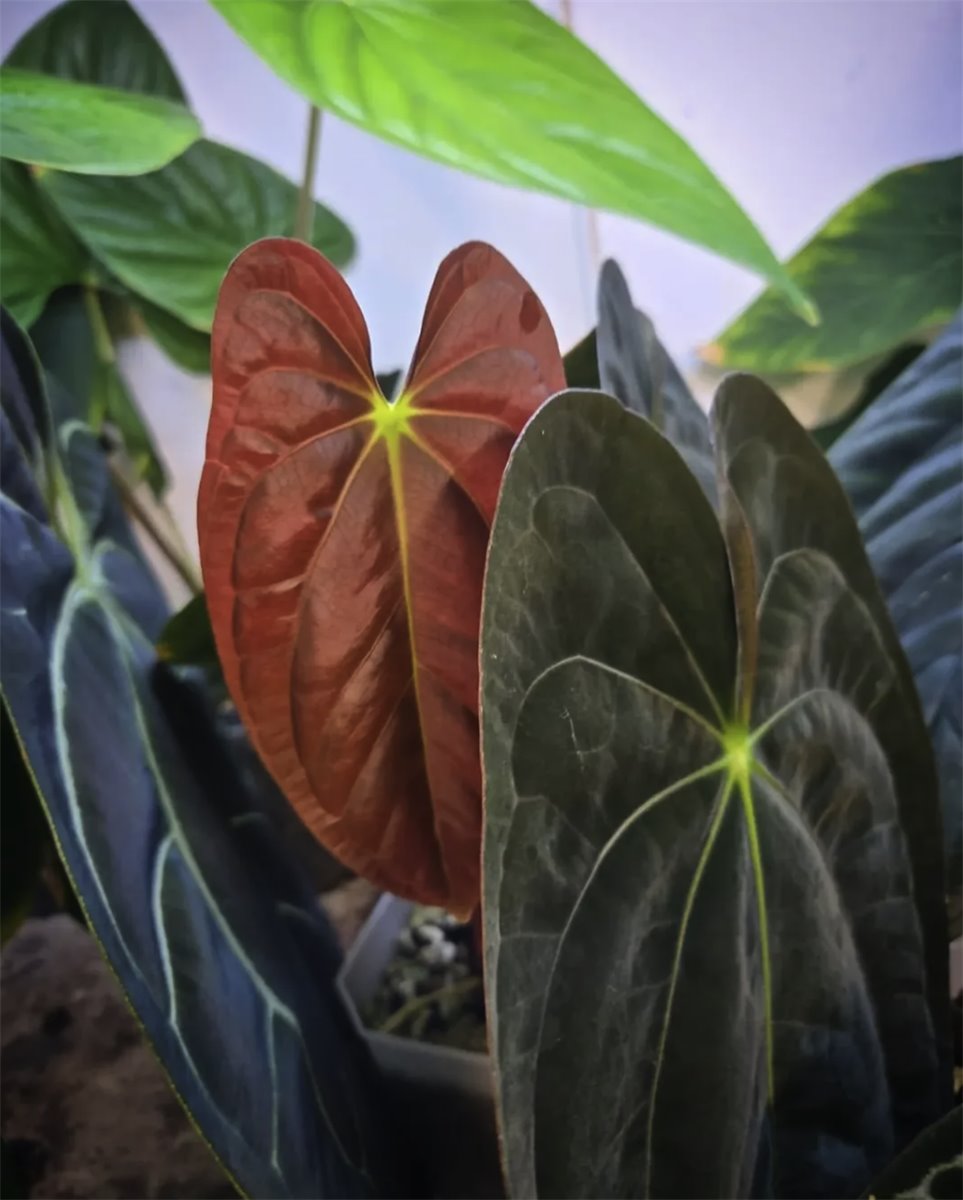
Showy Emergent — New Leaf Color
New leaves that visibly pop before hardening off — red,
pink, purple, copper, iridescent, or golden-green flush. Distinct from mature
foliage color; the emergent phase is often why collectors grow the plant.
Key idea: new leaf color pop
besseae aff. — oily dark-blue emergents
Wonderboy / Red Crystallinum — red new leaves
Canal papillilaminum
— mahogany or golden-green flush
Circus Peanuts — copper-bronze emergent
Persistent Red
Persistent Red — Mature Foliage
Red, pink, or copper on veins, midrib, or petiole that
remains visible after the leaf hardens. Distinct from Showy
Emergent, where the color is mainly a new-leaf phase. Some red
crystallinum-type lines hold color on mature silver-veined foliage; others fade
to green.
Key idea: mature red veins or petiole
Wonderboy · NSE Red Crystal · Tezula Red Crystallinum · NSE Zara
Michelle — red midrib & petiole sinus on mature leaves
Red Spider · Red Spider × NOID — spidery red veins, red petiole
Stands out for tolerating typical indoor humidity and
light better than velvet collectors — bird's nest rosettes and entry-level
clarinervium-type plants. Still an anthurium (chunky mix, no wet feet), but not a
cabinet-or-greenhouse mandate.
clarinervium — entry-level velvet; more forgiving than dark
Panama types
crystallinum · magnificum
— intermediate crystallinum-type velvets (65%+); not tagged easy or high
High Maintenance
High Maintenance — Collector Conditions
Needs stable high humidity (often 70%+), careful
watering, and minimal environmental swings — queen/giant strap-leaves, dark
Panama velvets, fussy forgetii, and variegated headline hybrids. Cabinet, tent,
or greenhouse culture is the norm, not a bonus.
Key idea: humidity + stability
warocqueanum · regale
· veitchii
· luxurians
papillilaminum · dressleri
· forgetii
· pendant straps
RVDP · Ace of Spades · King of Spades · variegated releases
Fast Grower
Fast Grower — Regular New Leaves
Noticeably productive in stable cabinet or tent culture —
new blades on a predictable cadence, not one leaf every few months. Crystallinum-type
velvets and bird's nest rosettes stand out here.
Key idea: steady leaf output
clarinervium · crystallinum
— monthly-ish in good culture
Weeks to months between mature leaves — often
one-at-a-time queens, bullate luxurians, and dark Panama velvets. Patience is
part of the cultivar; import recovery and leaf aborts are common discussion
points.
Key idea: patience required
warocqueanum · regale
· veitchii
· luxurians
papillilaminum · dressleri
· dark Panama species
Black Magic · Delta Dawn — luxurians-adjacent hybrids
DarkVelvetHigh MaintenanceAce of SpadesSilver Krome GardensCordate
Ace of Spades
Denis Rotolante / SKG named the standout clone from a
jungle-collected Ace of Spades seed batch — dark cordate velvet and the name most
collectors mean by Ace of Spades. Hobby shorthand AoS. Widely used as a pollen
parent in dark velvet breeding.
Known for: SKG-named batch clone
DarkVelvetHigh MaintenanceSlow GrowerTezula AoS Dark FormTezulaCordate
Ace of Spades (Tezula Dark Form)
Tezula Plants picked a dark seedling from the same
jungle-collected Ace of Spades batch SKG used, then color-graded and propagated it
as their own line. Same starting batch — different chosen plant than the SKG-named
clone. Mature leaves run near-black velvet with pale primary veins; emergents open
dark and harden deep green to black. Slower and more humidity-sensitive than
Tezula's easy-care red lines.
Known for: dark pick from AoS batch
DarkRippledVelvetHigh MaintenanceAce of Spades × LuxuriansWuHoo TropicalsCordateBullate
Ace of Spades × Luxurians
AoS × luxurians cross — dark velvet with luxurians-type
bullate texture.
Known for: AoS × lux bullate dark
DarkVelvetVeiny(Ace × Dress) × Red CrystalUnderstory OasisCordate
(Ace × Dressleri) × Red Crystal
Paul Marcellini cross — second-generation stack using Ace of Spades × dressleri seed crossed back to red crystallinum.
Known for: PM Ace × dress × RC batch
DarkVelvetHigh MaintenanceSlow GrowerAntolakii
Antolakii
Black Velvet Eastern Panama — collector shorthand BVEP.
Also called "Darkest Panamá" / Black Velvet Panama by Vannini for habitat
material — not the Indonesian trade Goliath. Formally described species, not a
hybrid.
Rory Antolak BVEP / antolakii holdback gifted to
Paul Marcellini — described it as very bullate. Mother plant in his Florida
program (including Swamp Raisin × Yard seedlings).
Known for: bullate Rory BVEP holdback
Strap LeafCompactBakeriLinear
Bakeri
Central American epiphyte — narrow linear strap leaves,
short compact stems. Reddish-brown glandular punctations on the lower
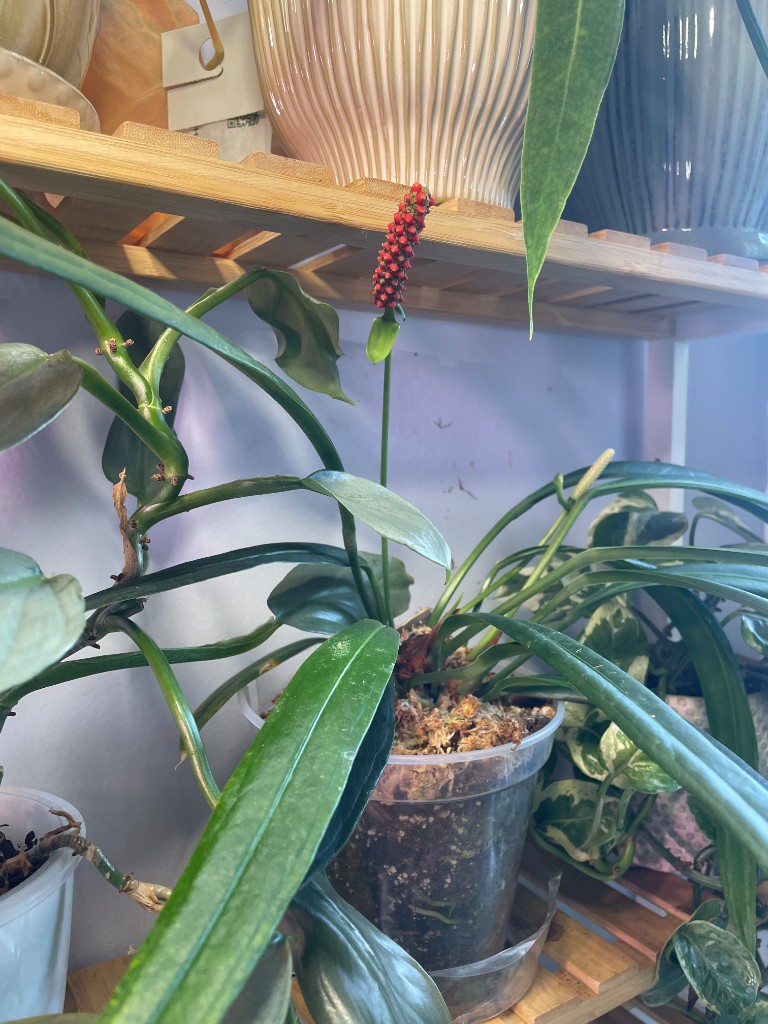
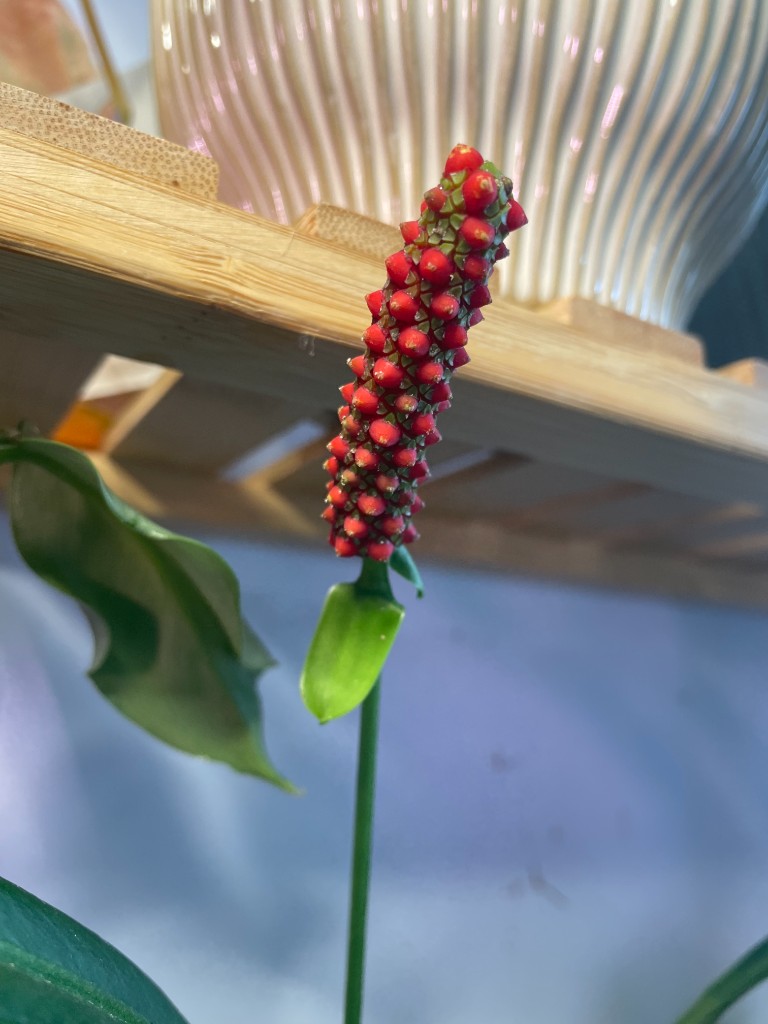
surface are the ID tell. Apomictic: sets bright red pointed berries without
pollination. Sometimes listed as loefgrenii or gracile.
Known for: bright red berries
CompactVeinyVelvetBesseaeCordateOverlapping Sinus
Besseae
True Anthurium besseae Croat (2005) — small
terrestrial Bolivian endemic (Cochabamba / Chapare), not Ecuador. Ovate-cordate
velvet with few (2–4) primary lateral veins raised and paler above; sinus
narrow to closed with overlapping posterior lobes. Inflorescence small: green
spathe often maroon-tinged, dark purple spadix. Rare in cultivation (Selby /
Dewey Fisk lines).
Source: Vannini on velvet anthuriums.
Known for: rare Bolivian true species
CompactVeinyVelvetShowy EmergentCordate
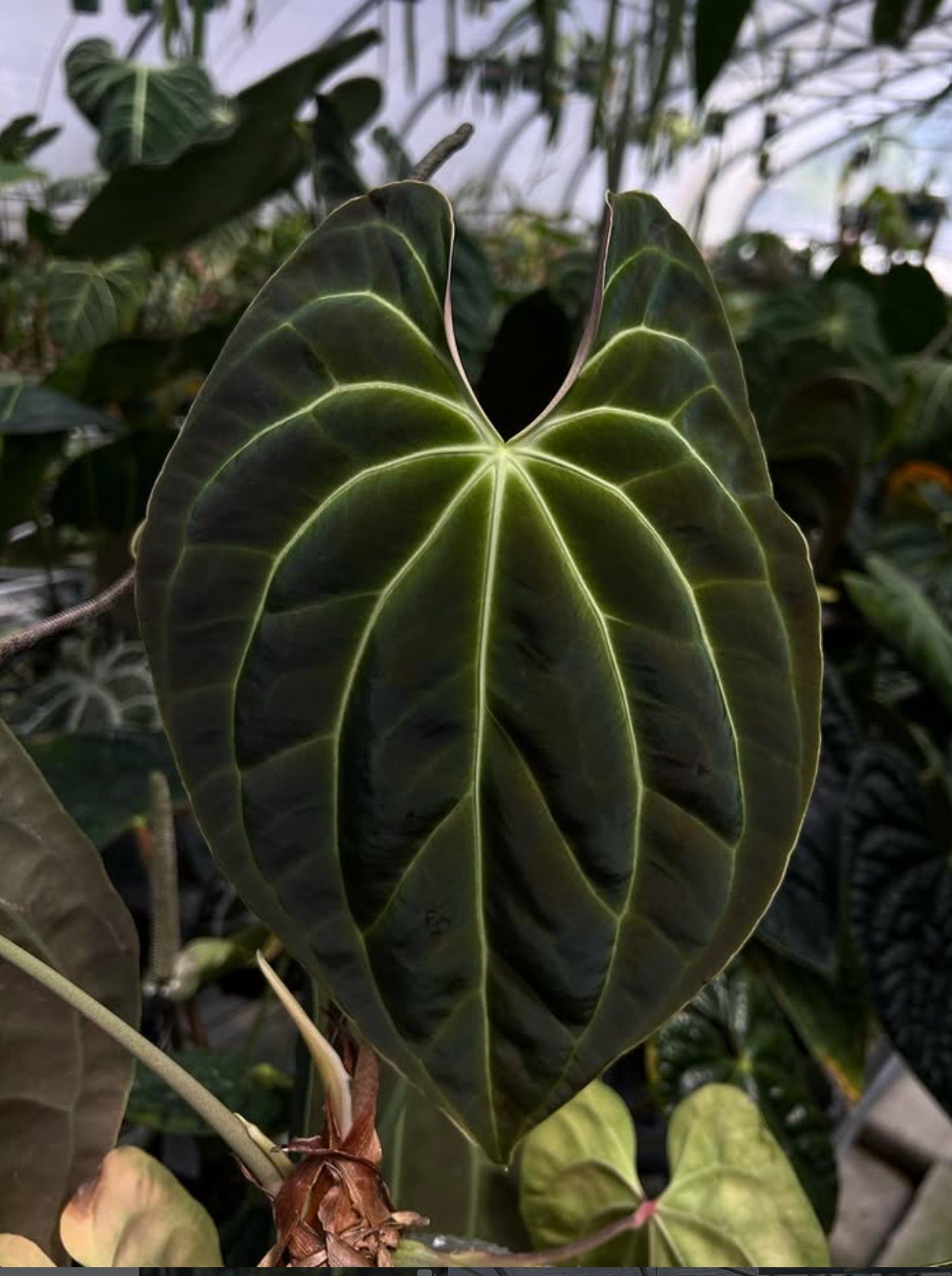
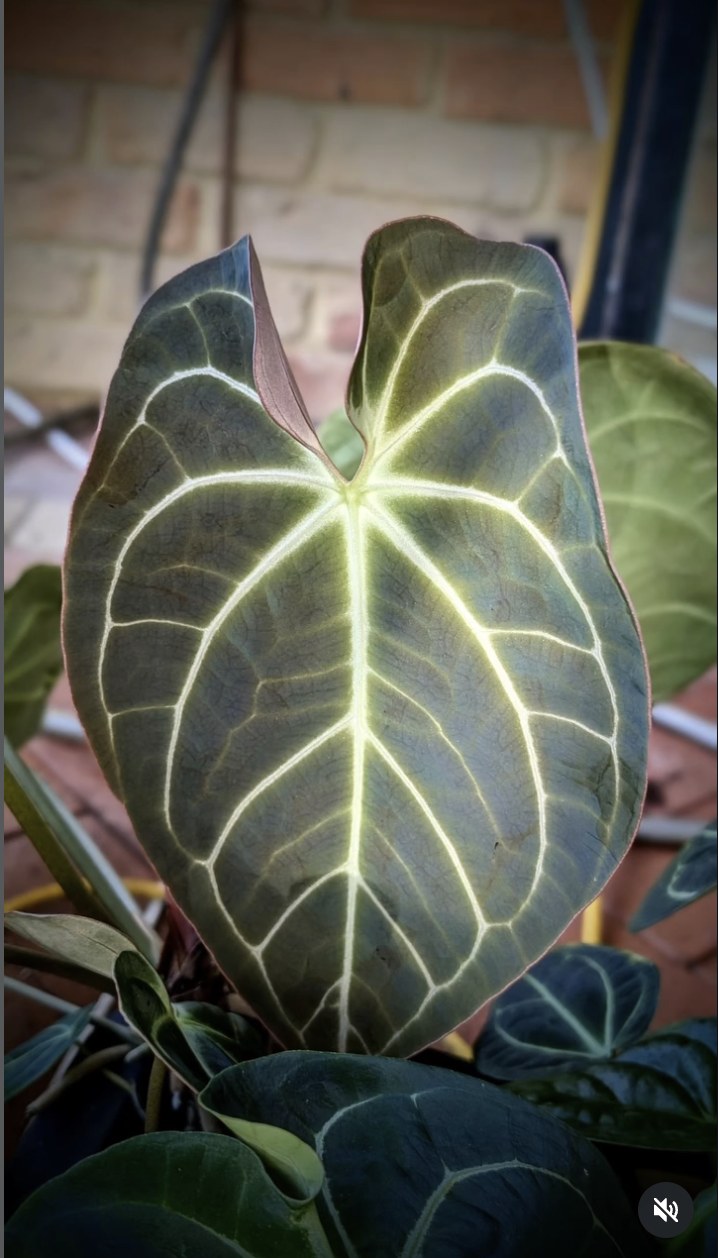
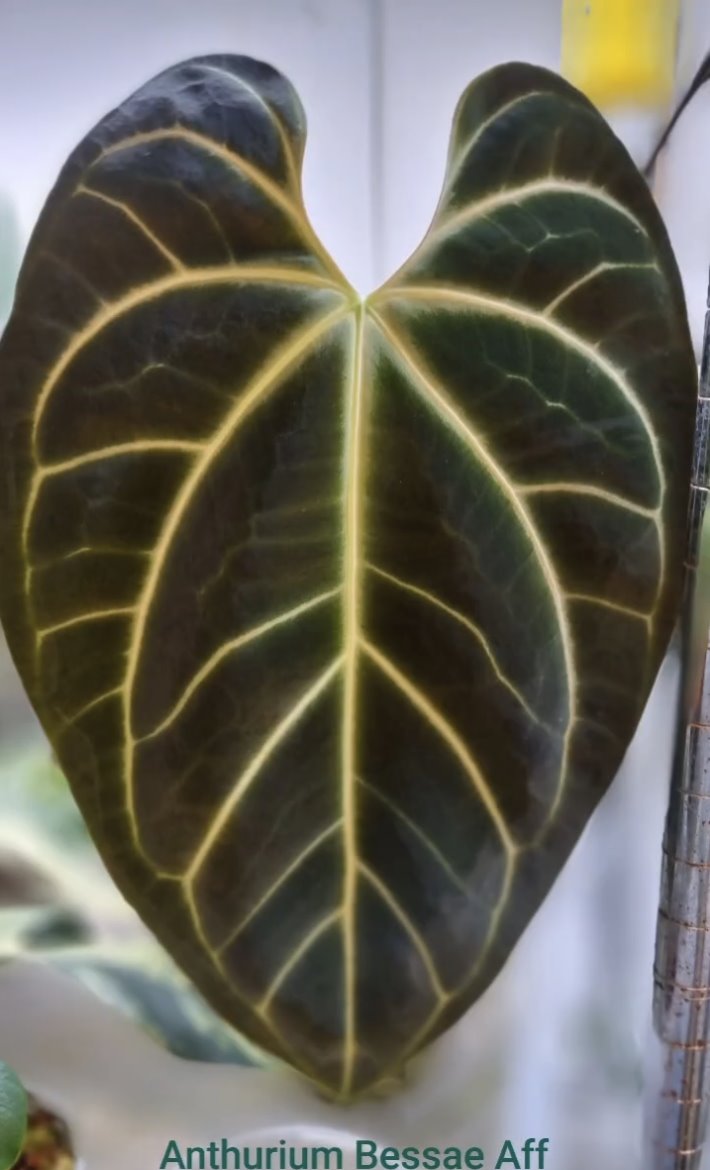
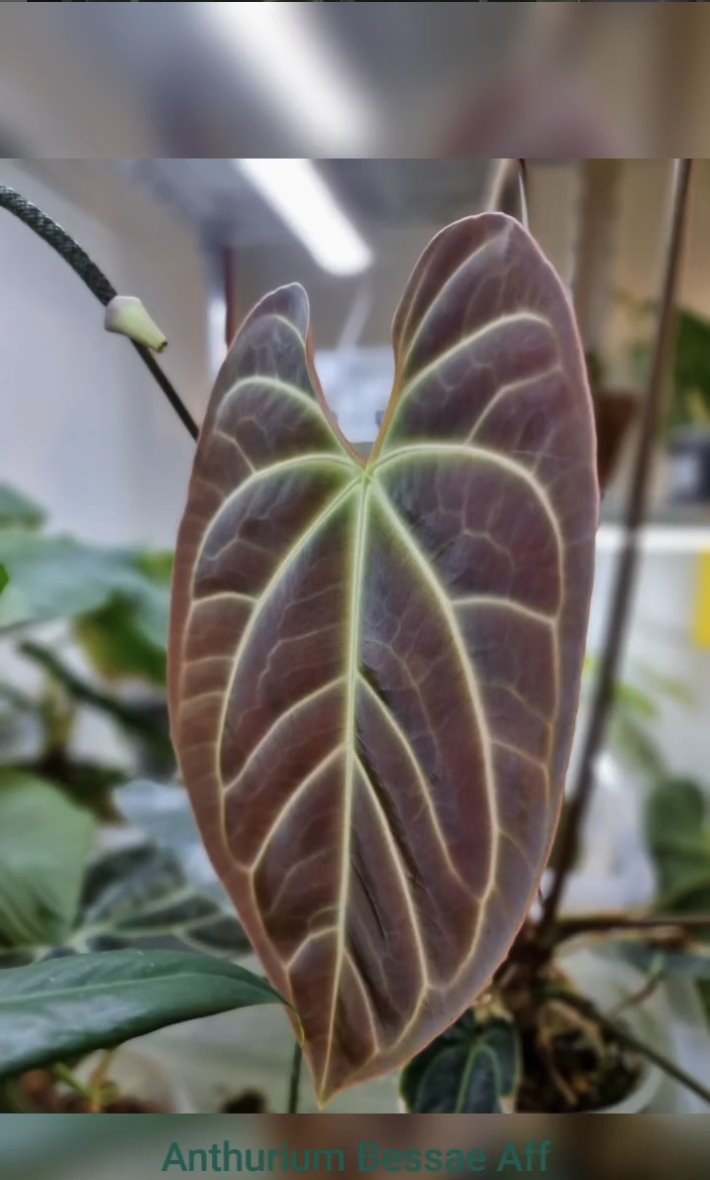
Besseae aff.
aff. (affinis) = besseae-like —
not true Bolivian A. besseae. Default Ecuadorian nursery trade name for
dark crystallinum-adjacent ("esqueleto") velvets: oily dark-blue emergents,
silver double-contour veins (often greenish-yellow), and highly variable leaf
shape (wide sinus, elongated blades, forms like Spider, Flat / Negative Sinus, Turtleback).
Often microarched between veins; true besseae is flatter. Includes
hybrids sold under the same label. See Besseae for the
published species.
Karaul-associated named cultivar — deeply lobed dark
velvet with a footprint-shaped blade. Parentage unpublished. Distinct from the
Indonesian Goliath / Darkest Panama trade line.
Jay Vannini cross — luxurians
× dressleri RG. Gothic bullate dark foliage; typically circulated as limited
clone or seedling stock rather than mass tissue-culture.
Known for: gothic JV grail
DarkVelvetBlack WidowDr. Jeffrey BlockCordate
Black Widow
Near-black Doc Block cultivar — reduced patterning,
maximum dark foliage. Prized for breeding dark velvet backcrosses.
DocBlock Zara® — IAS-registered magnificum ×
red-leaf crystallinum. Red-brown emergents with "red-eyes" at the
petiole sinus; leaf reverse starts pink with burgundy veins, maturing to dark
velvet green with contrast veins on both sides. Frequent DocBlock cross parent.
Siam Flora (Jeera Jukmongkol) 2019 sibling from Thai
papillilaminum variegata × Ace of Spades — gold/cream sectors on dark velvet.
The Bullion clone itself was not widely distributed; hybrids from the line are what
circulate.
Known for: gold sector sibling — hybrids only
CompactDarkVeinyVelvetCarlablackiaeCordate
Carlablackiae
Hobby shorthand carla. Compact, dark, heavily veined velvet —
one of the most crossed species in collector anthuriums.
Known for: compact dark velvet; many numbered clone lines
Clone culture
In US collector trade, carlablackiae usually circulates as named or numbered clone lines rather than as one uniform look. Common tags include OG (Scott Cohen),
RA (Rory Antolak), PM (Paul Marcellini / Understory Oasis), Wu (WuHoo Tropicals), District, Kuna, and hobby A-numbers. Each tag refers to a specific mother line — plants from OG2, RA7, PM3, or Wu1 should match that line at maturity.
When a clone or type is not named, the line may simply be unknown — not every plant has full provenance on the tag.
Cross culture
Some programs label batches with codes like carla 5×10 (generation × selection number). For crosses, listings may show seed parent × pollen parent — for example OG carla × RA carla — when that information is available.
CompactDarkVeinyVelvetCarlablackiaeCordate
Carlablackiae — Amanda
Named minimal-vein carlablackiae clone in US collector
trade — reduced pink venation on compact dark velvet. Collector lore ties the
line to Dylan Nguyen; widely used as pollen parent in dressleri RG × Amanda and
other dark velvet programs. Amanda names this carla stock, not the
dressleri cross.
Named carlablackiae mother clone of Brendan Buzer
(Buz Plants) — reduced, calmer veining vs heavy OG types. Common pollen parent in
papillilaminum × District crosses.
Known for: Buz Plants calm-vein carla mother
CompactDarkVeinyVelvetCarlablackiaeCordate
Carlablackiae — Kuna
Early unnumbered RA-era wild clone in veteran US
collections — circulated alongside OG carla before the RA numbering system.
Original Scott Cohen carlablackiae clone from Rory
Antolak material — OG-numbered distribution, not a species card replacement.
Always ask which OG number.
Paul Marcellini numbered carlablackiae mother.
On his garden tour he noted spathe diversity among pure carlas — PM2 among them
with a large spathe that differs from sibling lines. PM numbers are tracking
labels, not a ranking.
Source: Paul Marcellini garden tour.
Paul Marcellini numbered carlablackiae mother —
on his garden tour he identified PM3 as a seedling from Rory Antolak's RA5
"spider" carla. Wider blade form than his narrow Yard carla; large spathe
noted on that plant. PM numbers are his tracking labels for distinct mothers.
Source: Paul Marcellini garden tour.
Eastern Andean epiphyte (Colombia–Ecuador–Peru). Pendent
habit with long, narrow, matte blades — often confused with pallidiflorum
or wendlingeri in listings. Petioles are conspicuously sheathed;
inflorescences hang with a green spathe and a spadix that turns reddish, then
white berries.
Known for: pendent strap leaf — not a velvet hybrid
Trade name for a crystallinum-type velvet known for
chocolate / reddish-brown emergents and angular forked ("Y") veins near
the leaf margins. Nursery accounts relay wild Colombian plants moved into Ecuador
trade — multiple original clones, not one mother plant — though some circulating
stock is selfed or bench-hybrid material sold under the same name. Forked-vein
look is a strong breeding trait in red crystal × chocolate batches and S1 lines. See also
WuHoo's numbered Chocolate Crystallinum Wu1.
Source: Granthuriums on Chocolate Crystallinum.
WuHoo Tropicals numbered chocolate crystallinum clone —
chocolate emergents and forked "Y" veins within the broader Chocolate
Crystallinum trade type. Little public detail on this clone's specific
provenance beyond the Wu1 tag; used as a named breeding parent in WuHoo
crosses.
Historic Selby Gardens hybrid (~dressleri × leucostachyum /
versicolor) by Mike Bush — hobby shorthand CP. Selby name Mike's Goliath; trade
name from the inflorescence's artificial-banana scent. Large mature hastate blades;
copper-bronze emergent leaves maturing dark green.
Paul Marcellini cross — Circus Peanuts × carlablackiae.
He reports Circus Peanuts is a low-yield parent (~nine seedlings in one batch he
discussed) and numbers sibling clones because they diverge hard. Carla influence
shows up in larger, more colorful spathes on some keepers; he has bred selected
clones back toward carla.
Source: Paul Marcellini garden tour.
Known for: low-yield CP × carla siblings
GiantDarkVelvetFast GrowerCirinoiLanceolate
Cirinoi
Large velvet species in US hobby lines — often sold as aff.
cirinoi from Hawaii collections. Long, dark blades with strong primary venation;
vigorous compared with queen anthurium. Common pollen parent in cirinoi × waroc
crosses.
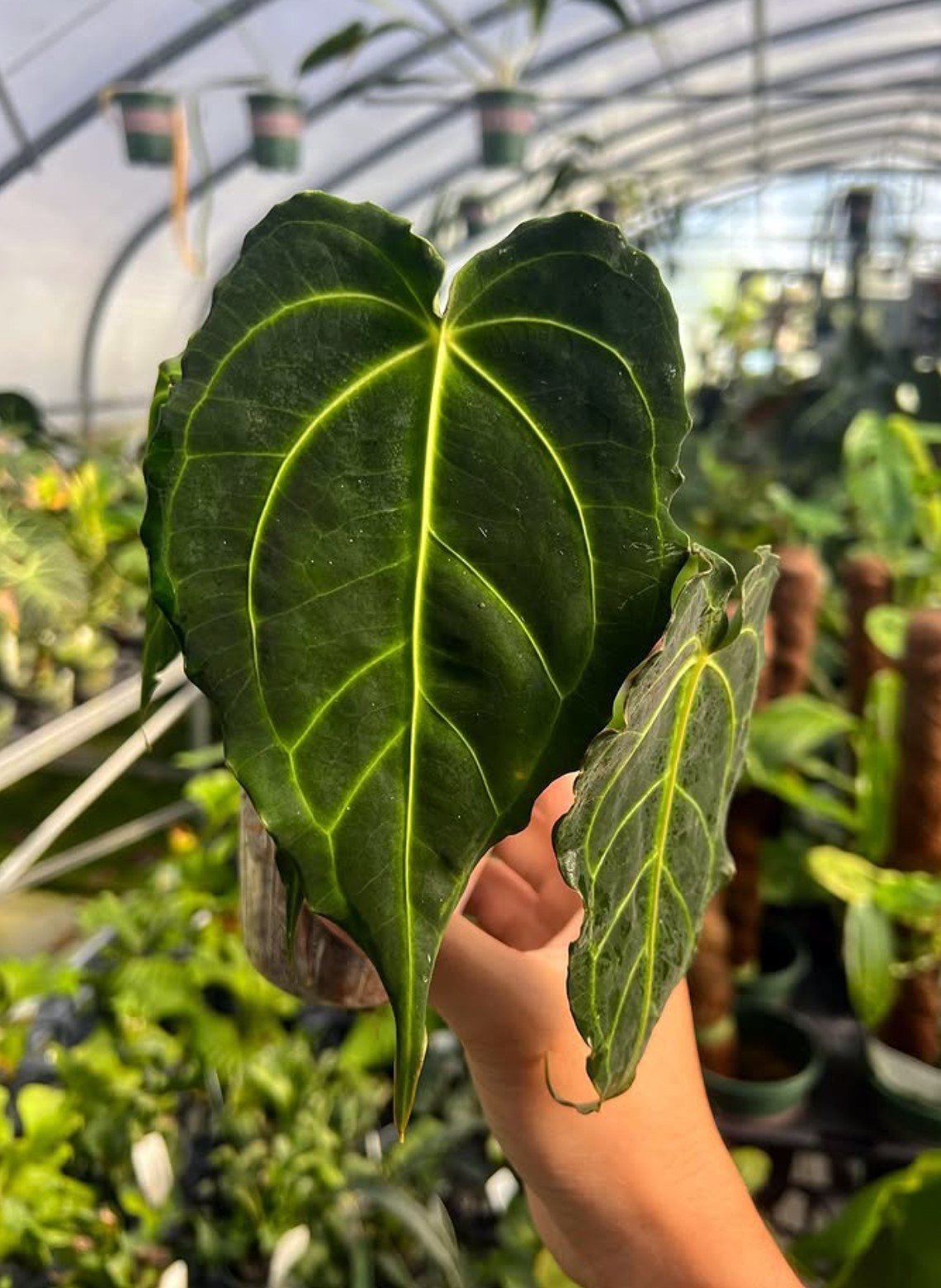
Dark matte velvet with bold white venation — classic
velvet + veiny + dark stack. Reflective white veins are the reference for
blister variegation (structural silver, not chimeric sectoring).
Dark velvet NOID prized for purplish mature foliage
and metallic emergents — a widely circulated breeding parent in US collector
batches. Upstream cross not published; often paired with dark pap clones like
Pap A+ in F1 work.
Known for: dark NOID breeding parent
GiantHigh MaintenanceSlow GrowerCoriaceum
Coriaceum
Leatherleaf anthurium — thick, stiff leaves to several
feet. Landscape giant, not velvet. Needs room and decades to reach full stature
in collection conditions.
The workhorse carla cross — silver contrast venation on
compact dark velvet. Backbone of Red Crystallinum-type programs and countless
F2 seedlings in trade.
Jay Vannini flagship — sp. nov. aff. nigrolaminum
'Rimachii' × Fort Sherman papillilaminum. Inky dark velvet with wide sagittate
sinus; sibling to Hechicera (Rimachii × dressleri RG).
Known for: JV dark flagship
VeinyVelvetDarkShowy EmergentDark and HandsomeDr. Jeffrey BlockCordate
Dark and Handsome
DocBlock chocolate-emergent velvet — chartreuse veins
against chocolate-toned new leaves maturing to medium green. Clone '9'
from genetics shared by Monroe Birdsey and selected by Dr. Jeffrey Block; parent
in many red-emergent DocBlock crosses.
Named hybrid — originally crossed by John Banta as
"Dark Moma" using giant green form warocqueanum ×
papillilaminum. Jay Vannini's documented remakes — including plants sent
to NSE Tropicals in 2006 — used Fort Sherman pap with standard
green waroc. Vannini notes that many circulated "pap" are bench hybrids;
crosses with those lack the uniform Dark Mama look. The form NSE circulated was
bred by Karel Havlicek. Later hobby remakes often use the darker narrow
waroc clone more common today. Waroc-length blades with pap-type dark velvet and venation.
Source: Vannini on Dark Mama;
NSE Tropicals on Facebook.
Steve Nock hybrid from Ree Gardens, Miami (1990s) — selected
F1 seedling from clarinervium × pedatoradiatum. Only this clone had the
deltoid (triangular) leaf and narrow tip; later repeats of the cross did not recreate it.
Reproduced only by division or tissue culture.
Known for: unusual triangular or deltoid leaf shape
BoyGardening Stranger Things cross — NSE Red Crystal × Mind
Flayer. Mature plants run medium green velvet with silver primary veins and light
green ribbing, plus a fused sinus inherited from the Mind Flayer side. Seedlings
vary on vein density and how fully the sinus closes. Reported very fast and easy
grower.
Known for: silver veins on medium green velvet
VeinyVelvetCompactDorayakiOrbicular
Dorayaki
Indonesian trade cultivar named for its round leaf shape
— crystallinum-derived compact velvet with heavy silver veins. Parentage
debated (crystallinum selection vs forgetii × crystallinum). Often listed as Anthurium crystallinum
'Dorayaki'.
Near-black velvet from Panama. RA and RG numbered
clones circulate in US trade. Parent in many dark hybrids including Dark Phoenix
(~papillilaminum × dressleri).
Dylan Nguyen cross (per collector sources) — dressleri
RG × carlablackiae Amanda. Amanda names the minimal-vein carla
clone used as pollen parent, not this hybrid. Dark velvet, fast growth; widely
recreated and used in pap × carla and other hobby programs.
Jay Vannini ecotype from Río Guanche, Panama — recessive
near-black velvet with strong hastate lobes. Hobby shorthand RG (not Ree
Gardens pap). Pollen parent in Black Magic (luxurians × dressleri RG) and
Hechicera lines.
Unknown hybrid Paul Marcellini got from NSE Tropicals and
named Enid's Bench — he says it carries stripey-type traits. Active mother
in Florida crosses (including Enid's Bench × besseae aff.).
Source: Paul Marcellini garden tour.
Paul Marcellini cross — Enid's Bench × besseae aff.
On his garden tour he said about 95% of the seedlings didn't look like much,
but a standout carried the parallel stripe venation he was after.
Source: Paul Marcellini garden tour.
Also sold as FTG Crystallinum — the historic Fairchild Tropical
Garden (Miami) crystallinum-type plant. Large dark velvet blades with heavy
silver primary and secondary veins, a wide sinus, and ruffled margins. Exact ID is
unknown: garden records do not document acquisition, and it is unlikely to be a
pure wild crystallinum — many collectors treat it as a crystallinum ×
magnificum hybrid or crystallinum-type mutation. Most plants in trade are selfings
or clones of that line.
BoyGardening cross from Dark Mama × papillilaminum — seed
parent to Xenomorph and other Alien Franchise crosses. Wider, faster-growing
than Dark Mama with chocolate-toned emergents and deep forest-green mature
velvet. Pap clone unspecified per breeder.
Round form = reference peltate attachment and fused sinus
— petiole joins under a closed round blade, not merely a tight cordate slit.
Breeders cross forgetii into pap, luxurians, and carla lines to pull round form
into dark velvet.
Dark-form forgetii selection — near-black to deep green
velvet with the species' fused peltate sinus. Mahogany to burgundy emergents on
good clones; minimal silver veining on near-black velvet.
Shield hybrid — luxurians bullate texture with forgetii
pulling the wide luxurians sinus closed. Leaves rounder and more compact than
pure luxurians; best clones overlap or fuse; seedlings often intermediate.
Named dark round hybrid — forgetii's peltate outline with
nigrolaminum's glossier, heavier lamina. Near-unbroken sinus and orbicular
blade; among the most sought-after closed-sinus collector releases. Pollen
parent is the Nigrolaminum 'Gigi' selection — see that card for the
upstream plant.
Multi-gen cross — Fort Sherman × Ralph Lynam (FSRL) ×
besseae aff. High-maintenance dark velvet with iridescent sheen on new leaves.
Juvenile blades run very dark sagittate velvet; emergents flash besseae-type
reflective sheen before hardening off.
Known for: iridescent emergent sheen on dark velvet
Indonesian dark velvet trade line — also sold as Darkest
Panama. Large round near-black blades with bold veins; parentage unpublished.
Common seed or pollen parent (especially with Dark Phoenix / RVDP). Not the same
as Vannini's "Darkest Panamá" / antolakii (BVEP).
Australian clone sold as Bloodmoon or Hoffmannii Red
Sinus — round cordate velvet with a bold red sinus at the leaf base. Emergents
run deep red before hardening to dark green or near-black. Widely treated as an
OG clonal line, not a seedling batch.
Known for: red sinus on dark round velvet
Bird's NestEasy CareFast GrowerHookeri
Hookeri
Landscape-grade bird's nest — radiating strap-shaped
leaves from a central rosette. Tolerates lower light than velvet species.
Known for: easy bird's nest
CompactVeinyVelvetDarkHigh MaintenanceIngrid de PortillaCordate
Ingrid de Portilla
Ecuagenera release — besseae aff. × nigrolaminum.
Architectural cordate blades with textured green foliage and reddish petioles.
An inverse-cross version (nigrolaminum × besseae aff.) also circulates.
Trade cultivar selection within clarinervium-type
genetics — heavy white venation on dark velvet with bronze-to-copper emergent
flush. Darker, more heavily veined blades than typical species clarinervium,
often with a slightly more spade-shaped outline.
Known for: king-line clarinervium selection
DarkVelvetHigh MaintenanceKing of SpadesHaji UlihOrbicularOverlapping Sinus
King of Spades
Named hybrid (~crystallinum × magnificum). Hobby shorthand KOS.
Round dark velvet with overlapping posterior lobes. Premium Round Form and flat-sinus Butterfly selections
exist; F2 seed variation is significant.
King of Spades (HU; ~crystallinum × magnificum) seed ×
((Long × Long Bullet pap) × NSE Port) pollen. HU = Haji Ulih KOS line; LLB =
Scott Cohen Long × Long Bullet papillilaminum; NSE Port = NSE Tropicals
portillae. Mature plants run medium cordate velvet with thin, pale primary
veins — finer than typical KOS or crystallinum contrast veining. Fast grower but
humidity-sensitive.
Known for: thin veins on medium green leaf
DarkVelvetHigh MaintenanceKing of SpadesHaji UlihFlat / Negative Sinus
King of Spades 'Butterfly'
Named KOS selection — wider posterior lobes with a
flat-sinus butterfly silhouette. Premium KOS clone selected for the wide flat sinus.
F2 seedlings vary widely.
Known for: butterfly-lobe KOS pick
DarkVelvetHigh MaintenanceKing of SpadesHaji UlihOrbicularOverlapping Sinus
King of Spades — Round Form
Reference KOS clone — coin-round dark velvet with tight
overlapping posterior lobes. The form collectors mean when a listing says
"true KOS."
Known for: the "true KOS" form
DarkVelvetVeinyShowy EmergentKing of Spades × Red CrystallinumWide SinusHastate
King of Spades × Red Crystallinum (HURC)
Multi-gen cross pairing King of Spades dark cordate
velvet with red-emergent crystallinum-type genetics. Mature foliage runs dark
with pale primary veins and a wide sinus. Also listed as RC × KOS — cross
direction may vary.
Community multi-gen cross — one parent is Kuna
carlablackiae × papillilaminum; the other is an F2 batch × Amanda (the
minimal-vein carlablackiae clone). Which bracket was seed parent and which F2 line sat on the other side are unknown.
Very dark mature velvet with dramatic soft velvet emergents and bullate
puckering between recessed veins. Petiole and sinus can keep reddish color even
after leaves harden off.
Known for: dark bullate velvet & some red petiole hold
Panamanian species (Croat & Vannini, 2010) from Guna
Yala — nearly round subvelvet blades, ribbed petioles, and metallic pink-brown
emergents on good clones. RA and PM numbered lines are the most cited in US
hobby collections — PM = Paul Marcellini (Understory Oasis).
Paul Marcellini (Understory Oasis) PM7 kunayalense
mother clone. Species-typical round blades and ribbed petioles apply
to the kunas generally.
Known for: PM kuna mother #7
VeinyVelvetLeuconeurumCordate
Leuconeurum
Mexican velvet with pale major veins —
crystallinum-adjacent look, often debated as a natural clarinervium hybrid.
Historic European hybrid parent (macrolobum
lineage) with pale petioles and major veins.
Known for: old Mexican velvet
DarkVelvetHigh MaintenanceLong × Long Bullet (LLB)Scott CohenLanceolate
Long × Long Bullet (LLB)
Scott Cohen pap cross — Papillilaminum Long × Long Bullet,
two numbered canal clones from his distribution program. Hobby shorthand LLB.
Elongated dark velvet blades with rugged quilted texture; common pollen parent
in US multi-gen batches (e.g. × portillae, × King of Spades). F2 seedlings vary.
Pendant species with a long central lobe and two short
basal lobes — a distinctive trilobed / bird-wing outline. Needs room to hang and
high humidity along the full leaf length.
Deeply bullate, quilted dark green leaves with a
naturally wide open sinus — high humidity specialist.
Crossed with forgetii to close the sinus in shield-type hybrids; parent of
Black Magic (× dressleri RG).
Species cross — magnificum seed × crystallinum pollen.
Winged-petiole scale and bold silver veins; seedlings vary. Related to but not
interchangeable with named King of Spades (~crystallinum × magnificum) lines.
Doc Block flagship — near-black velvet with raised
silvery-white blister variegation. Thick silver veins emboss the blade; red to
pink flush runs the midrib and petiole sinus, bleeding into the silver
veination toward the leaf base. Puckered tissue between the veins gives a
clarinervium-type pop — not flat contrast veining. Multi-generation Block
selection from Tim Anderson Palm Hammock / Wonderboy stock — not a Wonderboy
clone.
Known for: near black leaves with silver veins, red
midrib
BoyGardening Stranger Things line — forgetii mutant with
penta-veination and a fused, bowl-shaped leaf. Not a published species cross;
selected from forgetii stock for extreme vein count and orbicular silhouette.
Parent to Demogorgon and other ST franchise seedlings.
Known for: penta-vein forgetii mutant
VeinyVelvetDarkCompactMoodianumCordate
Moodianum
Dark velvet species in US hobby circulation — compact
cordate blades with contrasting veins.
US batch cross (~2022) — Indo Portillae × NSE Portillae
Dorito. Batch name, not one clone; seedlings vary from green to near-black.
Best selections: dark velvet, triangular blades, flat to negative sinus — the
trait collectors select for in this line.
Indonesian crystallinum mutation/cultivar — sculptural
ruffled margins and heavy silver venation on compact velvet foliage. Widely
used as a breeding parent in hobby crosses (× red crystallinum, × papillilaminum,
× Michelle).
Night Dragon (Ye Long / 夜龙) — 2019 Siam Flora sibling from the
same Thai pap variegata × Ace of Spades batch as RVDP. Vs RVDP: even darker
near-black velvet, heavier burgundy-red vein contrast, and a bullate (quilted)
surface — RVDP is smoother solid-dark velvet with lighter vein paint. Vs RDP:
usually darker and more textured, with stronger red veining. Siam Flora gave the
original clone to one collector per country (~2022): Jorge Dominguez / Anthurium
Story (USA), Chandra G. Hendarto (Indonesia), Tasson Crafts Garden (Thailand),
MaoYe Plants / 茂野 (China); Australia was in progress at announcement. Not sold as
widely like RVDP and RDP.
Near-black compact velvet from Panama — parent line of
Nigrolaminum 'Gigi' and Jay Vannini Curandero (Rimachii clone × FS pap).
Rimachii selections circulate as numbered dark parents.
Named dark nigrolaminum selection — the parent plant behind
Forgetii × Nigrolaminum 'Gigi', not the hybrid release itself. Glossy near-black
lamina on a compact hastate frame; circulated as a pollen parent for closed-sinus
forgetii crosses.
Known for: Gigi cross pollen parent
DarkVelvetNovelty G Ace of SpadesCordate
Novelty G Ace of Spades
Hawaiian Novelty Greens line — darker velvet and minimal
veining on a cordate AoS-type blade. Constant ID thread name in US listings.
"Wavy df" batches are selections within this trade line.
Known for: Hawaiian dark AoS line
VeinyVelvetShowy EmergentPersistent RedNSE Red CrystalNSE Red CrystallinumCordate
NSE Red Crystal
Enid Offolter's named red-emergent line — red new leaves
and silver veining from Wonderboy-derived genetics. Mature foliage can keep red
on the midrib and central veins.
Known for: red emergent NSE line
VeinyVelvetCompactShowy EmergentPersistent RedNSE Red Crystal × DorayakiNSE Red CrystallinumOrbicular
NSE Red Crystal × Dorayaki
NSE Red Crystal red-emergent line crossed with round
silver-vein Dorayaki habit — compact coin-shaped blades with red flush and heavy
crystallinum-type venation. Enid Offolter / NSE program adjacent; seedlings vary
on red retention and vein density.
Known for: red NSE × round dorayaki
VeinyVelvetShowy EmergentPersistent RedNSE Red Crystallinum ZaraNSE Red CrystallinumCordate
NSE Red Crystallinum Zara
Named NSE cultivar — strong red central stripe and silver
lateral venation that can hold on mature leaves. One of the most circulated NSE
selections in secondary market listings.
Jay Vannini PanaMama™ — papillilaminum Fort
Sherman × dressleri RG. Remake of his original pap × dressleri line
(Croat's earlier TC782 was the same species combo). Dark Panama velvet with
pap canal blades on a dressleri-influenced outline.
Jay Vannini canal pap cross — blends FS elongation with
RL reddish vein color. Wide sinus retained in best selections; F2 batches vary.
Also reversed as RLFS.
Known for: Jay V canal cross
DarkVelvetCompactPap (FS×RL) × DistrictWide Sinus
Papillilaminum (FS×RL) × District
Multi-gen Canal pap × carlablackiae
District — wide pap blade with calmer District veining.
Jay Vannini canal pap cross — reverse of FSRL: Ralph Lynam
seed × Fort Sherman pollen. Same clone parents, opposite direction; hobby
shorthand RLFS or Pap (RL×FS). Same parentage as FSRL, opposite direction.
Scott Cohen papillilaminum clone — rounder, darker
canal-type blade from his A+ selfing line. Inky velvet with strong red or violet
abaxials on good specimens; widely used as a pollen or seed parent in dark pap
crosses.
EU hobby clone ("Daniel" / EU pap) — canal-type
sagittate blade and dark velvet. Popular pollen/seed parent for Velvet Mask (pap ×
forgetii) crosses chasing round fused sinuses.
Canal-type OG clone from Panama Canal zone. Reference
sagittate form — elongated triangular leaf with open basal gap, inky dark velvet,
golden-green emergent veins.
Selfed Fort Sherman canal pap — hobby shorthand pap OP or FS
self. Seedlings from FS pollen on FS (or an identical FS clone), not the mother
Fort Sherman clone; each plant is its own genotype. Canal-type elongated inky
velvet with golden-green emergent veins and open sinus — batch variation on
elongation and vein color.
Jay Vannini Lago Gatun clone from the type locality —
bullate dark green leaves with minimal basal indentation (flat sinus). Same
provenance as RA#5; leaves darken substantially at maturity.
Guna Yala ecotype — compact rounded pap with pillowy
bullate texture and a narrow to overlapping sinus. Shorter petioles and tighter
habit than Canal sagittate lines; intense velvet from Comarca Guna Yala
collections.
Lago Gatun (LG) ecotype — rounder posterior lobes and a
tighter basal gap than Canal forms. Contrast to Fort Sherman sagittate canal
lines; often sold simply as "pap LG."
Long bullate pap selection — elongated dark velvet blade
with heavy quilted bullate texture — elongated dark velvet from a named long-leaf bullate clone line.
Canal pap collected and distributed by Ralph Lynam —
slightly broader and more quilted than FS, with reddish emergent veins and inky
abaxials. Sagittate elongated blade; backbone parent for FSRL and RLFS crosses.
Selfed Ralph Lynam canal pap — seedling from RL pollen
on RL (or an identical RL clone). Not the mother Ralph Lynam clone; each plant
is its own genotype. Canal-type elongated velvet with the RL look: reddish
emergent veins and inky abaxials.
Marie & Steve Nock (Ree Gardens, Florida)
canal-ecotype clone — narrow elongated blade, open sinus, purple-red
abaxials. Some US growers consider it FS-adjacent; widely seed-propagated into
Asian hobby lines.
Scott Cohen numbered pap clone — hobby shorthand SC1
(separate from OG carla lines). Canal-type elongated blade, mahogany emergent
color, high "ears." Parent in SC1 × SC2 and Carnivero breeding
batches.
Scott Cohen numbered pap clone — hobby shorthand SC2.
Long canal-type shape, vigorous grower, dark velvet with strong emergent
mahogany. Common pollen parent with SC1 in US hobby seed batches.
Wild canal-type pap from Vanderbilt University greenhouse
material — dispersed when the collection closed. Elongated dark velvet with
open sinus; phenotype overlaps FS/RL but provenance is
distinct.
Thai variegated pap form — seed parent of the 2019
Siam Flora Ace of Spades batch (RVDP, RDP, Night Dragon, Bullion, Peach Lava).
Sector stability varies plant to plant; sinus form follows the underlying clone.
Pulls Canal pap shape and darkness into compact carla
footprint — among the most common dark hybrid directions. Clone on both sides
matters (FS, RL, OG, District).
Hobby name for pap × forgetii — dark pap velvet on
forgetii's closed round silhouette. Seedlings often show intermediate
sinuses; breeders select later generations for true fused form. Daniel and Logo forgetii are
common parents.
Siam Flora 2019 sibling — peach-toned variegation on dark
velvet from the same pap variegata × Ace of Spades batch as RVDP. Like Bullion, the
Peach Lava clone was not widely distributed; new hybrids from it circulate instead.
Hobby trade name for compact dark velvet with triangular
blades and a flat or minimal sinus. Much of what circulates traces to Dewey Fisk
Ecuadorian material related to sp. nov. DF — open-pollinated and hybrid
stock rather than one wild species. Numbered RA clones and NSE flat-sinus
selections like Dorito are the most cited named lines.
Source: Vannini on velvet anthuriums.
NSE Tropicals flat-sinus portillae selection —
compact Dorito-shaped triangular blade with minimal basal notch. Trade history
traces to Dewey Fisk "OG Portillae" material that went to Enid Offolter,
then into NSE selections including Dorito (alongside NSE Portillae / Portilloi);
the path is mostly oral, not a formal cultivar registration. US reference for
flat port morphology; Indo Portillae × NSE Dorito-type ports are the parents
behind Mr. Worldwide (~2022).
Known for: NSE flat Dorito port
DarkVelvetQueen of HeartsSilver Krome GardensCordate
Queen of Hearts
SKG tissue-culture cultivar — dark cordate velvet,
dark cordate velvet with a deep green to near-black blade. Hobby shorthand QOH.
Species cross pairing creeping radicans with bullate
luxurians. Foliage typically stays more compact than a full-size luxurians,
with quilted dark texture and a creeping or low habit from the radicans side.
Seedlings vary on bullation and scale.
Community multi-gen cross — Red Crystallinum × King of
Spades (RC × KOS) × Indonesian portillae. Mature plants run very dark, puffy bullate velvet with
dramatic pale veins and wide-sinus blades that flare like vampire wings. Bright red inflorescence on some specimens.
WuHoo Tropicals numbered red-emergent crystallinum-type
clone — red new leaves with silver venation.
Known for: Wu numbered red crystal
VeinyVelvetShowy EmergentRed CrystallinumCordate
Red Crystallinum
Trade shorthand for red-emergent crystallinum-type
foliage — bright red new leaves and silver venation on dark velvet, usually from
Wonderboy-derived genetics. Many named breeder lines fit this look; the tag describes
the phenotype more than a single clone.
Known for: red emergent trade type
DarkVelvetHigh MaintenanceRDPSiam Flora
Red Dark Phoenix
Red Dark Phoenix — dark-forward sibling from the same 2019
Siam Flora batch as RVDP. Near-black solid velvet with red primary veins — same
non-variegated dark look as RVDP, but usually inkier overall with slightly softer
vein contrast. Vs Night Dragon: smooth not bullate, less extreme dark/red. Sold
alongside RVDP from ~2022 — often under the Thai Exotic import label. Not
Indonesian Dark Phoenix.
Red-toned Dorayaki selection crossed with Michelle —
compact round-to-cordate velvet with silver blister veins and red emergent or
midrib flush. "Red Dorayaki" is a trade name, not a single documented
clone.
Eddy Pranoto (Semarang, Central Java) named selection from a
papillilaminum × magnificum batch — one standout seedling from ~300
siblings with raised spidery red veins. Closed round sinus and red petiole flush
read forgetii-like but parentage is pap × mag per the breeder. Red Spider EPP =
Eddy Pranoto Private seed-grown selections that intensify the venation.
Hobby-trade seedling sold as a Red Spider hybrid — the other parent
is NOID and cross direction is unconfirmed. Mature plants show dark velvet
with red-toned veins, a fused sinus, and reddish petiole flush. Fast grower
relative to typical dark velvet lines.
Haji Ulih (HU farm) named F1 hybrid — Dorayaki MBR × NSE
Red Crystallinum. Selected for tiger-stripe silver venation with red to pink
emergent flush. Also sold as Tiger Red; HU-tagged stock is the verified line.
Known for: tiger-stripe silver veins, red emergent
Red Vein Dark Phoenix — Siam Flora (Jeera Jukmongkol)
2019 standout from Thai papillilaminum variegata × Ace of Spades. Solid
maroon-black velvet — not sector-variegated. Headline trait: burgundy-red midrib and
laterals that stay vivid on mature leaves, not just emergent flush. Elongated
heart-shaped pap blade. Vs RDP: more vein-forward; vs Night Dragon: smoother, less
extreme dark/red. Sector-variegated batch siblings are Bullion and Peach Lava. Sold
from ~2022, often under the Thai Exotic import label. Not Indonesian Dark Phoenix.
DocBlock red-emergent velvet — tear-drop cordate blades
with reflective burgundy to red new leaves and silver venation. Clone
'24' from Dr. Jeffrey Block's magnificum × crystallinum breeding
lines; widely used as a seed or pollen parent in DocBlock pairings.
Known for: DocBlock red-emergent mother clone
VeinyVelvetDarkShowy EmergentPersistent RedRed Velvet Cake × Dark and HandsomeDr. Jeffrey BlockCordate
Red Velvet Cake × Dark and Handsome
Named hybrid cross — Red Velvet Cake seed × Dark and
Handsome pollen. Dark velvet with showy red emergent color.
Named regale clone in collector circulation — large ribbed
Peruvian cordate foliage with silver veining. Named clone line noted for larger
blades and heavier vein prominence than typical seed-grown regale.
Known for: named regale Linden clone
VeinyVelvetEasy CareFast GrowerRotolanteumSilver Krome GardensCordate
Rotolanteum
Unpublished SKG species (Croat sp. nov. ined.) — green
reticulated cordate foliage from the Denis Rotolante / Silver Krome Gardens
lineage. Origin debated (Colombia vs Ecuador); reproduces reluctantly from seed in cultivation.
Siam Flora cross — RVDP back into papillilaminum. Dark
velvet with wide sinus and variegated or blister patterning on some seedlings.
Known for: variegated RVDP × pap cross
VeinyVelvetCompactSilver BlushCordate
Silver Blush
Crystallinum-type named cultivar — thick bright silver
venation on compact velvet foliage. Horticultural selection (sometimes sold as
crystallinum mutation); also crossed with NSE Red Crystallinum and Dorayaki in
hobby programs. Super Silver and Super Silver Blush are trade labels for
extra-heavy silver selections within this line. Syn. Crystal Hope in some Asian
listings.
Known for: diffuse silver veins
VeinyVelvetDarkShowy EmergentSilver Krome WonderboySilver Krome GardensCordate
Silver Krome Wonderboy
SKG-distributed Wonderboy-adjacent material from the
Rotolante program — red/silver emergent lines alongside Ace of Spades dark
selections.
Known for: SKG red/silver line
VeinyVelvetCompactSilver TigerCordate
Silver Tiger
Indonesian collector cultivar — bold lightning-like silver
venation on compact velvet foliage. Common cross parent in hobby programs (× SKG
Silver, × red crystallinum, × Muchlis). Parentage not formally published;
distinct trade name from Silver Blush and Red Tiger.
Known for: lightning silver veins
VeinyVelvetDarkShowy EmergentSKG GreySilver Krome GardensCordate
SKG Grey
William Rotolante SKG selection — emergent orange or
burgundy fading to grey-silver sheen at maturity — a Rotolante selection sibling to SKG Silver.
Known for: fades grey-silver
VeinyVelvetShowy EmergentSKG Red CrystalSilver Krome GardensCordate
SKG Red Crystal
Silver Krome Gardens red-emergent crystallinum-type
selection — bright red new leaves with silver venation in the broader red
crystallinum trade type.
Known for: SKG red-emergent crystal
VeinyVelvetShowy EmergentSKG SilverSilver Krome GardensCordate
SKG Silver
William Rotolante SKG line — new leaves emerge silvery
grey rather than red-toned like SKG Grey. Iridescent cordate velvet; limited
distribution beyond Florida collector networks.
Known for: silvery emergent flush
VeinyVelvetCompactShowy EmergentSKG Silver × ForgetiiSilver Krome GardensPeltateOrbicularFused Sinus
SKG Silver × Forgetii
William Rotolante SKG Silver crossed with forgetii —
silvery emergent cordate-to-orbicular foliage scaled to forgetii's compact
fused-sinus habit. Seedlings vary on emergent silver vs red tone and how closed
the sinus stays.
Known for: SKG silver emergent × forgetii round
VeinyVelvetCompactShowy Emergent(SKG Silver × Red Crystal) × Silver TigerCordate
(SKG Silver × Red Crystal) × Silver Tiger
Multi-gen community cross — SKG Silver × red crystallinum
as the seed-side pairing, then Silver Tiger. Expect compact crystallinum-type
velvet with heavy silver venation and possible red-emergent flush. Seedlings vary
on vein density and how much SKG silver vs tiger striping shows.
Ecuador Napo Province collector tag for undescribed
cloud-forest material — not a published species name. Long pendant dark velvet
blades on thick petioles, warocqueanum-adjacent in silhouette. Mid-elevation
Napo collections include several distinct undescribed cardiolonchium and
polyneurium types under this shorthand.
Undescribed Ecuadorian velvet — placeholder for Dewey
Fisk, not "dark form." Near-black triangular blades with a flat /
negative sinus; extremely limited true clones in US collections.
Known for: Dewey Fisk grail
DF × carlablackiae · Demon Mama (× warocqueanum)
Do not confuse with forgetii df or AoS df listings
Unlabelled plant from Doc Block collection — Paul Marcellini
assumed Stripey × Magnificum and kept the name for simplicity. Magnificum-like
habit: ridged petioles, upright growth, robust sizing. One of his top three
favorite parents for contrast venation; he also notes the lineage throws roughly
10% variegated seedlings even when parents are not variegated. Separate mother
from Stripey X1 and Stripey X2.
Source: Paul Marcellini garden tour.
Hand-picked from an untagged wholesaler batch alongside
Doc Block material — Paul Marcellini's best read is a likely Black Widow
hybrid (NOID). Named Stripey Hybrid 1, shortened to X1. Sibling to Stripey X2;
parallel-vein stripe trait is recessive and sought for breeding (× besseae af
Narrow, × Stripey X2, and other PM crosses).
Source: Paul Marcellini garden tour.
Sibling to Stripey X1 from the same unnamed wholesaler
batch — Paul Marcellini hand-picked both and gave clonal names only. X2 reads
more like good Black Widow × Michelle clones; cross direction unknown. Heavily
used pollen and seed parent (× carla, × Stripey X1, and other Florida crosses).
Source: Paul Marcellini garden tour.
Known for: PM stripe hybrid #2 (NOID)
Bird's NestEasy CareFast GrowerSuperbum
Superbum
Upright funnel rosette — broad leathery leaves. More
forgiving humidity than velvet collectors.
Known for: upright funnel nest
DarkVelvetGiantEasy CareFast GrowerTezula AoS DF × (Cirinoi × Waroc)Lanceolate
Tezula AoS DF × (Cirinoi × Waroc)
Multi-gen community cross — Tezula Ace of Spades dark form ×
(Cirinoi × Warocqueanum). Mature plants run long, dark, and dramatic: near-black velvet with pale primary veins, waroc-type blade length from the cirinoi × waroc side. Reported easy grower for a dark velvet queen-line
hybrid.
Known for: long dark dramatic foliage
VeinyVelvetShowy EmergentPersistent RedTezula Red CrystallinumTezulaCordate
Tezula Red Crystallinum
Tezula Plants flagship red-emergent crystallinum-type
line from Tim Anderson Wonderboy genetics. Strong silver veining, red new leaves;
mature foliage can keep red on the midrib and central veins. Also sold as
Tezula Red Crystal.
Known for: tezula flagship red
VeinyVelvetGiantTim Anderson Long Leaf (TALL)Tim Anderson — WonderboyLanceolate
Tim Anderson Long Leaf (TALL)
Distinct tall-growing Palm Hammock selection — elongated
oblong blades and longer petioles than round Wonderboy forms. Hobby shorthand
TALL; widely used as pollen parent in US hybrid batches (e.g. × magnificum
Stripey).
Known for: long-leaf Palm Hammock
DarkVelvetTim's BlackTim Anderson — WonderboyCordate
Tim's Black
Near-black velvet Wonderboy derivative — darker foliage,
reduced silver contrast. Frequently used as breeding stock in US velvet
programs.
Known for: near-black
wonderboy
VeinyVelvetShowy EmergentTim's StripeyTim Anderson — WonderboyCordate
Tim's Stripey
Striped emergent venation on Wonderboy-type foliage —
high contrast red/silver patterning from the Palm Hammock gene pool.
Super Narrow veitchii selection — the most extreme
narrow-form line. Lateral veins sit closer together than wide-form kings, so the
horizontal ribs read denser and more pronounced. Mature blades also run longer
and slimmer; the trade name covers rib spacing and leaf silhouette together.
Known for: dense ribs on narrow king leaf
DarkVelvetVermithorBoyGardeningCordate
Vermithor
BoyGardening Dragon Series — Rusty Brown Bear × NOID
Vhagar. Exceptionally dark, almost-black velvet blades with minimal visible
venation from the Vhagar side. Mature leaves keep a very slight red flush at the
petiole.
Known for: near-black velvet
CompactVeinyVelvetVillenaorumCordate
Villenaorum
Compact oval velvet with subtle greenish-white veins —
often overlooked next to crystallinum. Epiphytic; does well mounted.
Río Gloria ecotype / form of wendlingeri —
rippled pendant straps from the Río Gloria locality in Panama.
Known for: Río Gloria wendlingeri
VeinyVelvetDarkShowy EmergentPersistent RedWonderboyTim Anderson — WonderboyCordate
Wonderboy
Flagship Tim Anderson selection — red-emergent velvet
with silver veining; mature leaves can keep red on the midrib and central veins.
Root genetics behind NSE, Tezula, Doc Block, and Scott Cohen lines.
Pink-emergent Wonderboy derivative — softer new-leaf
color than red-emergent NSE/Tezula lines. Notable for blister variegation on
bubbly leaf margins and wide silver veining; key Cohen line for pink-toned
velvet hybrids.
Known for: bubbly blister margins
DarkVelvetGiantHigh MaintenanceSlow GrowerWuHoo's First NightWuHoo TropicalsSagittate
WuHoo's First Night
Large dark pap-type velvet with a sagittate blade and fine
dark primary veins. Pap hybrid × Ace of Spades (Tezula dark form).
BoyGardening Alien Franchise — Fat Mama × Facehugger.
Fat Mama is Dark Mama × papillilaminum; Facehugger is carlablackiae × forgetii.
Nigel Tng names this batch Xenomorph (Alien lore: facehugger +
mom → xenomorph). BoyGardening's parent chart also lists Fat
Facehugger as offspring of Fat Mama × Facehugger — same cross, two
breeder names, not a rename. Seedlings vary: mature plants run deep forest to
near-black velvet with pale, high-contrast primary veins and a lightly quilted
blade. Emergents open deep brown and harden to deep green. Vigorous for a dark
velvet cross.
Known for: pale veins on dark velvet
VeinyVelvetShowy EmergentPersistent RedTim Anderson — Wonderboy
Tim Anderson — Wonderboy
Palm Hammock Orchid Estate. Multi-gen crosses of
crystallinum, magnificum, dressleri, regale — grandfather line behind NSE Red
Crystallinum, Dr. Jeffrey Block, Tezula, and Scott Cohen Wonderboy material.
Key idea: Palm Hammock OG line
DarkVelvetNSE Tropicals
NSE Tropicals
Enid Offolter's nursery — clone distribution and species
material beyond the red-emergent program. Includes dressleri Obsidian, portillae Dorito, and
other NSE-propagated selections. Not interchangeable with the NSE Red
Crystallinum breeding line.
Key idea: Enid nursery clones
VeinyVelvetShowy EmergentPersistent RedNSE Red Crystallinum
Enid Offolter — NSE Red Crystallinum
Enid's Wonderboy-derived red-emergent program — red new
leaves, silver veining, red central stripes that can hold on mature foliage.
Hobby shorthand nse / NSE Red Crystal.
Key idea: red emergent program
VelvetVeinyDarkDr. Jeffrey Block
Dr. Jeffrey Block
40+ years velvet-leaf selective breeding on Wonderboy
material. Hobby shorthand doc block. Seed-grown named cultivars from
multi-generation velvet selections.
Key idea: doc block velvet lines
VeinyVelvetShowy EmergentTezula
Tezula
Tezula Plants — red-emergent crystallinum-type line
from Tim Anderson Wonderboy genetics. Florida nursery program behind Tezula Red
Crystallinum and AoS Dark Form selections.
Key idea: Wonderboy parallel branch
CompactDarkVeinyVelvetScott Cohen
Scott Cohen
US clone distribution — numbered OG carlablackiae (OG1,
OG2…) and canal SC papillilaminum (SC1, SC2…).
Key idea: OG carla + SC pap clones
VeinyVelvetDarkScott Cohen — Wonderboy
Scott Cohen — Wonderboy
Palm Hammock Wonderboy distribution — Cohen's numbered
Wonderboy A, B, and Pink lines from Tim Anderson genetics — Cohen's numbered distribution of the Palm Hammock Wonderboy clone.
Key idea: Wonderboy A/B/Pink lines
DarkVelvetHaji Ulih
Haji Ulih
Indonesian breeder (hobby shorthand HU). Released named
hybrids King of Spades (~crystallinum × magnificum) and Dark Phoenix
(~papillilaminum × dressleri) — round and hastate dark velvet lines widely
propagated from those original releases.
Key idea: KOS & DP releases
VeinyVelvetCompactEddy Pranoto
Eddy Pranoto
Semarang, Central Java (also listed from Bogor in trade).
Hybridizer behind Red Spider — a papillilaminum × magnificum seedling selection
from his own batch — and the intensified Red Spider EPP (Eddy Pranoto Private)
seed-grown lines.
Key idea: Red Spider house
DarkVelvetRee Gardens
Ree Gardens
Marie & Steve Nock — Miami-area Florida nursery active from
the 1980s–90s. Canal-ecotype papillilaminum clone and headline hybrid
Delta Force (clarinervium × pedatoradiatum) both trace to this
program.
Key idea: Delta Force & Marie Nock pap
DarkVelvetVeinyShowy EmergentUnderstory Oasis
Understory Oasis — Paul Marcellini
Florida grower and hybridizer Paul Marcellini. Maintains PM-numbered carlablackiae and
kunayalense clones, Swamp Raisin, three separate stripe
mothers (Stripey Mag, Stripey X1, Stripey X2), Enid's Bench, Fairchild
Crystallinum × self, and Circus Peanuts × carla.
PM on clone tags = Paul Marcellini, not a generation code.
Key idea: PM clones & Stripey Mag
DarkVelvetWuHoo Tropicals
WuHoo Tropicals
Bryan Wu — Houston, Texas (founded 2018). Hobby shorthand
WuHoo. Numbered carlablackiae Wu1, Wu2, Wu3; numbered
papillilaminum Wu1 and Wu6; and WuHoo's First Night.
Key idea: Wu1–Wu3 carla & Pap Wu1 / Wu6
DarkVelvetSilver Krome Gardens
Rotolante — Silver Krome Gardens
Rotolante family, Florida. Hobby shorthand SKG.
Long-running velvet program — Ace of Spades, Wonderboy-adjacent material, and
collector-distributed clones.
Key idea: AoS home base
VariegatedDarkVelvetSiam Flora
Jeera Jukmongkol — Siam Flora
Siam Flora (Jeera Jukmongkol, Thailand) — made the 2019
papillilaminum variegata × Ace of Spades cross. After a few years of grow-out,
five seedlings got names: RVDP, RDP, Night Dragon, Bullion, and Peach Lava. RVDP and
RDP were later sold under the Thai Exotic import label (~2022). Night Dragon went to
one collector per country: Jorge Dominguez / Anthurium Story (USA), Chandra G. Hendarto
(Indonesia), Tasson Crafts Garden (Thailand), MaoYe Plants / 茂野 (China).
Key idea: 2019 pap × AoS batch
GiantDarkAmy Donovan
Amy Donovan
US hybrid breeder — large, frequent-blooming stock prized
for luxurians crosses. Delta Dawn is the headline cultivar.
Key idea: Delta Dawn breeder
DarkVelvetJay Vannini
Jay Vannini
Panama-focused US breeder — dressleri Río Guanche (RG)
ecotype, Lago Gatun pap (Green Genie), canal pap crosses (FSRL), and headline
dark hybrids Curandero, Hechicera, Black Magic. Hobby shorthand JV.
"The Ultimate Guide to Velvet Leaf Anthuriums" - Vannini's article - covers how velvet anthuriums
entered collector culture — wild forms, early clone lines, who remade which crosses,
and how trade material often diverged from true species stock. Useful if you want
historical context behind hobby tags and a clearer read on provenance when buying.
Key idea: RG dressleri + dark JV hybrids
Wide Sinus
Wide Sinus
Broad, open gap between posterior lobes — a dramatic
basal indentation distinct from the open but moderate sinus of Canal
papillilaminum. Hallmark of clarinervium-type hybrids and some bullate
species.
Key idea: open lobe gap
Delta Force · Curandero · Hechicera
FSRL / RLFS · mature luxurians
Often paired with sagittate outline in dark hybrids
Narrow Sinus
Narrow Sinus
Tight basal gap with rounder posterior lobes — less
elongated than sagittate Canal forms. Classic in Lago Gatun (LG) papillilaminum
ecotypes. Contrast to Canal sagittate clones on the same species card.
Key idea: tight LG gap
Lago Gatun papillilaminum · Green Genie (flat sinus)
Rounder lobes · shorter sinus
Flat / Negative Sinus
Flat / Negative Sinus
Basal gap nearly straight across with little or no
indentation — also called a negative sinus when the notch is absent or inverted.
Intermediate between sagittate Canal pap and tight narrow-sinus LG forms; common in
type-locality Lago Gatun selections.
Key idea: barely a notch — or none
Green Genie · Lago Gatun LG pap
King of Spades 'Butterfly'
portillae · NSE Portillae "Dorito"
Mr. Worldwide · sp. nov. DF
Overlapping Sinus
Overlapping Sinus
Posterior lobes touch or partially cover one another —
intermediate between open wide sinus and fully fused. Common in dark hybrids
where breeders are pulling toward round form without a true fused sinus.
Key idea: lobes touching
King of Spades · Round Form · Dark Phoenix selections
Forgetii × luxurians seedlings · pap × dressleri seedlings
Velvet Mask before advanced selection
Fused Sinus
Fused Sinus
Posterior lobes overlap and close completely — round,
coin-like silhouette. Reference trait in peltate forgetii and Red Spider
EPP selections.
Blistered, pebbled leaf surface — quilted texture
distinct from corrugated rippling. Reference in luxurians and gothic dark hybrids like
Black Magic (luxurians × dressleri RG).
Key idea: pebbled quilted texture
luxurians · Green Genie pap · Black Magic
Forgetii × Luxurians · Luxurians × Delta Dawn
Peltate
Peltate
Petiole attaches beneath the blade rather than within a
basal sinus — the structural basis of forgetii's round shield form. Often
co-occurs with fused sinus but describes attachment, not lobe overlap alone.
Key idea: petiole under the leaf
forgetii round · Esmeraldae form
Velvet Mask selections · Gigi · Red Spider
Cordate
Cordate
Heart-shaped blade with a basal sinus and petiole
inserted within the notch — no dramatic posterior lobes. Backbone shape for
crystallinum-type collectors: crystallinum,
clarinervium,
magnificum, carlablackiae.
Key idea: heart with a notch
Hastate
Hastate
Arrowhead-like blade with pronounced posterior lobes
spreading outward — distinct from cordate heart forms. Classic in dressleri and many
dark Panama species with strong lobe definition.
Key idea: spread arrow lobes
Sagittate
Sagittate
Triangular blade tapering to posterior lobes — elongated
arrow or dagger silhouette in collector shorthand. The defining Canal
papillilaminum outline.
Key idea: dagger / arrow outline
Fort Sherman · Ralph Lynam · Ree Gardens · Daniel · SC1/SC2
FS × carla · Curandero · FSRL
sp. nov. DF
Lanceolate
Lanceolate
Long, narrow blade tapering to a point — minimal lobe
development. Queen anthurium warocqueanum
is the velvet reference; mature veitchii is the rippled king-form
example — elongated leaves measured in feet, not inches.
Key idea: long narrow taper
Orbicular
Orbicular
Nearly round leaf outline — often paired with fused sinus
but describes the whole blade, not just the basal gap. Forgetii round form is
the species reference; breeders select for orbicular silhouettes in hybrid
programs.
Key idea: round blade
Linear
Linear
Long, narrow strap-shaped blade — structural morphology
behind the strap-leaf characteristic. bakeri,
vittarifolium,
wendlingeri,
pallidiflorum
hang pendant with linear blades along the full leaf length.
Key idea: full strap length
02 — Nomenclature
Reading Tags & Provenance
How hobby tags name clones, crosses, breeding lines, and morphology.
Five-Axis Tags
Example: Fort Sherman = Characteristics:
dark + velvet · Species:
papillilaminum · Morphology:
sagittate. King of Spades = Breeding
line: Haji Ulih · Named
hybrid: King of Spades · dark
+ velvet · overlapping
sinus.
Characteristics stack · other axes = one each
RA Clones
Plants from or traced to Rory
Antolak's numbered wild clones — RA1, RA2, RA3, etc. Applies
heavily to papillilaminum, dressleri, portillae, and other species lines.
Anthurium papillilaminum RA3
OG Clones
OG = Scott Cohen carlablackiae clones (OG1, OG2…). RA = Rory Antolak
numbered wild lines. Wu
= WuHoo Tropicals (carla Wu1–Wu3; pap Wu1 and Wu6). District
= Brendan Buzer / Buz Plants named carla clone. Cross tags need both parents.
carla OG2 · RA7 · crystallinum ×
carlablackiae
Hybrid Notation
Seed parent listed first, pollen parent second. An × between them.
Nested parentheses for multi-generation crosses.
(crystallinum × carlablackiae) × dressleri
F1, F2, F3… — Filial Generations
F = filial (offspring) generation from a cross of two different
parents.
F1 = first generation from that cross (Parent A × Parent B).
Often more uniform than later generations. F2 = next
generation, usually from F1 × F1 (or selected F1 siblings). Traits segregate
more — siblings can look very different. F3, F4… = further
generations of that line.
Listing tip: "F2 × Amanda" means one parent came from an F2 batch, not
that the whole plant is named F2. A cutting or clone taken from an F1 plant is
still F1 — only seed from that plant starts the next generation.
F1 = first cross · F2 = next gen, more variation
S1, S2, S3… — Selfed Generations
S = selfed: pollen from a plant used on the same plant (or a
genetically identical clone).
S1 = first selfed generation (Plant × itself).
S2 = a self of an S1 plant, and so on. Selfing is used to lock
in traits. It is not the same as F1/F2:
F1 / F2 = generations after a cross of two
different parents. S1 / S2 = generations after
self-pollination.
"Wu2 selfed" or "S1" ideally means true selfing, but
"selfed" is sometimes used loosely for an F1/F2 sibling cross.
A cutting or clone of an S1 plant is still S1 — only seed from that plant is
S2.
S1 = first self · not the same as F1
× Self / Selfed
× self (or "selfed") on a listing means the plant was
pollinated with its own pollen — or pollen from a genetically identical clone of
itself. Same idea as an S1 start. Example: "carlablackiae Wu2 ×
self" or "Wu2 selfed."
Offspring are still seedlings (each genetically a new plant), not the mother
clone. "Selfed" is sometimes used loosely for related plants in the same
line rather than true selfing.
Clone = a plant that is genetically identical to a named mother,
kept going by vegetative propagation (cutting, division, or tissue culture of
that plant). Numbered lines like OG2, RA3, or Wu1 are clone IDs. A seedling grown
from that plant's seed is not the clone — even if the listing says
"from OG2." A mature cutting or clone should look like the mother plant.
Cutting = a stem or growth piece rooted on its own. If it came from a
named clone, it is still that clone — and at maturity it should match the mother.
Same for generation tags: a cutting or clone of an F1 is still F1;
a cutting or clone of an S1 is still S1.
Germinated seed = a seed that has sprouted — usually the youngest stage
sold (first roots and early leaves).
Seedling = a young plant grown from seed. Each seedling is genetically
its own plant. Siblings from one pod can look different.
Community pot = several seedlings (often siblings from one cross or
batch) sharing one pot. Sold as a group; each plant is still its own seedling —
not one clone. Buyers usually separate them later.
clone = vegetative copy · seedling = from seed · community pot = shared pot
FS & OG Clones
Fort Sherman — a
long-circulated wild papillilaminum
clone from the Panama Canal zone. "OG" signals early-collection
lineage, not a clone number.
papillilaminum FS OG
Unnumbered ≠ Seedling
"Unnumbered" means a specific wild clone that predates or sits
outside the RA catalog — not every plant missing a number on its tag. Most
unlabeled plants are open-pollinated seedlings.
Ask which unnumbered clone is meant
Named Hybrid vs Other Hybrid
Named hybrid = market name for a specific
cross (King of Spades, RVDP, Wonderboy). Other hybrid =
parentage only — seed parent × pollen parent — when there’s no cultivar name
(crystallinum × carlablackiae, pap × forgetii). Breeder / breeding line =
who or which program (Haji Ulih, NSE Red Crystallinum, Scott Cohen OG).
Named hybrid: King of Spades · Other hybrid:
crystallinum × carlablackiae
Morphology Axis
Sinus: wide · narrow · overlapping ·
fused. Blade:
cordate · hastate · sagittate · lanceolate · orbicular · linear. One tag per
plant — pick the most distinctive structural trait.
Red Crystallinum is the trade
shorthand for red-emergent crystallinum-type plants — a look, not one breeder.
NSE Red Crystallinum is Enid Offolter's
named program within that type. Breeding line = who made it; characteristics =
what it looks like — and those can stack.
Wonderboy → Red Crystallinum · NSE Red Crystal · Tezula · Block
Breeding Lines
Multi-generation programs: Tim
Anderson — Wonderboy, NSE
Red Crystallinum, Dr.
Jeffrey Block, Tezula,
Silver Krome Gardens,
Jay Vannini
(RG dressleri, Green Genie pap, Curandero, Black Magic). NSE Tropicals
(Obsidian dressleri, portillae Dorito) and NSE Red Crystallinum (red-emergent
line) are separate breeding-line tags. Scott
Cohen (OG carla, SC pap clones) and Scott Cohen — Wonderboy
(A/B/Pink lines) are separate breeding-line tags. Line cultivars (Michelle, NSE
Zara) tag under breeding line — not the named-hybrid axis.
NSE Red Crystallinum · Block 'Michelle'
Ace of Spades — Which Line?
True AoS = Denis Rotolante SKG
jungle-seed batch — SKG named one clone from that batch (Florida). Tezula AoS
Dark Form = a different seedling picked from the same batch. Novelty
G AoS = Hawaiian Novelty Greens trade line — separate provenance. Queen of
Hearts and tissue-culture plants sold as Ace of Spades are other lines.
SKG batch clone · Tezula batch pick · Novelty G AoS
Thai Exotic — import label
Thai Exotic is Jeera Jukmongkol's
import shop name — not a separate breeder. The crosses were made at
Siam Flora; listings often say Thai Exotic because
that's how the plants were sold (~2022 onward).
Siam Flora = breeder · Thai Exotic = shop label
IT / BVIT — Caution
Indo type (IT) and Black Velvet Indo Type (BVIT)
are informal trade labels for Indonesian-bred dark velvets — not a single clone
or registered cultivar. The same label can cover plants with different parentage
and quality.
BVIT ≠ verified hybrid name
HURC — Cross Shorthand
HURC = HU × RC — hobby acronym for
King of Spades × red crystallinum. HU tags
Haji Ulih's KOS line; RC is generic red-emergent
crystallinum-type shorthand — not the same as NSE Red Crystal unless Enid's
line is named. Also sold as RC × KOS; cross direction may
vary by batch.
HURC = KOS × RC · RC × KOS
aff. — Affinis
aff. = affinis (Latin: related to, akin to). The
plant looks like the named species — not confirmed true wild-type or
the described species. In the hobby, besseae
aff. is the default label: almost every circulated
"besseae" cross or selection is besseae-like, not confirmed A. besseae. Same
shorthand on JV lines as sp.
nov. aff. (e.g. Rimachii parentage on Curandero / Hechicera).
df = dark form selection (forgetii df, AoS df, Tezula
clone). Sp. nov. DF
= undescribed species placeholder for Dewey Fisk — completely different plant.
Never assume "DF" on a tag means the Ecuadorian sp. nov. line.
forgetii df · sp. nov. DF
Cataphyll Stage / Almost Flowering
A cataphyll is a protective sheath that wraps new growth before a
leaf or bloom opens.
On young plants, each new leaf usually emerges from the previous
leaf's axil — leaf after leaf, with no bloom yet.
On mature plants, the pattern shifts: an inflorescence
(spathe and spadix) often develops from the previous leaf, and the
next new leaf grows out of a cataphyll. So cataphyll stage
on a listing also implies the plant is mature enough to flower and breed.
Sellers say almost flowering for the same idea — cataphylls up often
means a bloom is on the way. It is not a guarantee of flower size or timing;
some plants stall or abort a bloom.
cataphyll ≈ mature enough to flower and breed
Word Salad
Hobby slang for a listing with long, nested, or unclear parentage — many
parentheses, shorthand, and missing clone numbers. The tag is hard to parse, so
results can be unpredictable — but the plant can still be beautiful. Ask for
seed parent, pollen parent, and clone IDs in plain order when you can.
(KOS × (LLB × port)) × RC — for example.
Tissue Culture (TC)
Tissue culture = lab propagation from small tissue samples of a
mother plant. The lab multiplies those samples into many genetically identical
clones on sterile media — the same idea as a cutting or division,
but on a much larger scale.
When a named hybrid or clone enters tissue culture, availability usually
goes up and price often comes down compared with
division or cutting stock from the original mother line. TC is how many popular
cultivars become widely available after starting as a rare release.
Over many lab cycles, TC lines can sometimes drift slightly from the OG mother
in look or vigor, so collectors may distinguish TC from jungle-seed, division, or
first-generation lab stock when provenance matters.
When breeders TC: usually after a specific plant has proven its
look and sells well — often a selected clone or a standout seedling from a batch,
not every sibling. The line also has to multiply reliably in the lab. Slow, finicky,
or highly variable plants may stay division-only. Breeders also weigh demand: TC
costs money to set up, so it tends to happen when they want to scale a proven
winner, not while a cross is still being evaluated.
Documented TC examples (not exhaustive — lines enter and leave
lab production):
Queen of Hearts — SKG tissue-culture line; widely produced
Ace of Spades — TC attempted at SKG; true jungle-seed dark form
is mostly division/seed stock — many TC listings labeled AoS are adjacent lines
Delta Force — F1 clone; reproduced by division or TC
Magnificum, crystallinum, clarinervium — among the most
mass-TC'd velvet species (Indonesia and US wholesale labs)
Regale, warocqueanum — common in wholesale TC catalogs; quality
and true-to-type varies batch to batch
TC = mass lab clones · often more available, lower price
Leaf Surface Terms
Collector-speak — fuzzy boundaries. Two axes matter:
surface optics (velvet / sub-velvet / canvas) vs
blade substance (cardboard). They can stack independently.
Velvet (velutinous) — deep micropapillose nap; light-eating
matte that shifts as you move the leaf; soft short-pile feel. Usually thinner,
more pliable blade. Warocqueanum, magnificum, regale,
papillilaminum, dressleri, crystallinum.
Sub-velvet (subvelutinous) — same cell type, shallower.
Matte-to-satin with faint sheen; smooth, not plush. Many hybrids;
clarinervium or kunayalense usually here.
Canvas — pure hobby coinage, no botanical equivalent. Matte,
slightly textured, but flat: no nap, no sheen shift, no softness.
Reads like unprimed linen; firmer than velvet.
Cardboard (coriaceous) — thickness and rigidity, not finish.
Stiff lamina that holds shape, doesn't drape; audible firmness when flicked.
Surface can be sub-velvet to semi-gloss. Clarinervium,
pedatoradiatum. Trade name velvet cardboard anthurium
is not a contradiction — stiff blade, softer surface.
Buying note: "Velvet" is the most loosely and/or mistakenly labelled. Even
reflection with a highlight that stays put as the angle changes should be sub-velvet. True velvet photographs badly and looks almost black in shadow.
Clarinervium = sub-velvet surface + cardboard stiff + veiny · Pap = velvet + dark
03 — Care by PLant Type
Species Growing Notes
Group-specific priorities:
Veiny / Crystallinum-type
Clarinervium & Crystallinum
Tolerate slightly brighter indirect light than velvets. Chunky aroid mix,
let dry 1–2" down. Humidity 65%+. Watch for edema on new leaves with
inconsistent watering.
Dark Velvet Species
Papillilaminum & Antolakii
Lower light than you'd expect — velvets burn fast. High humidity (70–85%),
excellent drainage, minimal leaf handling. Stable temps;
cold drafts cause aborts.
Strap Leaf
Pendant & Strap Leaves
Mount or basket with sphagnum + bark. Full leaf length needs airflow. Never
let tips sit against dry surfaces. Wendlingeri types love consistent moisture.
Compact Species
Carlablackiae & Crossed Lines
Varies by parentage — carlablackiae-heavy crosses want velvet rules;
crystallinum-heavy crosses want more light. Label with cross info so you
remember which regime applies.
Giant / Rippled
Warocqueanum & Veitchii Types
Root-bound stability matters more than frequent upsizing. High humidity
(70%+), excellent support for pendant leaves, patience — first leaves after
import often abort.
Bird's Nest
Rosette Forms
Tolerate lower humidity than velvets. Broad leaves collect dust — wipe
gently. Center cup can hold water; avoid overfilling to prevent crown rot.
Compiled guidance
Soil & Humidity
Generalized notes drawn from online care guides and hobby discussion — not one grower's setup. Climate, plant type, and acclimation all shift what works in a given home.
Humidity
Most online guidance for velvet and crystallinum-type anthuriums lands around 60–80% relative humidity, with humidifiers, greenhouse cabinets, or terrariums often recommended for the best foliage. That's why anthuriums are often thought of as high maintenance plants.
In hobby forums and grower threads, however, some people report keeping a variety of established, acclimated plants at lower ambient humidity — roughly 40–50% — especially crystallinum-type velvets, and other plants that have been stable in the same home for a while. Success at the low end usually comes with consistent watering, good airflow, and realistic expectations: new imports, queen anthurium (warocqueanum), dark Panama velvets, and variegated lines are less forgiving.
For propagation and root rehab, community advice commonly points to sphagnum moss in a closed prop box or high-humidity tent — often 80–100% — until new roots establish. That is short-term rescue culture, not everyday room growing.
A moss collar — lightly moist sphagnum kept around the base of the stem near aerial roots — appears often in care write-ups and hobby threads as a way to encourage root growth. The aim is stable humidity where nodes and aerial roots meet the pot, giving roots a moist, airy surface to grow into instead of drying against open air. Papillilaminum guides and repotting notes frequently mention a loose moss wrap or top dressing at the stem base after transplant, especially when aerial roots are present. Moss should stay damp, not sodden, remain loose rather than packed tight, and not sit wet against the crown, where constant moisture can invite stem rot.
Soil & repotting
Anthuriums are widely described as epiphytes that want an airy, well-draining mix — not dense bagged potting soil. Typical online recipes include orchid bark, perlite or pumice, horticultural charcoal, tree fern fiber (TFF), and sphagnum in small pieces. The mix should stay moist but never waterlogged.
There is no one right medium. How quickly a mix dries depends on temperature and humidity in the growing space, and on the vigor and size of the plant — a fast-growing crystallinum-type plant in a small pot will drink a bark-heavy mix down much faster than a slow Panama velvet in the same blend. Pot size matters too: a pot that is too large stays wet longer than the roots can use. Getting a mix that holds enough moisture for a particular plant, while still leaving air around the roots and not remaining wet for too long, usually takes trial and error in your own conditions. Many growers prefer semi-hydro setups (LECA, pon, or similar inert media with a reservoir) for more even moisture and less guesswork between waterings.
Chunky aroid mixes are generally a better fit for more mature plants with thicker, established roots. Seedlings and fresh cuttings are usually started in moss or a fine, moisture-retentive airy mix. Community advice and grower blogs commonly recommend stepping up through a tree fern fiber blend with some soil and perlite rather than jumping straight from moss to a very chunky bark-heavy mix — abrupt substrate changes are a frequent cause of root setback.
Online discussion often splits by growth habit: faster-growing crystallinum-type plants such as crystallinum and clarinervium are widely reported to handle chunkier, faster-draining mixes once roots are established. Slow-growing Panama velvets and papillilaminum-type plants still get airy, chunky recommendations in care guides, but consistent moisture seems to be more important for these plants.
Repeated advice across guides: roots dislike swinging from bone-dry to saturated (dried-out roots often rot on the next soak) and dislike abrupt substrate changes at repot time. Blend old and new medium or stage the transition. TFF and moss generally hold moisture longer than bark-heavy mixes — watering should be adjusted when components change.
Growing media terms
LECA (lightweight expanded clay aggregate) = fired clay balls used as an
inert substrate. In semi-hydro setups, the balls wick water up from a reservoir while leaving
air around the roots. Rinse new LECA well before use — dust and factory residue can irritate
roots.
Pon = hobby shorthand, usually for Lechuza-PON or similar
blended mineral mixes (zeolite, lava, pumice, plus a small organic fraction). Finer and more
structured than chunky LECA in many setups; used the same way in semi-hydro pots with a water
line.
Semi-hydro (semi-hydroponics) = growing in inert media with a standing water
or nutrient reservoir at the bottom of the pot — often a net pot inside an outer cachepot.
Moisture stays more even than bark-heavy mixes, but feeding and pH need attention; many growers
use very dilute fertilizer in the reservoir.
Pro-Mix = commercial peat-based potting mix (Pro-Mix BX, HP, and similar).
In aroid recipes it is usually a component blended with bark, perlite, and TFF
for moisture retention — rarely used straight for collector anthuriums because dense peat can
stay too wet.
Tree fern fiber (TFF) = fibrous material from tree fern trunks and roots,
chopped for potting mixes. It holds moisture longer than bark while staying airy, so it is a
common bridge between moss and chunky aroid blends — and a frequent base for intermediate
mixes with some soil and perlite.
Chunky aroid mix (a starting recipe many collectors cite) = 40% orchid bark, 25% perlite or pumice, 20% tree fern fiber, 10% horticultural charcoal, 5% fine sphagnum — adjust bark and perlite up or down for your humidity and pot size.
Compiled guidance
Fertilizer
Generalized feeding notes from online care guides and hobby discussion. Most collector anthuriums here are grown for foliage — not florist-style blooming — so bloom-booster formulas are not the default.
General approach
Anthuriums are widely described as light feeders with salt-sensitive roots. The most repeated rule across guides is to use a balanced liquid fertilizer — often something in the 10-10-10 to 20-20-20 range — at ¼ to ½ the label strength, never full dose.
Typical timing in care write-ups: feed during active growth (spring through early fall), then reduce or pause in winter when light and growth slow. Many sources say to fertilize only when the substrate is already lightly moist, not bone-dry, and to let excess drain away so salts do not sit in the saucer.
For the velvet and hybrid lines in this guide, online advice usually prioritizes steady leaf growth over pushing flowers. Higher-phosphorus "bloom booster" formulas (for example 10-30-20) show up more often in florist andraeanum guides.
Two feeding styles appear in community discussion: a monthly or every-few-weeks pulse during the growing season, or "weakly, weekly" — a small amount with most waterings when the plant is actively growing. Either can work; the important part is not stacking full-strength doses on top of each other.
Products hobbyists mention
Diluted all-purpose liquid fertilizer — including general-purpose Miracle-Gro and similar balanced houseplant formulas — is commonly reported to work fine for anthuriums when used weakly. That matches the broader online advice: the product matters less than low strength and consistency.
In aroid and anthurium forums, Dyna-Gro Foliage-Pro (9-3-6, with calcium and magnesium) is frequently recommended for foliage plants and inorganic mixes that do not hold nutrients well. Orchid or aroid-specific liquids, diluted fish emulsion, and occasional slow-release granules away from stems also come up — usually with the same dilute, cautious approach.
Watch for salt buildup — white crust on the pot rim or soil surface, repeated leaf-tip burn despite good humidity. Guides commonly recommend flushing the pot with plain water every month or two to leach accumulated minerals. Skip fertilizer on fresh imports, root rehab, and stressed plants until they are stable. Growers using RO or distilled water sometimes add a cal-mag supplement because those water sources lack minerals.
Compiled guidance
Pests
Mite problems come up often in anthurium and aroid care threads — especially on velvets and plants in drier air. Notes below combine common online advice with practical approaches collectors report using.
What tends to show up
Spider mites are among the most frequently reported pests on collector anthuriums. Signs include fine webbing, stippling, bronzing, and crisping along leaf edges — often flaring when humidity drops or airflow is poor. They are visible with magnification and sometimes to the naked eye as moving specks on leaf undersides.
Flat mites (false spider mites) also come up often in anthurium discussions. They do not make silk webs, can be hard to spot without a hand lens, and may cause bronzing, pitting, or darkened patches — especially on velvet foliage. Grower supply write-ups often single out Neoseiulus californicus (formerly Amblyseius californicus) as a useful predator on anthurium collections because it targets spider mites and flat mites.
Broad mites and thrips appear less often but still show up in pest guides for aroids: broad mites tend to distort new growth and buds; thrips leave silvery scarring and scraped patches. New imports and stressed plants are common entry points — isolation before joining a collection is widely recommended.
Treatment approaches
A manual wipe-down followed by follow-up sprays is a common hobby approach for active infestations: gently wipe leaf surfaces — especially undersides — with a soft cloth dampened in a mite-targeting spray (insecticidal soap, horticultural oil, or a labeled miticide per product directions), then spray the plant weekly for about two weeks to catch hatch cycles. Heavier infestations may need a longer run or repeated rounds spaced roughly two weeks apart, matching what many extension and nursery pest guides suggest for miticides. When a single leaf is heavily infested, removing it entirely is often the more practical option — it reduces the pest reservoir and limits spread to cleaner foliage on the same plant.
Beneficial insects are another integrated-pest-management route. Neoseiulus californicus (often sold as Amblyseius californicus) is the most commonly used option on houseplant collections. Other predators that come up include Phytoseiulus persimilis, Amblyseius andersoni, A. swirskii, A. cucumeris, and lacewing larvae — but which works best depends on climate, humidity, and the pest involved. For a side-by-side overview, see DMV Beneficials — Meet the Predators. Releases are often repeated every two weeks for two to three rounds while pressure is high. Local group orders are a common way to split bulk shipping costs — chapters are listed on the DMV Beneficials Chapters page, and regional houseplant groups on Facebook or Discord are another place collectors coordinate buys.
Beneficials and chemical sprays generally do not mix well on the same timeline — oils, soaps, and miticides can knock out predator populations. Many growers either lead with wipe-down and spray cycles, or switch to beneficials once residues have cleared. Increasing humidity, improving airflow, and isolating affected plants are repeated supporting steps across both approaches.
Compiled guidance
Plant Doctor
Quick symptom pointers — not a substitute for inspecting roots or checking leaves under magnification. Several problems can look similar; treat these as starting points.
Root problems
When leaf growth slows significantly, stalls, or stays stunted — or new leaves emerge noticeably smaller than the previous leaves — hobby threads often point to root rot or root loss as a likely cause. Yellowing on newer leaves can point the same way when the root system is struggling to support fresh growth. Damaged roots cannot support normal leaf size or pace even when older foliage still looks green. Checking the root ball, easing back on watering, and moving to moss rehab are common next steps discussed in care write-ups.
Pest warning signs
Yellowing or bronzing around the edges of newer leaves — especially with stippling, crisp margins, or dulling velvet — is a pattern often linked to mite pressure: spider mites, flat mites, and related pests covered in the Pests section above. These signs tend to show up before webbing or obvious colonies. Magnification of leaf undersides and isolation from the rest of the collection are widely recommended when edge discoloration appears on recent foliage.
Dried brown edges or tips
Crisp, dried brown leaf margins, tips, or whole leaves show up constantly in anthurium care threads — most often tied to low humidity, especially on velvets and other High Maintenance lines. Underwatering — or roots cycling too dry between waterings — is another common cause when foliage goes brown and papery even when room humidity looks acceptable. Salt or fertilizer buildup in the root zone is a frequent factor when tips brown despite adequate humidity and watering. Mite damage can look similar, so checking newer leaves and undersides is worth doing before assuming an environmental issue alone. Raising local humidity, keeping the mix more evenly moist, flushing the pot, and dialing back feed strength are common responses discussed in Soil & Humidity and Fertilizer notes above.
Distorted or holed new leaves
When a leaf unfurls distorted, puckered, torn, or with holes and patchy tissue, hobby threads often trace it to an interruption while the leaf was forming — usually inconsistent moisture or humidity during the cataphyll stage rather than damage after the leaf opened. Dry spells, sudden soaking, or a humidity crash while a new leaf is developing are common suspects. Broad mites can also distort new growth, so checking recent foliage and buds against the Pests notes is still worth doing when distortion keeps repeating on successive leaves.
04 — Quick Glossary
Abbreviations You'll See Often
Term
Means
Notes
Almost Flowering
Bloom looks imminent
Mature plant able to flower and breed;
bloom from prior leaf, next leaf from cataphyll
Amanda
Carlablackiae clone
Minimal-vein carla cultivar — pollen parent in dressleri RG × Amanda crosses; not the hybrid name
AoS
Ace of Spades (named hybrid)
Silver Krome Gardens; RVDP pollen
parent — not KOS
Black Magic
Black Magic (named hybrid)
Jay Vannini luxurians × dressleri
RG; bullate gothic form
Blister Variegation
Reflective silver vein pop
Structural air pockets — not
chimeric sectoring; clarinervium, Wonderboy Pink, red crystal × pap
blister seedlings
Bullate
Blistered / pebbled surface
Luxurians, Black Magic direction
BVEP
Anthurium
antolakii
Black Velvet Eastern Panama; still
called BVEP in trade
BWM
Black Widow × Michelle
Doc Block Black Widow × Michelle;
hobby shorthand for the cross
Canvas
Flat matte finish (hobby)
No nap or sheen shift — unprimed-linen look; firmer than velvet; not
warocqueanum depth
Cardboard
Thick stiff blade
Coriaceous — holds shape, doesn't drape; surface can be sub-velvet to
semi-gloss; "velvet cardboard" clarinervium
Carla
Anthurium
carlablackiae
Hobby shorthand; many numbered clone lines;
provenance may be unknown on some listings
Cataphyll Stage
Plant pushing protective sheaths
Implies mature enough to flower and
breed; next leaf from cataphyll
Clone
Vegetative copy of a named mother
At maturity should look like the mother —
not a seedling from its seed; clone of F1/S1 = still F1/S1
Community Pot
Several seedlings sharing one pot
Often sibling batch; each plant is its own
seedling — not one clone; usually separated later